


Of course, the AWOL brand’s popularity is slightly inferior to, for example, Japanese Sony, South Korean Samsung, or Chinese Hisense. Nevertheless, in just a few years, the company has already established itself in the home video electronics segment.
AWOL Vision was founded in 2020 by a group of enthusiasts. Over the course of several years, the company has developed and introduced the LTV series of UST 4K projectors with a triple laser light source.
Several years ago, the company split into AWALL CoB MicroLED Display and AWOL Vision. New company develops and manufactures large-format MicroLED Chip-on-Board (CoB) displays for luxury home theaters.

AWOL Vision continues to develop ultra short throw (UST) 4K laser projectors.

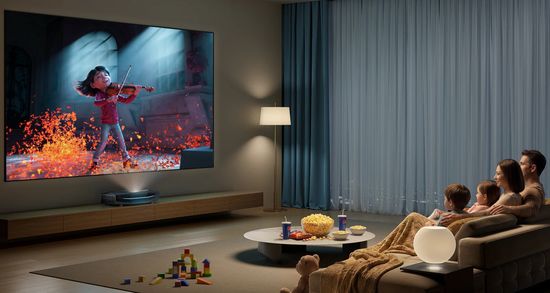
In 2026, the company introduced the flagship 4K UST triple-laser DLP projector AWOL Vision Aetherion Pro priced at $ 3,499 and announced the AWOL Vision Aetherion Max with an MSRP of $ 4,499.
Their specs are nearly identical. Both models offer the flagship MT9655 SoC (8GB RAM + WiFi 7), 1ms low-latency gaming with VRR/ALLM, and the RGB Triple Laser engine with Dolby Vision and IMAX Enhanced support. Differences between the Aetherion Max and Pro include brightness (3,300 ISO lumens vs 2,600 ISO lumens, ~27%), price (~$ 4,499 MSRP vs $ 3,499), and availability (announced / pending vs Kickstarter).
In fact, brightness is the main and only difference. As known, ambient lighting makes the projector image appear dimmer and faded. Brightness compensates for this negative impact. As a result, a sufficiently bright projector provides acceptable quality even in diffuse daylight without additional dimming. A less bright model requires additional dimming to achieve similar quality. Simply put, a projector’s brightness may be acceptable in an apartment in foggy Albion, but insufficient in sunny California.
Aetherion Pro and Max
Otherwise, both premium 4K triple-laser UST projectors offer identical specs, including:
– triple-laser RGB engine.
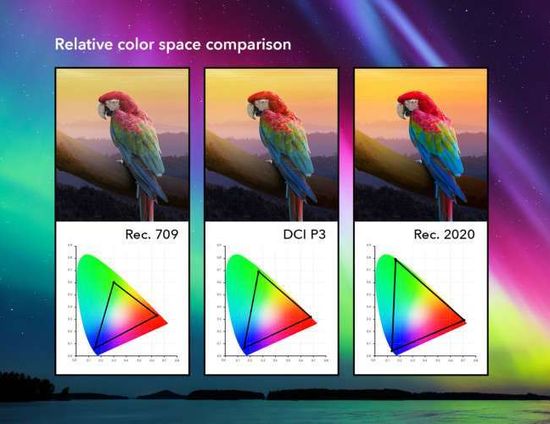
This light engine cover up to 110% Rec.2020 color space, which is the best result in the industry today.

– advanced NoirScene II.
In fact, this cutting-edge hardware and software image processing technology uses the Enhanced Black Level (EBL) algorithm. Both features are proprietary developments by Valerion, which is a premium brand associated with AWOL Vision. They are used for high-end processing of HDR content and blacks. In particular, the projectors provide deep blacks with impressive contrast ratio up to 6,000:1;
– dinamic contrast up to 60,000:1 with an adjustable 7-step mechanical iris;
– Throw Ratio of 0.18:1 provides projection from 80″ to 200″ (203-508 cm) diagonally with Throw Distance from 0.4 m to 0.9 m (100″@6.2 inches/15.8 cm);
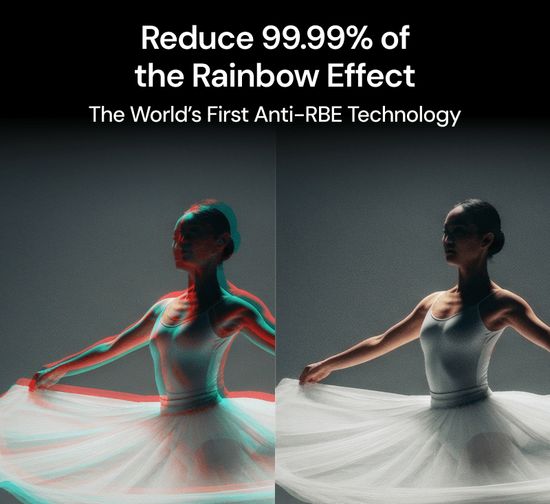
– 99.99% anti-RBE (Anti-Rainbow Effect) technology.
These algorithms increase the laser switching speed by thousands of times, making color microflashes invisible to the human eye.


Similar technology was previously implemented in the flagship VisionMaster Max series.

– HDR support, including Dolby Vision, HDR10+, and IMAX Enhanced;
– audio – Dolby Atmos support;
– powered by Google TV on a MediaTek MT9655 chip with 8GB RAM/128GB storage;
– 1ms input lag (latency gaming) at 1080p@240Hz or 4K@60Hz, VRR (Variable Refresh Rate) and ALLM (Auto Low Latency Mode);
– motorized dust-sealed lens cover;
– proprietary PixelLock technology.
This an integrated alignment system ensures superb edge-to-edge 4K clarity on screens up to 200″. It uses optical, mechanical, and digital components.
Key Features
The projectors share an identical, slightly futuristic design and are quite compact in size and weight (14 cm x 56 cm x 32 cm)@8.8 kg.

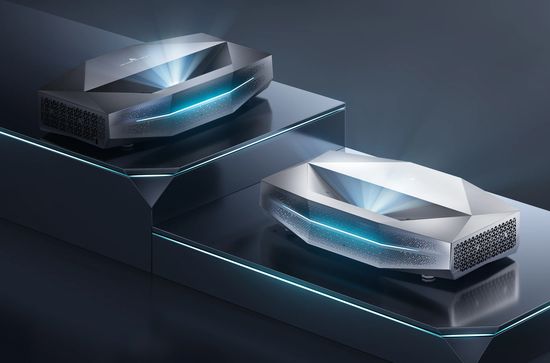
For comparison (UST models):
– Epson Lifestudio Grand Plus – (16 cm x 70 cm x 34 cm)@12.5 kg;
– Hisense L9Q – (17 cm x 62 cm x 32 cm)@12.9 kg.
Specs
– 4K UHD resolution.
Both models use XPR technology-based 0.47-inch DMD (digital micromirror device chip) from Texas Instruments (TI). XPR stands for eXpanded Pixel Resolution. Several years ago, it enabled manufacturers of DLP projectors to dramatically reduce the prices of 4K DLP projectors. Essentially, the TI increased resolution with pixel-shifting technology in relatively inexpensive Full HD (1080p) DMDs.
Its operating principle is simple and elegant. The projector receives 8 million pixels of 4K content and divides them into four parts of 2 million each. It then forms four Full HD images with 2,000,000 micromirrors, shifting them diagonally by half a pixel relative to each other. Of course, the projector only displays one Full HD image at a time. But due to their high frequency, the brain perceives them as a single image at a higher resolution. Pixel shifting is achieved by tilting the lens, which uses four electromagnets in the XPR module.

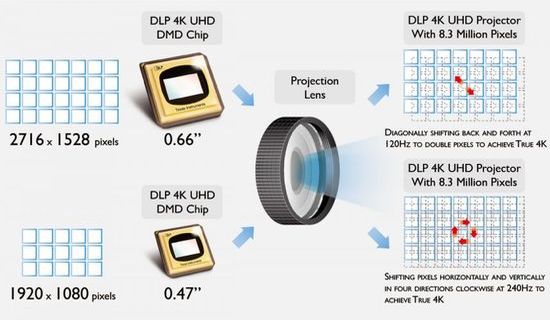
Combined with proprietary PixelLock technology, the projectors ensure edge-to-edge sharpness and perfect pixel alignment even on massive images.
Projector screen
Fierce competition drives companies to improve all aspects that affect image quality. Of course, the screen is one of the key factor, especially for UST projectors used as living room TVs. Unwilling to risk their reputations, some leading manufacturers only sell UST models with a screen included. Unfortunately, given the high price of CLR (Ceiling Light Rejection) screens for UST projectors, this solution significantly increases the price. However, the lucky owner may have a screen from a previous projector, receive one as a gift, or inherit it. Finally, they can buy one later when they become a little richer. Therefore, most companies have abandoned this practice, offering screens only as an option.
Furthermore, manufacturers regularly improve the quality of cheaper ALR (Ambient Light Rejection) projection screens. AWOL Vision also offers a wide range of them.

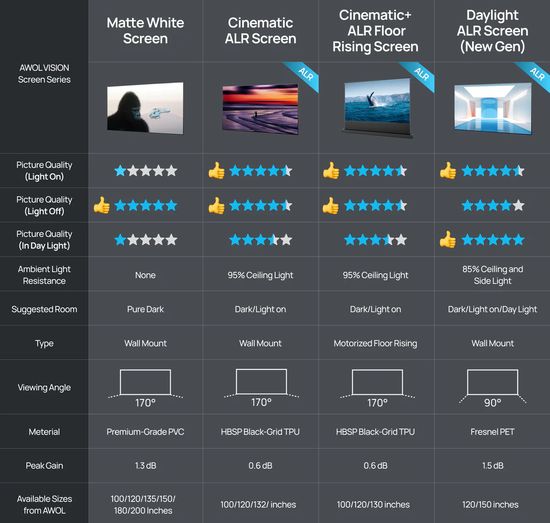
Today, companies typically offer 100-, 120-, and 150-inch screens. Of course, this choice affects the image size, which depends on the room size. To calculate the optimal viewing distance, ophthalmologists recommend calculating it as ‘Diagonal x 1.2 = Viewing Distance’. Accordingly, a comfortable viewing distance for a 150-inch image is 180 inches, or 4.5 meters. In a villa near the ocean, this limitation is unlikely to be a problem, but in an ordinary living room, placing a projector could pose a challenge.
The optimal screen material depends on the viewing conditions, which can be of three types:
– bright living room (daytime viewing, curtains open) – DayLight series Fresnel ALR Screen with a high gain (1.5);
– controlled Living Room (curtains closed, reflected light from the ceiling) – Cinematic series screen rejects 95% of ceiling light and offers a super-wide 170° viewing angle;
– Home Theater (Lights off / Pure Dark Room) – an inexpensive matte white screen.
Conclusion
The young company is successfully confirming its ambitious claims to a worthy place among the industry’s innovative leaders. Of course, excellent contrast is the main bonus of its new projectors. The projectors offer a 6,000:1 contrast ratio with excellent black levels thanks to advanced NoirScene II and dynamic contrast up to 60,000:1 with an adjustable 7-step mechanical iris. As known, the contrast influences detail in dark scenes and HDR performance. Perceived colors in a high-contrast image appear more saturated, and grayscale contours are better defined. Therefore, in recent years, improving image quality by increasing contrast has become a key focus for developers.
However, the other features and specifications are also quite premium. This list, for example, includes Anti-RBE technology, 1ms input lag, proprietary PixelLock technology, etc.
Of course, projectors aren’t exactly cheap yet. But traditional launch price adjustments could well further improve their price-to-quality ratio, providing them with cloudless marketing prospects.
This video demonstrates the power on setup of the new AWOL Vision Aetherion Pro/Max UST 4K RGB laser projectors.
