
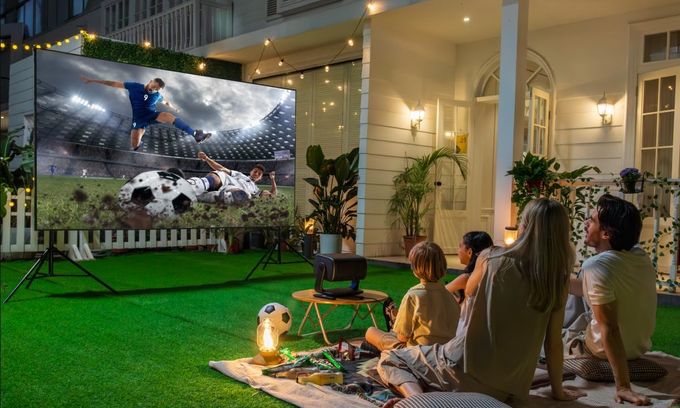


The successful development of LED and laser light sources, simplified installation and setup, improved operating systems, and AI video processing have dramatically improved projector image quality quality while maintaining quite affordable prices. Indeed, the advances in brightness, contrast, and color gamut of modern mid-range projectors have reached the level of inexpensive TVs. But projectors offer several significant bonuses, including image sizes from 100″ diagonal and portability. As a result, many choose projectors as an alternative to TVs or as an additional portable screen that can easily be placed in the backyard. Of course, companies are responding adequately to demand, actively filling the market with a variety of projectors.
Simplified classification of home projectors:
– by light source – LED, laser, and hybrid (LED+laser).
The light source affects brightness, color accuracy, and color gamut;
– brightness – low-power (up to 1,000 lumens), medium (1,000 – 3,000 lumens), and high-power (over 3,000 lumens).
For reference, ambient light makes any image appear dim and washed-out. Brightness compensates for this negative impact. Accordingly, light output affects room darkening requirements. High-brightness models deliver rich, vibrant colors even in diffuse daylight.
Throw Distance and resolution
By focus, projectors are divided into mid-throw and ultra-short throw (UST).
The UST design radically solved one of the main problems with home theater projectors. Traditional mid-focal models have Throw Ratio from 0.7:1 with and higher, forming a projection from a distance of several meters. Therefore, the projector is placed in the center of the room. This creates the problem of the power cord on the floor. Of course, ceiling mounting solves it, but radically limits the projector’s mobility. Indeed, it’s unlikely that a user will dismantle the complex mount to watch a baseball game in the backyard.
Using aspherical mirrors, the UST projector has Throw Ratio of ~ 0.2:1 and projects a 100-inch image from a distance of just a few inches. This allows the lucky owner to install it flush against the screen on the wall.

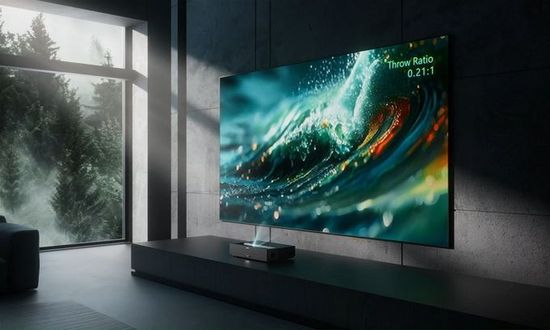
However, they are bulkier and more expensive.
Resolution – Full HD or 1080p (1,920 x 1,080) and 4K (3,840 x 2,160).
Until recently, 4K models were very expensive. Pixel shifting has radically changed the situation. Today, many DLP (Digital Light Processing) projectors provide 4K resolution thanks to XPR (eXpanded Pixel Resolution) tech from Texas Instruments, which is implemented in the DMD (Digital Micromirror Device) chipset.
Its operating principle is simple and elegant.
The projector receives 8 million pixels of a 4K image, divides them into four parts, and sequentially reproduces them with a diagonal shift using only 2 million micromirrors in the 1080p DMD.

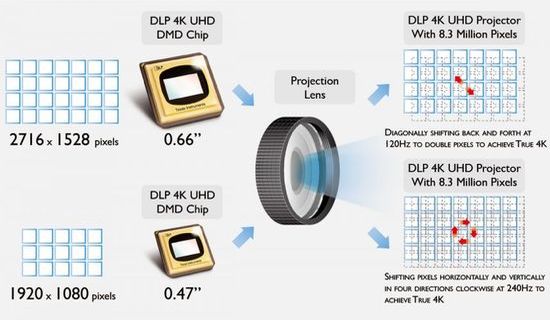
Due to the high frequency, the eyes and brain perceive four Full HD images as a single, higher-resolution image. Pixel shifting is achieved by tilting the lens using four electromagnets in the XPR module.
New Dangbei N3 Max
This year, the list of mid-focal projectors expanded with the Dangbei N3 Max. For reference, Dangbei Network Technology Co was founded in 2013 in Binjiang District, Hangzhou City, Zhejiang Province. The Dangbei X5 Ultra was released in September 2023 and became the brand’s first sensation. It was the first to use the innovative hybrid ALPD 5.0-based (Advanced Laser Phosphor Display) light engine with three lasers and three LED light sources, significantly expanding the color gamut. Today, companies already offer a fairly wide range of hybrids, including NexiGo TriVision Ultra, XGIMI Horizon S Max, and others.
The Dangbei N series offers portable LED Full HD projectors with official Netflix and autofocus, including:
– Dangbei Emotn N1 ~$ 400, Full HD@(330-500 lumens).

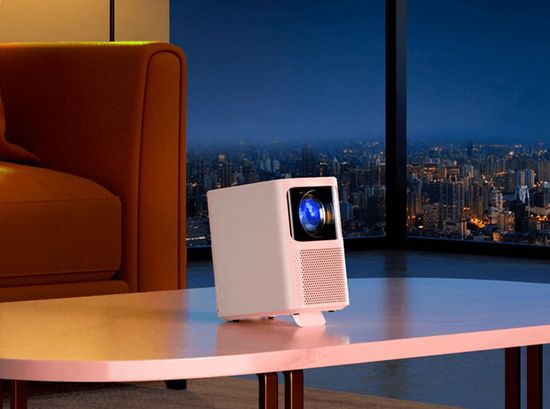
– N2/N2 Mini – ($ 200-$ 400)/($ 150-$ 230), Full HD @ 400/200 lumens, Google TV, adjustable stand with 180° tilt.

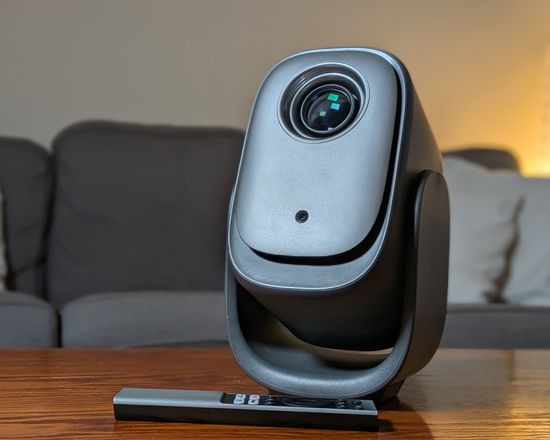
– Dangbei N3 Max ~$ 450 (company website), Full HD@(1,000 lumens), 4K content decoding with the MT9660 chipset and native 1080p playback, VIDAA OS with voice control and Kidoodle.TV mode for children, InstanPro AI Image Setup with auto-keystone correction, autofocus, and obstacle avoidance.

The MediaTek MT9660 is a quad-core smart projector chipset based on the Cortex-A55 architecture with a clock rate of up to 1.53 GHz. It supports 4K video decoding and refresh rate up to 60Hz.
As known, Kidoodle.TV is a safe service for children under 12. Viewing kid-friendly shows requires no credit cards or hidden costs. The service offers over 50,000 verified episodes of children’s content.
Of course, Full HD resolution, 1,000 lumens brightness, and 1,500:1 contrast (full on/off) are unlikely to provide premium-level superb image quality. But for a few hundred dollars, it’s a great portable alternative to a TV.
Specs and Key Features
Specs
– native resolution – Full HD (1,920 x 1,080);
– brightness – 1,000 ISO lumens (ISO 21118 standart);
– contrast – 1,500:1 (Full On/Off);
– LCD panel & LED light source;
– HDR10 and HLG;
– Throw ratio & Throw distance & Image size – (1.14:1)@(1.6m – 3.9m)@(60″–150″).

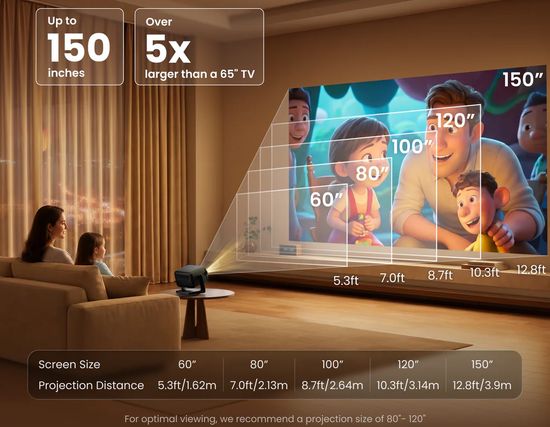
However, the company promises optimal image quality in the range from 80″ to 120″. Image clarity begins to decline due to decreasing pixel density as the projection size increases beyond 120 inches. This is typical for Full HD models;
– VIDAA OS (Netflix, YouTube, Prime Video, and Disney+ built in);
– HDMI 2.0, dual USB, Bluetooth, Wi-Fi, 3.5mm audio out;
– dual 6W speakers;
– autofocus, auto keystone, screen fit, obstacle avoidance;
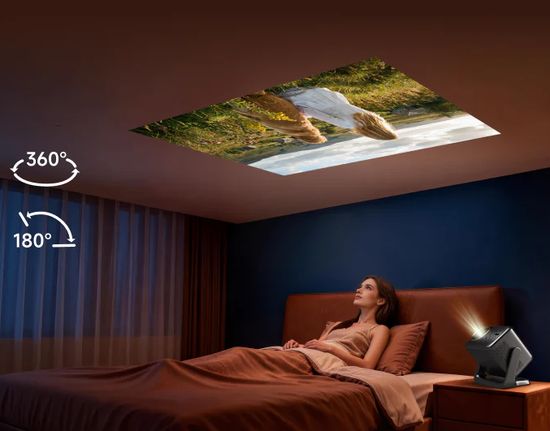
– integrated 180° rotation stand.
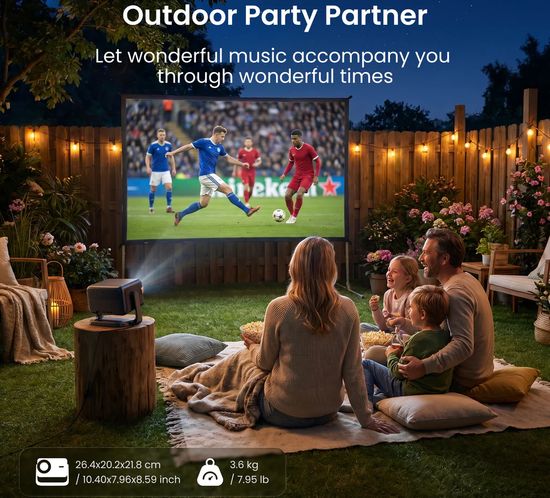
Dangbei doesn’t market the N3 Max as compact, but its (26 x 20 x 22 cm)@3.6 kg fits this criteria. Given its easy installation with InstanPro AI Image Setup and light weight, even a teenager can easily move the projector.

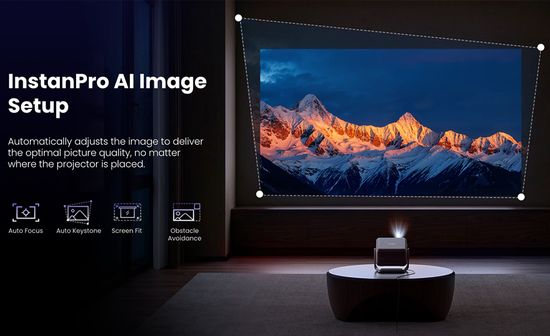
However, its compactness and simple settings will also be convenient for adults to have a good time in the backyard.

180° Rotatable Stand for ceiling projection is very convenient in the bedroom.

Colors are quite accurate and look natural ‘out of the box’ without additional calibration. HDMI 2.0 input is great for Apple TV, Fire TV, Roku, or Chromecast with Google TV sticks. Generally, the absence of obvious flaws, including rainbow artifacts, aggressive sharpening halos or unnatural color shifts, is one of the main bonuses of the model.
The Epson EF-22N and Lifestudio Flex Plus have the closest specs to the Dangbei N3 Max, but they’re twice the price.
Conclusion
Companies continue to seek the optimal compromise between image quality and portability. This year, the 8849 sub-brand of China’s Unihertz introduced new smartphones with a built-in DLP Full HD (1,920 x 1,080) pico projector, including Unihertz 8849 Tank X and Tank 5. Their brightness exceeded 200 lumens for the first time, reaching 220 lumens. This output power is already quite enough for acceptable image quality in the dark on a screen size of up to 80 inches. Of course, the projector is hardly ideal for admiring the colorful views of the Serengeti. But it’s quite suitable for watching baseball in the backyard with friends and a beer.
Last year, American AAXA Technologies introduced the triple-laser RGB AAXA M8 Full HD UST DLP projector with (20.5 x 12.2 x 7.6 cm)@1.26 kg, the brightness of which reaches 1,100 lumens. Of course, Dangbei N3 Max with (26 x 20 x 22 cm)@3.6 kg is larger and heavier, but it also follows the miniaturization trend.
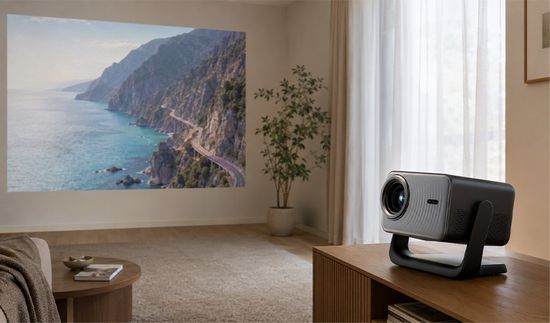
It’s priced at around $ 450 and is perfect as an extra portable “TV” for your backyard, bedroom, or kitchen.
List of improvements compared to the previous Dangbei N2/N2 Mini:
– price – $ 450 vs $ 150 – $ 200;
– brightness – 1,000 ISO Lumens vs 400/200 ISO Lumens;
– stand design – 180°+ gimbal stands vs 5° tilt range;
– audio – 12W Dolby sound vs 6W;
– OS – VIDAA OS vs Linux/custom smart platforms with core apps.
This video introduces the new Dangbei N3 Max smart projector.
