
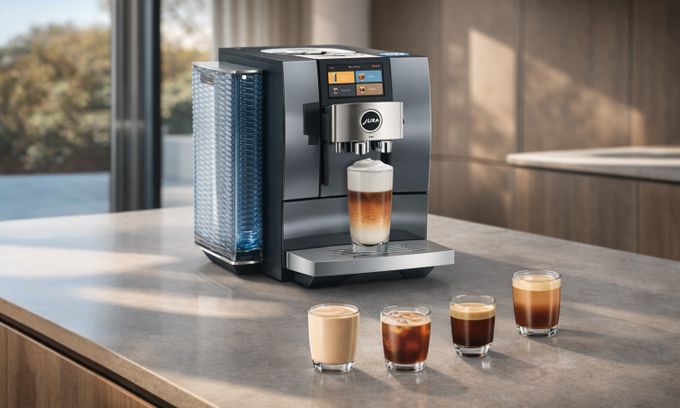


The Jura brand has long become a cult favorite in the segment of premium coffee machine. It belongs to the Swiss company Elektroapparate AG, which has been developing, manufacturing, and selling premium home appliances for nearly 100 years.
Jura models are manufactured in Switzerland by Eugster/Frismag company. Like Saeco, it’s the world’s leading manufacturer of coffee machine, being an OEM supplier (original equipment manufacturer) for Bosch, Melitta, Nivona, etc brands.
To be fair, the most expensive Jura midels can hardly boast of superb value for money. But the high price is quite adequate for impeccable reputation, suberb build quality, luxurious design, highest innovation level and ultra-wide functionality.
For many years, Jura has rightfully positioned itself as one of the innovative leaders in the fully automatic coffee machine segment. The updated Jura Z10 model convincingly confirms this status, offering virtually all the innovations in the industry.
Z10 2nd gen functionality includes:
– classic Hot Brew programs – espresso, Americano, classic coffee, and all their milk variations;
– Light Brew (extraction at ~60°C to enhance the fruity or acidic components depending on the variety);
– Cold Brew with cold extraction (reduced water temperature under pressure to enhance sweet and soft flavor components;
– Sweet Foam includes drinks with various syrups and chocolate.
Additional optional accessories:
– Cool Control maintains the optimal milk temperature;
– Cup warmer;
– Chocolate module offers a variety of dessert recipes.

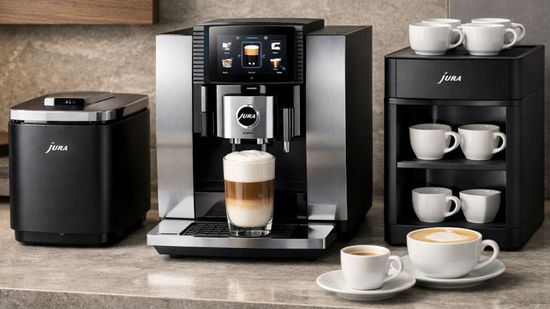
Updated Jura Z10
The Z10 is rightfully positioned as one of the most innovative ‘home’ series with an impressive pace of its evolution.
The Jura Z10, including the popular EA 15348 and 15361, was released in 2021. It pioneered the Cold Extraction Process that produces popular Cold Brew drinks in just a few minutes. This method uses cold water under high pressure through coarsely ground coffee for extraction. Some companies have long advertised a ‘Cold Coffee’ feature, which actually involves simply adding ice cubes to regular coffee. Of course, this has nothing to do with Cold Brew.
Other features are also impressive:
– Product Recognizing Grinder (P.R.G.) – the electronically controlled grinder automatically optimizes the grind depending on the selected coffee variety;
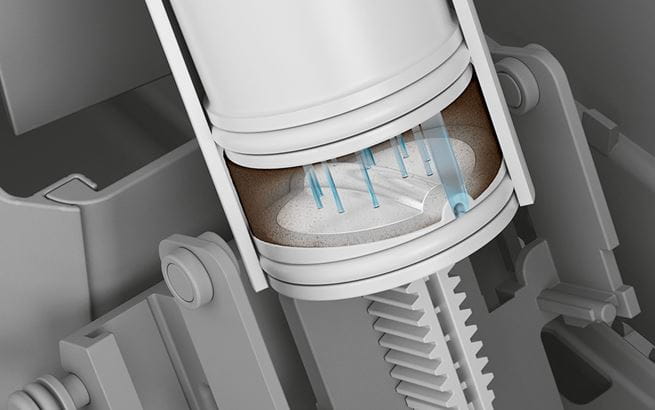
– 8th-generation brewing unit with 3D brewing technology, where the convex surface of the piston head increases the contact area between the water and ground coffee, ensuring maximum aroma development;
– 32 programs in the menu plus 8 additional programs for preparing coffee with syrup;
– 4.3-inch color touchscreen display, illuminated Blue Crystal rotary knob for intuitive menu navigation, and J.O.E. app support via Wi-Fi.
The second generation of the Jura Z10 (EB/EA) was released in late 2025. Software and design improvements:
– the number of programs has been increased from 32 to 51, including new Espresso Doppio and Mocha (espresso, hot milk, chocolate).

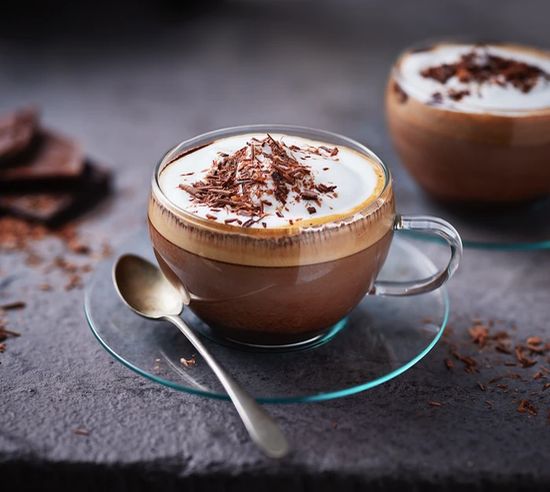
– new Light Brew modes (extraction at ~60°C) and expanded Sweet Foam options with sweet foam. Including Hot/Cold Brew, the new Jura Z10 offers virtually all popular coffee drinks;
– improved P.R.G. 2+ grinder with a choice of flavor profiles for coffee beans;
– Caffeine Regulator (adjustable caffeine content), Milk Assistant (milk types), and a built-in smart function timer.
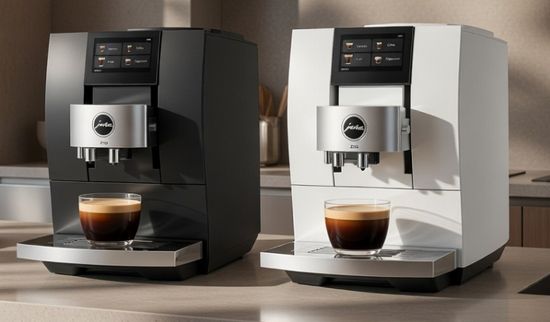
The model is available in two colors.

Cold Extraction Process
For reference, this method was invented by Dutch merchants. They loved coffee very much, but were deprived of the opportunity to prepare it due to the lack of hot water on the ships of that time. Cold brewing uses very coarse grinding and very long soaking, the duration of which reaches 24 hours, providing sufficient extraction.
Jura Cold Extraction Process:
– Product Recognising Grinder (P.R.G.) automatically selects the coarsest grind for cold extraction programs;
– ‘High-Pressure Pulsing’ forces cold water from a reservoir through the coffee grounds in slow, high-pressure pulses. This mode draws out fruity and nuanced aromas that are typically lost or altered by heat;
– the eighth-gen brewing unit with 3D Brewing technology ensures water flows evenly through the grounds at multiple levels for a balanced flavor. To compensate for the lower water temperature, the coffee machine increases the contact area between the water and the coffee tablet, and increases the intensity of squeezing water through it. Specifically, it uses a convex surface shape of the lower piston and a complex configuration of nozzles to inject water simultaneously from all sides. As a result, the nozzles work like a 3D shower, providing sufficient extraction even at room temperature.

Pros
– Brew Time ~2–3 minutes vs 12–24 hours;
– perceived acidity is lower than hot espresso;
– creamy, smooth, and aromatic texture;
– room/tank temperature.
For comparison, similar technology was only developed by the Italian Delonghi in collaboration with the Specialty Coffee Association. It also uses more precisely controlled pressure and a slower flow of water through the ground coffee, which compensates for the lower extraction temperature.
Z10 (2021) vs Z10 (2025)
– Programs – 32/40 vs 51;
– Drink Types – Hot Brew, Cold Brew vs Hot Brew, Light Brew, Cold Brew, and Sweet Foam;
– Coffee Grinder – P.R.G. vs P.R.G.2+ (with flavor profile selection);
– Brewing Technologies – 3 vs 5;
– Volume (l) / Grain bin (g) / Ground Coffee Volume (g) are identical and are 2.4 l / ~280 g / 5-16 g;
– Milk System – HP3 vs advanced HP3;
– Display – 4.3″ Touch + Rotary vs 4.3″ Touch + Rotary with Improved OS;
– Smart Features – Basic J.O.E. vs advanced J.O.E., Coffee Timer, Caffeine Regulator, Milk Assistant, Quality Assistant;
– light / chocolate drinks – no vs yes (with a chocolate container).
The Jura Three Milk System
System Models Foam Texture:
– Basic Frothing (ENA 4, D6 / foam texture and large bubble size) – dense, coarse foam, large visible bubbles.
The system draws milk from a tube and injects steam through it. The thick, bubbly, and inconsistent foam is ideal for a simple cappuccino, but does not provide proper layering, for example, for flat white or latte macchiato;
– HP2 Fine Foam (E6) / smooth, creamy, slightly shiny foam with fine bubbles.
It makes a more uniform bubbles with more controlled mixing chamber;
– HP3 Fine Foam (E8, S8, Z10, J8 / silky microfoam with very small bubbles.

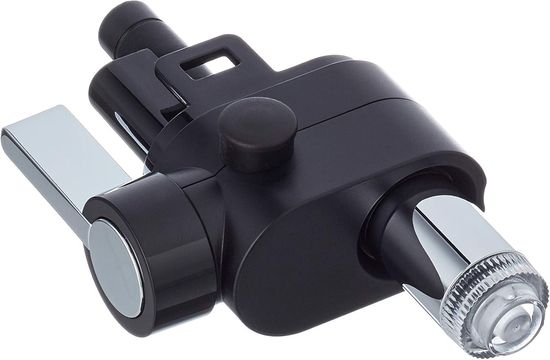
HP3 (High-Performance Pump 3) fine foam in E8, S8, Z10, and J8 uses a second chamber. The first chamber is designed for aerated with precision-controlled air. The partially frothed milk passes into a second chamber and is homogenized. At this stage the bubbles are broken down to a micro-size, turning into uniform microfoam with glossy and satiny texture.
Conclusions
Improved 2nd gen Jura Z10 (2025) offers PRG2+ grinder, new ‘Light’ brewing mode, increased program menu to 51+ drinks, and Milk/Quality Assistants. In fact, it offers a huge selection of popular coffee-based drinks, ranging from classic espresso to chocolate drinks.
Moreover, these additional bonuses had little impact on the price. Although they vary significantly depending on the region, global market pricing for the 2021 model typically ranges from $ 4,000 to $ 4,300. The new model is priced between $ 4,400 and $ 4,500. Therefore, the price-quality ratio of the new Jura Z10 is higher than its predecessor. Given its popularity, the updated Jura Z10 version could well be a contender for a place on the list of best-selling fully automatic premium coffee machines.
The video demonstrates the 2nd generation of Jura Z10 (2025) coffee machine.
