
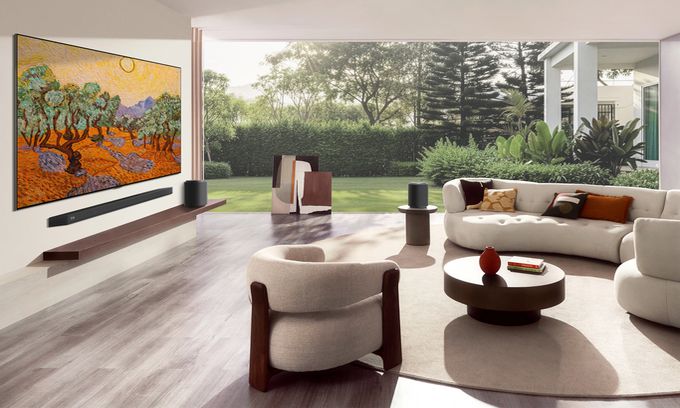


As known, LG’s popular family of OLED TVs is divided into several classes. Until recently, the company divided them into ‘A’ (budget-friendly), ‘B’, ‘C’, and the flagship ‘G’ series. A few years ago, the South Korean giant abandoned the ‘A’ series, concentrating relatively affordable models in the ‘B’ series. Meanwhile, the ‘C’ models slightly inferior to the flagships in terms of technology but significantly cheaper. As a result, they regularly appear on bestseller lists due to their superb volume-quality ratio.
A few years ago, LG introduced its premium line of ultra-thin ‘Wallpaper’ OLED TVs. Due to their extreme thinness (3.85 mm), these models utilize a separate external soundbar-hub. Furthermore, the series employs an innovative wireless signal transmission ‘True Wireless’ tech with a ‘Zero Connect Box.’ While the Wallpaper line is technically part of the LG OLED family, comparing it to other models is not entirely appropriate, given the significant difference in their technological level.
LG OLED 2026
This year, LG continued experiments with classification, dividing the mid-level segment into the 6C and C6H series. Thus, the following OLED series are available today:
– entry-level LG B6 – Perfect Black tech, Alpha 8 AI 4K Gen3, 144 Hz (120 Hz for B6E) refresh rate, webOS 26 with integrated Google Gemini, Microsoft Copilot and LG Shield, peak brightness is about 835 nits in Filmmaker Mode, 0.1 ms response time, support for GeForce NOW cloud gaming and Bluetooth GamePad – $ 2,000 for 77-inches model;
– mid-level 6C and C6H;
– flagship G6.

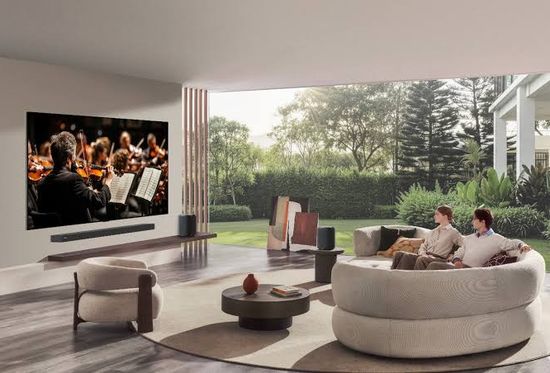
The new C6H series between the C6 and G6 raises some questions, so comparing them may be useful.
Naturally, comparing TV prices is only valid for models with the same panel size. The G6 is offered in 48, 55, 65, 77, 83, and 97-inch versions. The C6H is available only in 77-inch and 83-inch screen sizes. The C6 includes 42, 48, 55, and 65-inch TVs. Therefore, the 77-inch G6 and C6H, as well as the 65-inch G6 and C6 models are the most suitable for comparison.
Price:
– 77-inch G6 ~ $ 4,500 / $ 3,800 (with active retailer discounts) in USA, and (€ 4,750–€ 4,800) / £ 4,000 in Europe;
– 77-inch C6H ~ $ 2,300 / $ 2,000 in USA, and (€ 2,300 – € 2,350 discounted) / (£ 2,500- £ 2,600) in Europe;
– 65-inch G6 ~ $ 2,500 / (€ 2,590 – € 2,880) / (£ 2,700 – £ 3,000);
– 65-inch С6 ~ $ 1,500 / (€ 1,500 – € 2,300) / £ 1,900 (with promotional code).
In fact, the G6 is almost twice as expensive vs C6H. It’s curious, but the price difference with the simpler C6 does not exceed 70%.
Key innovations
All series:
– Apple Home, Amazon Alexa, and Google Assistant;
– new Alpha 11 AI (Gen 3) processor with a 12-bit processing pipeline;
– 165Hz refresh rate, Variable Refresh Rate (VRR), NVIDIA G-Sync, and AMD FreeSync Premium;
– 4x HDMI 2.1 ports and offer a response time of less than 0.1 ms;
– run on webOS 26.
WebOS 26 (webOS 11.0) vs webOS 25
– Google Gemini: A new voice assistant and multi-AI system replace the previous version, enabling smart home control through natural conversation;
– Updated design: System notifications are now centered rather; a dedicated ‘My Page’ (AI Voice ID, Custom Widgets and AI Concierge Integration) with widgets has been added; updated Home Hub with integration for the Homey platform;
– Native support for the cloud-based GeForce Now service (up to 4K at 120Hz) and a new Bluetooth ULL (Ultra-Low Latency) protocol, reducing input latency to as little as 1ms;
– AI-powered image and music generation for ‘Gallery’ mode, a dedicated ‘Kids Mode,’ and customizable buttons on the remote control;
– Removed features: no calibration tools (ColourSpace, bscpylgtv), 360° VR viewing in the web browser, DTS audio format.
LG refers to a set of key innovations in its 2026 OLED TVs as ‘Hyper Radiant Color’ tech.

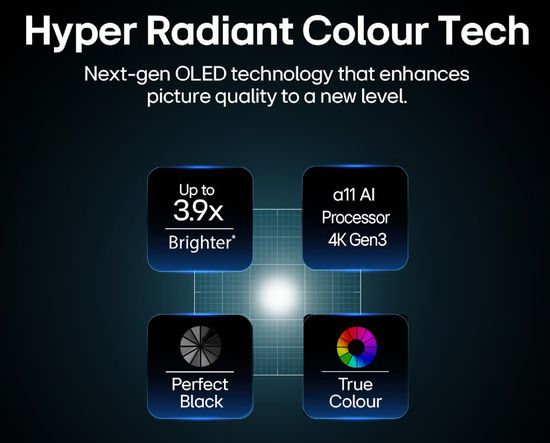
It includes:
– Primary RGB Tandem 2.0 / Hyper Radiant (an additional layer of organic light-emitting diodes);
– Brightness Booster Ultra/Pro (a hardware-software system for power and panel management);
– α (Alpha) 11 AI Gen 3 processor with a Dual AI Engine (for real-time image processing, enhanced color accuracy, noise reduction, and texture preservation);
– Reflection Free Premium anti-reflective coating (a certified screen coating that limits reflections to 0.5%).
But it’s available only on the G6 (with the exception of the 97-inch model).
Brightness Booster and Primary RGB Tandem 2.0
Both the C6H and the flagship G6 feature a ‘Primary RGB Tandem 2.0’ panel, and ‘Brightness Booster Ultra’ (or Brightness Booster Pro in C6H) feature, which provide a significant boost in brightness and improved color vibrancy compared to last year’s models.
Brightness Booster
According to the company, the Ultra version of Brightness Booster is up to 3.9 times brighter than the base B6 (3,000–3,900 nits peak brightness). The Pro modification outperforms the B6 by up to 2.1x – 3.2x. In five years the company has already presented 4 generations of this technology.

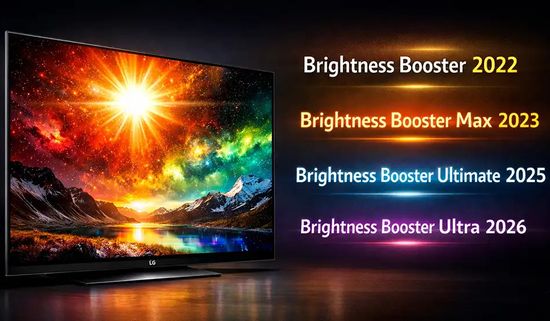
The performance difference between Ultra and Pro is due to two:
– models with Brightness Booster Ultra feature a premium anti-glare ‘Reflection Free Premium’ coating, which absorbs external light without requiring an increase in brightness;
– the Ultra version incorporates advanced pixel-level light control, power optimization algorithms, and an improved heat dissipation system.
Primary RGB Tandem 2.0
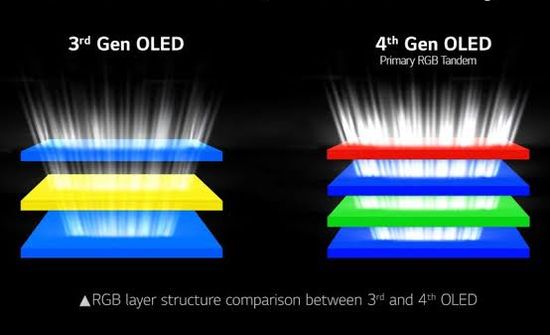
It employs a multi-layer architecture within OLED panels to enhance brightness, durability, and energy efficiency. Simply put, it uses a stacked structure, which consists of two OLED layers placed one on top of the other.
Key Features
– the multi-layer structure incorporates several organic red, green, and blue layers that operate synchronously, reducing the load on each individual diode.

– peak brightness of up to 4,500 nits;
– color gamut of up to 99.5% of the DCI-P3 standard, with deep blacks (HDR True Black);
– response time of ~0.02 ms;
– surface light reflection of up to 0.3% with anti-reflective ‘Perfect Black AR’ coating.
G6 Key Features
The flagship G6 also features LG’s ‘Flush Fit Gallery’ design with zero gap.


The C6 and C6H models retain the classic design characteristic of this series.
Furthermore, the G6 includes a heat sink, which further dissipates heat, ensuring a safe increase in voltage and, as a result, brightness. This tech was first used in the G2. In fact, this is a physical layer to pull heat away from the organic panel. To be fair, it does not prevent pixel burn-in, but lowering the panel temperature during high-brightness operation does extend the lifespan of the pixels.
The use of the ‘Primary RGB Tandem 2.0’ panel, ‘Brightness Booster Ultra’ tech, and heat sink enables a peak brightness of an unprecedented 3,000 nits in a 10% window without overheating.
The peak brightness of the C6H (featuring the ‘Primary RGB Tandem 2.0’ panel and ‘Brightness Booster Pro’, but lacking a heat sink) reaches nearly 1,900 nits for 10% window in Filmmaker Mode. The LG C6 achieves over 1,400 nits in this mode. Unlike brighter modes, such as ‘Sports’, Filmmaker Mode focuses on the color accuracy.
Unlike the C6/C6H, which features a traditional glossy anti-reflective coating with a reflection level of 1.5%–2%, the G6 utilizes a screen with an enhanced ‘reflection-free premium coating’. It reduces reflections to unprecedented 0.5%.
Audio
G6 offers 4.2ch / 60W audio, Dolby Atmos, AI Object Remastering (audio scaling), Clear Voice Pro (improved dialogue clarity), Orchestra (synchronized operation of TV speakers with compatible LG soundbars), and 11.1.2h virtual sound (the signal is divided into independent audio streams using frequency and phase analysis).
C6H and C6 have 2.2ch / 40W audio sistem, Dolby Atmos, 11.1.2h virtual sound, WOW Orchestra, LG Sound Sync and Clear Voice Pro.
Conclusion
Overall, the experiment of splitting the ‘C’ series into the C6 and C6H appears successful. Brand fans are getting a very successful expansion of the product lineup. Furthermore, by limiting the C6H series to 77-inch and 83-inch models, the competition between the C6 and C6H is significantly reduced. At the same time, the C-series models remain substantially more affordable than the flagship G6, while offering highly comparable specs. Admittedly, a peak brightness of up to 3,000 nits (achieved in part through a heat sink), an innovative ‘Reflection-Free Premium Coating,’ and a ‘Flush Fit Gallery’ design are significant bonuses for the G6. They will probably be enough for perfectionists with a good budget.
But the C6H also utilizes the ‘Primary RGB Tandem 2.0’ panel and ‘Brightness Booster Pro’ (as opposed to ‘Brightness Booster Ultra’), delivering a peak brightness of nearly 2,000 nits in a 10% window. Perhaps in a bright living room in sunny California, the G6’s extra brightness will prove useful for daytime viewing. But even 1,400 nits of C6 and, even more so, up to 2,000 nits of C6H are excessive for the SDR format that dominates satellite and cable television. This is due to network capacity, and the situation is unlikely to change in the near future. Therefore, HDR content, which demands high brightness, is available only in expensive Netflix subscriptions and Blu-ray discs for now. In all other respects, the C6H differs little from the G6 and could well become a bestseller once again, thanks to its superb price-to-quality ratio.
The video showcases the 4th gen of LG OLED panels, which utilizes Primary RGB Tandem tech.
