
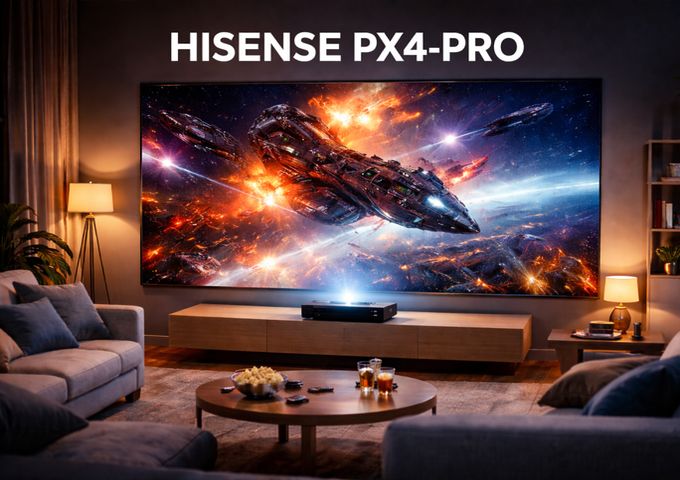


Traditionally for innovative industry leaders, Chinese giant Hisense expands its model range every year, and 2026 is no exception. At CES 2026, it unveiled the ultra-bright mid-focal flagship Hisense XR10 and the ultra short throw (UST) PX4-Pro.
Both projectors use TriChroma technology-based proprietary triple-laser (RGB) LPU 3.0 Digital Laser Engine.

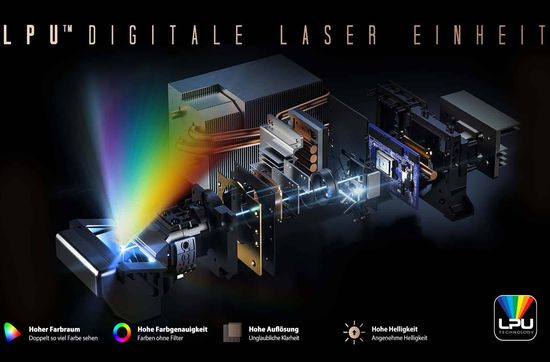
It was introduced in late 2025 and represents a new generation of TriChroma technology.
New light endine provides brightness up to 6,000 ANSI lumens in XR10 and up to 3,500 ANSI lumens in PX4-Pro. Its color gamut reaches 110% for the BT.2020 standard.
Both models use an IRIS lens system (dinamic IRIS), increasing the projectors’ contrast to 6,000:1.
The models support 4K resolution and utilize AI-powered real-time image adjustment.
As known, the speckles (grainy artifacts) are the serious problem for triple-laser models. To address this, Hisense models feature advanced speckle suppression to reduce visual noise. According to the company, this reduces grainy artifacts by up to 6%, which is one of the best results in the industry.
Key Features
As known, UST projectors re-reflect the image using a complex system of lenses and aspherical mirrors, creating a huge image from a very short distance. In turn, their placement near a wall with a screen eliminates the problem of mid-focal models with power cords on the floor due to the projection distance of several meters. Currently, only ceiling mounting solves this problem, but it radically limits the projector’s mobility. Several years ago, this factor contributed to the explosion in popularity of UST projectors, which became an alternative to traditional TV in the living room. By the way, the Hisense TriCroma L9H/9G/9Q became the first ultra-popular series of UST 4K projectors on the market.
The UST PX4-Pro provides an image focusing range of up to 200″/508 cm diagonal (100″@15–20″/ 38–50 cm) with 0.20:1 Throw Ratio.

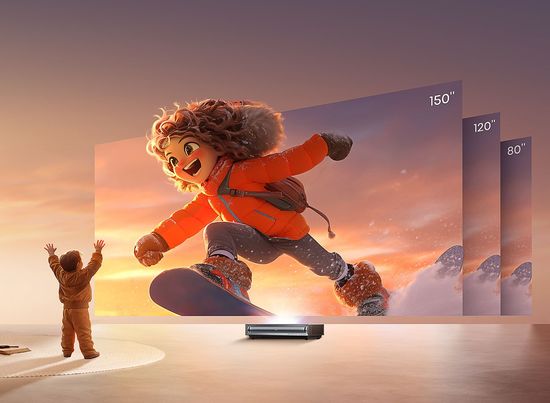
The mid-focal XR10 supports screen sizes from 65 to 300 inches, has a 0.84x–2.0x optical zoom, H/V lens shift (±130% vertical, ±46% horizontal), 4-camera + dual TOF for AI-assisted image adjustment (±15-degree correction).
Besides the Throw Ratio (0.2:1 vs 0.84–2.0:1), the models differ in DMD architecture (TRP vs SST) and their cooling system. Unlike the PX4-Pro with a traditional fan-based air cooling, the flagship XR10 uses an industry-first advanced sealed microchannel liquid cooling system.

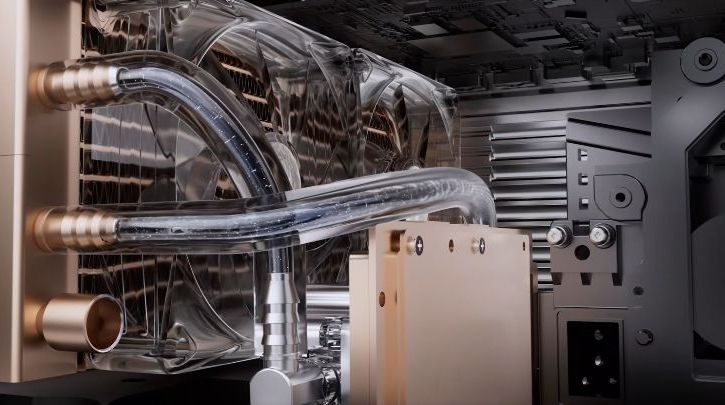
This provides more efficient heat dissipation at low noise compared to traditional air-cooled models.
According to preliminary data, both projectors are excellent for gaming. In particular, the XR10’s response time is only ~4.2 ms. Furthermore, it offers optimized settings for dedicated gaming monitors.
The PX4-Pro has a superb 1 ms response time for 2K@240Hz, supports 4K@120Hz and FreeSync VRR.
Both projectors provide great sharpness with the 16-element all-glass lens system.
Resolution and SST architecture
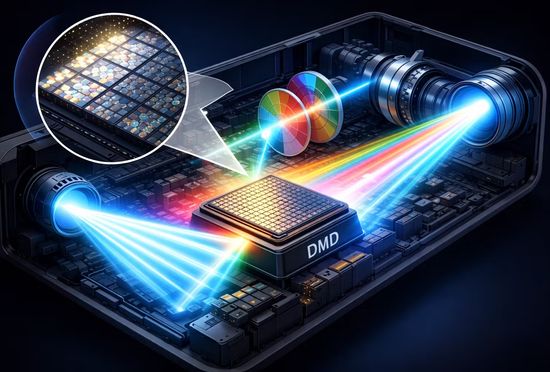
The projectors reproduce 4K content with 0.47-inches DLP DMD (Digital Light Processing and Digital Micromirror Device), which supports eXpanded Pixel Resolution (XPR) technology.
Its operating principle is simple and elegant. The projector divides the 8 million pixels of the 4K input signal into four parts of 2 million each and displays them sequentially, offset by half a pixel diagonally. Importantly, the projector uses only 2 million micromirrors of a relatively inexpensive Full HD chip. Of course, it only displays one Full HD image at a time. But due to the high frequency, our brain perceives four Full HD pictures as a single, higher-resolution image. Pixel shift is achieved by tilting the lens using four electromagnets in the XPR module.
However, the chipsets in the models differ significantly. The Hisense PX4-Pro uses a traditional chip with TRP (Tilt & Roll Pixel) architecture. The flagship XR10 features an improved version based on the ultra-fast third-generation SST (Single Springtip Torsional with single-spring design) architecture.

SST is optimized for high laser light density, which reaches 60 W/cm² and is three times better than previous performance. Its mirrors can switch up to 20,000 times per second, increasing precision, improving light output and optimizing heat dissipation. The company promises a 30% increase in power efficiency.

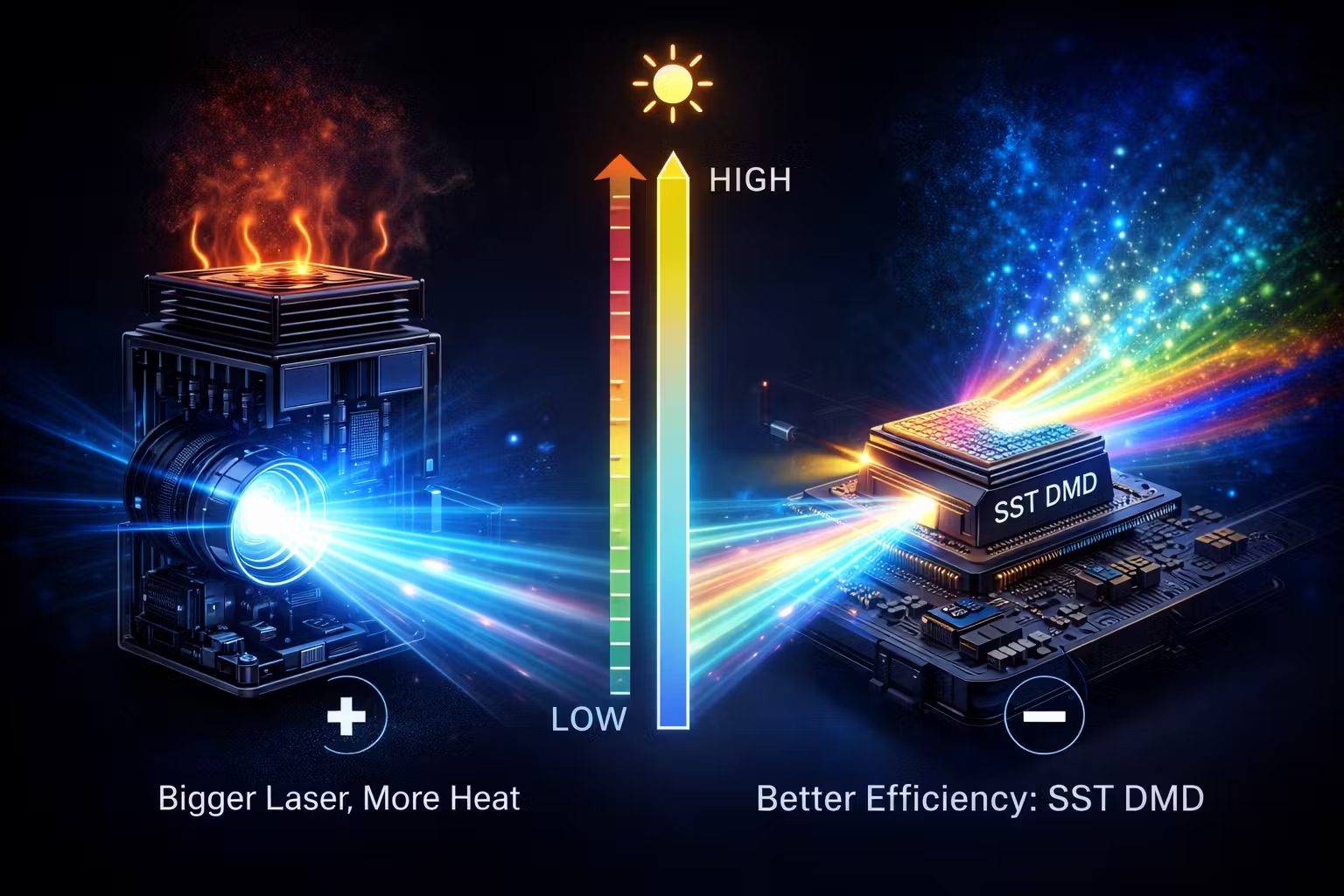
Furthermore, the denser placement of micromirrors reduces the gaps between them, improving contrast and image clarity. Finally, SST supports refresh rates up to 240 Hz, minimizes input lag and motion artifacts.
The dual RGB MCL39 uses 56 high-performance laser chips encapsulated in GaN on a silicon substrate. In this model, 28 chips (2 x 14) are intended for red, 14 for green and 14 for blue.
Hisense model range
In fact, the XR10 may be positioned as a global version or analogue of the Vidda C5 Boundless Master.

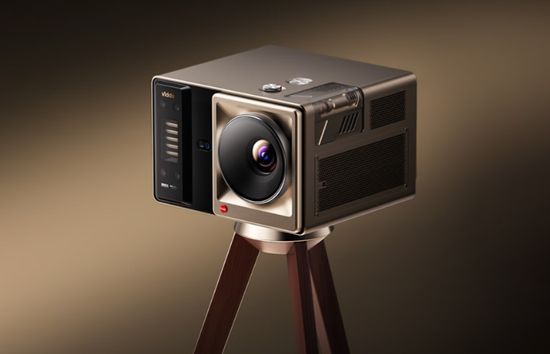
This flagship 4K triple-laser projector was released in late 2025, offers brightness up to 6800 CVIA lumens (2,500 ~ 3,000 ANSI lumens), built-in JBL 2.1ch sound, and is priced at 24,999 yuan in China (~$ 3,500 or € 3,260 – € 3,700). For reference, the American company JBL is part of Harman International Industries (a subsidiary of Samsung Electronics) and specializes in high-quality audio equipment. According to the company, the model’s light engine uses Alpha Dual Engine laser technology with a color gamut of up to 110% for the BT.2020 color space. The projector delivers a dynamic contrast ratio of up to 5,000,000:1 and, according to the company, an ‘8,000:1 native contrast ratio’ with its IRIS system.
The 17-element Hubble Red Label glass lens with a 7-stop variable aperture (F/2.0–F/5.0) and 2.38x zoom provides an image size of up to 300 inches diagonally from a distance of 1.9–13.3 meters. The projector supports autofocus using 3D ToF sensors and real-time keystone.
Vidda C5 uses a MediaTek MT9681S with 8 GB of RAM and 1 TB of built-in flash memory, supports 4K@60Hz and 1080p@240Hz, has HDMI 2.1, USB 3.0, Ethernet, Bluetooth 5.4, and Wi-Fi 7. Like the XR10, it uses a liquid cooling system.
The Hisense PX4-Pro is the successor to the PX3-Pro. Like its predecessor, it uses TriChroma technology and is IMAX Enhanced certified.
PX4-Pro vs PX3-Pro:
– estimated price – € 4,200 vs $ 3,500;
– brightness – 3,500 ANSI lumens vs 3,000 ANSI lumens;
– contrast – up to 6,000:1 (with the new IRIS) vs 3,000:1 (full on/off);
– image size – up to 200″ vs 150″.
Conclusion
Hisense has once again successfully confirmed its status as one of the innovative industry leaders.
Unprecedented 6,000 ANSI lumens brightness with LPU 3.0 Digital Laser Engine, 6,000:1 contrast with inovative IRIS lens system, high laser light density of new Texas Instruments’ chip with ultra-fast 3th gen SST (Single Springtip Torsional) architecture, industry-first sealed microchannel cooling liquid system, advanced speckle suppression, wide optical zoom, lens shift, AI-assisted image adjustment, JBL sound and response time of ~4.2 ms make the XR10 one of the most innovative mid-focal projector in industry.
Of course, its marketing prospects will depend on its price-quality ratio. Considering the price of the Chinese Vidda C5 Boundless Master version, it’s unlikely to exceed $ 4,000.
But the competition will be very stiff. For comparison, superb Valerion VisionMaster Max offers 3,500 ISO Lumens and ‘Viewing Contrast’ up to 15,000:1 with EBL for $ 4,000. The fantastic XGIMI Horizon 20 Max (5,700 ISO lumens, contrast up to 20,000:1 with DBLE) today costs ~ $ 2,430.
The new PX4-Pro also promises to successfully expand the range of modern UST projectors and replace TVs in many living rooms, They are traditionally more expensive than their mid-focal counterparts, but the convenience of placing them near a wall significantly compensates for this aspect. In fact, the PX4-Pro can be positioned as a cheaper version of the premium and brighter Hisense L9Q, which costs $ 6,000.
Its main competitors include:
– JMGO O2S Ultra – $ 2,800, 3,600 ISO Lumens, 4,000:1 FOFO contrast, 110% BT.2020;
– Epson Lifestudio Grand – $ 2,700, 3,600 ISO Lumens white brightness and CLO, 4,000:1.
The video introduces the new Hisense XR10.
