
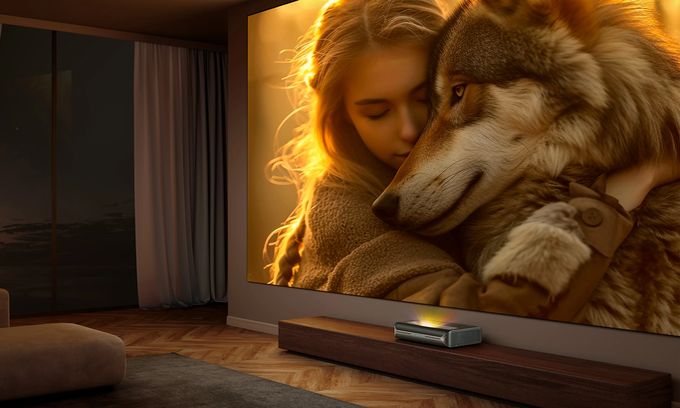


Introduced in April 2025 with MSRP of $ 3,499, the NexiGo Aurora Pro MKII UST 4K replaced the previous flagship Aurora Pro (September 2023), which currently costs $ 2,300.

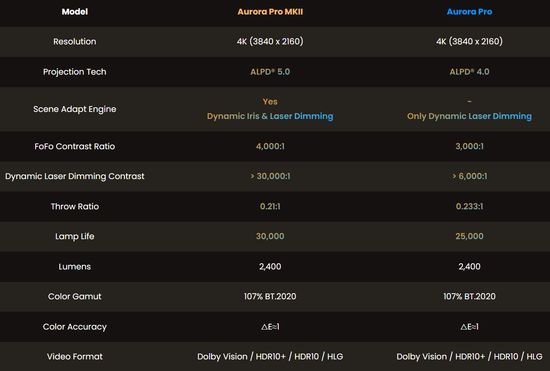
According to the specs, the Pro MKII covers 107% of the BT.2020 color space. But due to oversaturation, testing for сolor tracking only up to 90% for BT.2020 and around 100% for the P3 color space. However, calibration solves this problem.
The projector has a motorized focus and 4-/8-point keystone correction for coarse or precise adjustments.
Aurora Pro MKII
Today Aurora Pro MKII is available for $ 3,000. Thus, with the NexiGo Aurora PJ90 discontinued in September 2025, the series of ultra-short-throw 4K laser projectors still offers two models.
Almost all MKII’s specs are premium.

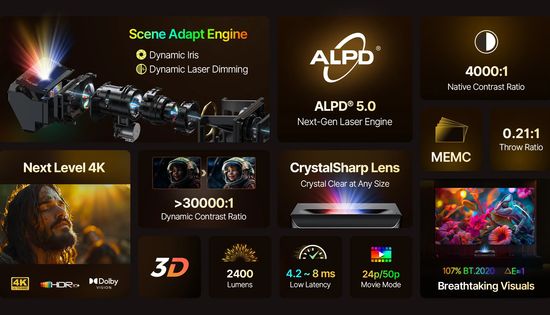
The laser engine became one of the main differences. The Aurora Pro uses an ALPD 4.0-based triple laser RGB+ light source, which provides of 2,400 ANSI lumens, 107% BT.2020 coverage, and 25,000+ hour lifespan. The ‘RGB+’ name is due to the use of an improved version of the Appotronics ALPD 4.0 technology with native contrast up to 3,000:1, better black levels, and enhanced color accuracy. In fact, the developers have increased the contrast without reducing color accuracy with the successful integration of dynamic laser dimming technology.
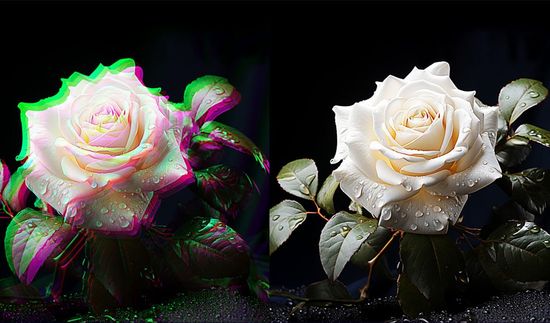
The new Aurora Pro MKII has ALPD 5.0 – based hybrid light engine, combining RGB laser and LEDs. The integration of six light sources (hree laser and three non-coherent LEDs) provides a more continuous spectrum, increases brightness, expands the color gamut, eliminates laser speckle and color fringing.

Both projectors use a 0.47″ DLP DMD chip, which reproduces 4K content using eXpanded Pixel Resolution (XPR) technology.
The principle of its operation is very simple, but elegant. The projector divides the 8 million pixels of the 4K input signal into four parts of 2 million each and displays them sequentially, offset by half a pixel diagonally. To achieve this, the projector uses only 2 million micromirrors of a relatively inexpensive Full HD chip. Of course, it only displays one Full HD image at a time. But due to the high frequency, our brain perceives four Full HD pictures as a single, higher-resolution image. Pixel shift is achieved by tilting the lens using four electromagnets in the XPR module.
NexiGo SAE and audio
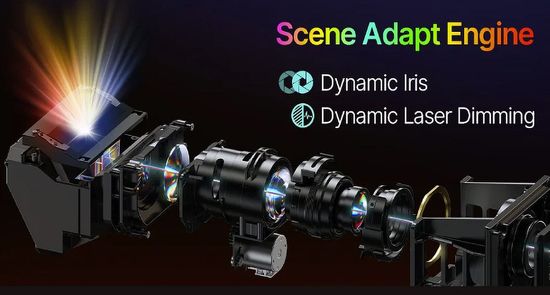
The company lists a native contrast ratio up to of 4,000:1 (FOFO-full on/off) and a dynamic contrast ratio of 30,000+:1. When tested, the model shows just over 3,700:1 in its Standard Brightness mode. The Scene Adapt Engine increases the dynamic contrast to nearly 31,500:1, which is unparalleled for a DLP UST projectors.
NexiGo’s SAE can be positioned as an advanced AI-driven image processing technology that optimizes contrast and picture quality in real time. Based on frame-by-frame content analysis, it optimizes dynamic laser dimming and iris adjustments to produce deeper blacks, brighter highlights, and enhanced shadow details, particularly in dark scenes. SAE is currently one of the best in the industry. It successfully competes with similar AI-based Enhanced Black Level (EBL, 15,000:1) from Valerion VisionMaster, XGIMI’s Dynamic Black Level Enhancement (DBLE, 20,000:1), and the new Hisense’s IRIS lens system (6,000:1).
SAE features:
– real-time optimization – instant adaptation of laser output to the scene’s content;
– dynamic contrast ratio >30,000:1;
– Dark Scene Enhancement – improving shadow detail without washing out black in low-APL (Average Picture Level) scenes;
– Machine Learning Integration – over 50,000 hours of training footage to predict and optimize image transitions smoothly;
– image stability – thanks to predictive algorithms, the system minimizes visual artifacts and motion blur, ensuring smooth transitions between frames.
In fact, the Aurora Pro MK2 became the first DLP projector with a hybrid dynamic contrast system, which eliminated noticeable brightness shifts when dark and bright scenes alternate.

Two 15W woofers and two 15W tweeters produce quite impressive the soundstage. Given the support for Dolby Atmos and DTS-HD, the built-in audio system will be quite sufficient for many. However, an external soundbar and eARC will allow music lovers to enjoy true symphonies.
Key Features
Current prices are $ 3,000 on NexiGo Official, € 2,700 in Europe, and $ 3,200 in the US.
The projector runs on Android 9.0 with a proprietary interface and does not support the official Google Play store. According to the company, this software solution ensures more efficient use of computing power, dedicating it to the Scene Adapt Engine (SAE) for improved dynamic performance. Indeed, many already have a dedicated external device, for example, Apple TV, Fire TV, or Roku sticks. In any case, their prices typically do not exceed $ 50.
The MKII’s design, size, and weight are identical to Aurora Pro, reaching (12 cm x 55 cm x 41 cm)@10.0 kg/ 22 lbs.
0.21:1 Throw Ratio provides an 80-150-inch diagonal image with (0.4-0.7m)/(3.17″/15.99″) Throw Distance (100″@6.3 inches).

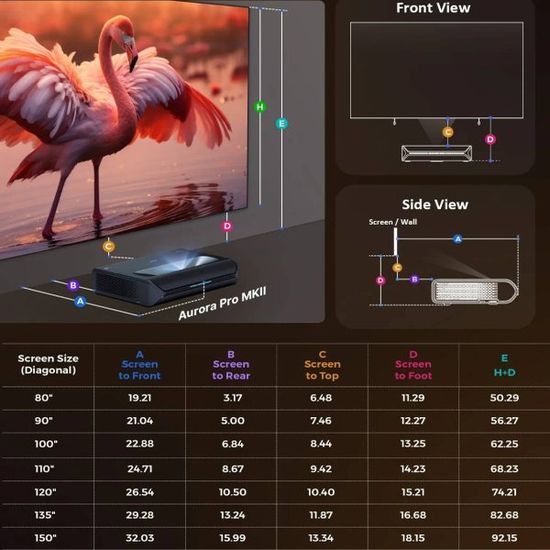
To be fair, the company does not recommend image sizes larger than 120 inches diagonally due to limited brightness. In this case, it may appear too dim.
NexiGo lists 4.2ms ~ 8ms latency. Measurements with Low Latency enabled and using gaming HDMI Input 3 demonstrate 20ms/13ms/9ms for 1080p@60Hz/120Hz/240Hz and 20ms for 4K@60Hz.
Apps can be installed manually via APK files from USB drives or third-party stores. AirPlay, Miracast and DLNA support wireless streaming of content from smartphones and PCs. The platform’s compatibility with Amazon Alexa enables voice control.
Of course, MKII supports all current HDR formats, including HDR10, Dolby Vision and HDR10+, and Dynamic Tone Mapping.
3x HDMI 2.1 ports rated at 32 Gbps, 2x USB 2.0 ports, a 3.5 mm audio-out port, S/PDIF and an RJ45 LAN provide a full range of connectivity options. HDMI 1 support eARC (Enhanced Audio Return Channel) for transmitting high-resolution multi-channel audio without compression or delay to the sound bar. HDMI 3 is optimized for gaming.
Picture Modes and settings
In total, the MKII has 21 picture modes for SDR and HDR formats. SDR, HDR, and HDR10+ use the same names, Dolby Vision offers Dolby Vision Bright/Dark/Vivid submodes. But the memory is unique to each dynamic range, allowing the user to save settings separately for SDR and HDR. The Picture Modes list is typical and includes Standard, Cinema Home/Pro, Custom, Gaming Mode, and Brightest.
Settings include the traditional Brightness, Contrast, Saturation, Sharpness, and Hue. But the Brightness in the Adjustment menu controls black level, while the Brightness in the main menu controls the overall luminance output to select between Standard, Brightest, and ECO modes.
Advanced calibration controls include a 2-point white balance setting for Gain/Offset, an 11-point white balance adjustment, and Color Management System (CMS). It’s designed for fine-tuning primary and secondary colors. They can bring a lot of joy to perfectionists who love to achieve the ideal.
But frankly, the model demonstrates quite adequate ‘out-of-the-box’ color accuracy. A slight blue or red bias due to too-cool or too-warm settings barely interferes with viewing. Some color tracking errors in the Custom mode are also too minor. Overall, Cinema Pro provides the most accurate color tracking, but sometimes exhibits slight oversaturation.
Pre-calibration measurements show quite acceptable dE (DeltaE) errors. In particular, for grayscale in Cinema Pro, the dE value exceeded 3.2 dE, and using a large color checker, it was over 4.6 dE. For reference, errors over 3 dE are visible, 2.3 dE are merely noticeable, and below 2.3 dE are not perceptible.

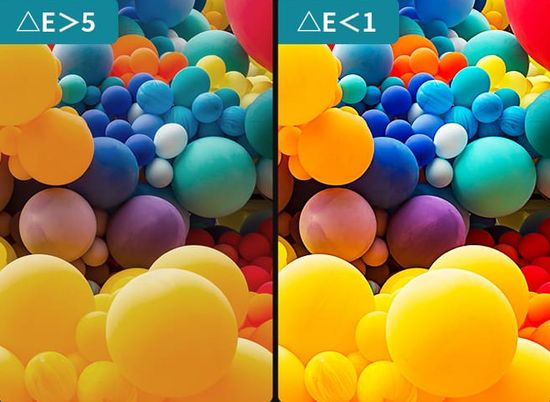
The MKII‘s problem is mainly caused by color oversaturation. However, calibration reduced them to 0.7 dE – 1.7 dE for grayscale and 2.4 dE measuremed with the large color checker, which is an excellent result.
NexiGo Aurora Pro MKIII
At CES 2026, the company announced the NexiGo Aurora Pro MKIII. This next-gen flagship 4K laser ultra-short throw (UST) model features higher brightness of up to 3,000 ANSI lumens, a native contrast ratio of up to 4,000:1, and a dynamic control system. It also features a new Virtual Masking feature for CinemaScope (Dynamic Aspect Ratio – widescreen formats 2.35:1, 2.39:1, and 2.55:1 without black bars), 3D, and the ability to use the 150-inch Fresnel ALR screen. Virtual masking uses automated or fixed black, light-absorbing panels to cover unused screen areas.
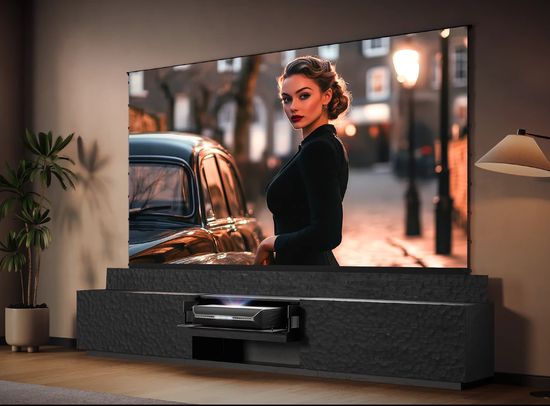
The model is compatible with the Eclipse Laser TV system, which combines a projector with a specialized stand and a 120-inch motorized screen.

The maximum screen size has been increased to 200 inches. Additionally, the MKIII supports Dolby Vision and HDR10+, utilizes an RGB Plus Tri-Color optical module, has a built-in audio system with Dolby Atmos support, and has a low input lag ranging from 4.2 ms to 8 ms. According to the company, the model is scheduled to hit the market in Q3 2026.
Aurora Pro MKIII vs. Pro MKII:
– brightness – 3000 ANSI lumens vs 2400 ANSI lumens;
– maximum screen size – 200″ vs 150″;
– features – ALPD 5.0 vs Virtual Masking;
– SAE (Scene Adapt Engine) – 2.0 vs 1.0 version.
SAE 2.0 offers improved shadow detail and black depth.
Conclusion
Pros
– next-gen ALPD 5.0-based hybrid light engine;
– Scene Adapt Engine (SAE) with dynamic iris and laser dimming;
– Dolby Vision and HDR10+ support;
– dynamic contrast ratio over 30,000:1;
– 4,000:1 (full on/off) native contrast ratio;
– Full HD 3D;
– 4.2ms ~ 8ms latency for gaming;
– 4x 15.0W internal speakers.
Cons
– 2,400 ANSI Lumens only;
– mid-level color accuracy;
– highlight clipping in HDR;
– no built-in smart OS platform.
A young American company successfully expanded the line of projectors with ALPD 5.0 – based hybrid light source, which utilizes three lasers and three LEDs. In 2023, Dangbei X5 Ultra introduced the first projector with a similar light engine. Last year, the hybrid family expanded with the mid-focal NexiGo TriVision Ultra and XGIMI Horizon S Max. The NexiGo Aurora Pro MKII became the first hybrid UST projector. As known, the ALPD 5.0-based hybrid light engine virtually eliminates laser speckle and color fringing, which is a major problem with ALPD 4.0-based triple-laser RGB light modules. Furthermore, the NexiGo Aurora Pro MKII offers superb contrast and detail in darker scenes with its unique Scene Adapt Engine (SAE).
To be fair, only 2,400 ANSI Lumens brightness, mid-level color accuracy ‘out of the box,’ and the lack of a built-in smart OS platform slightly disharmonizes with the premium level. But considering the lounch price of $ 3,000, the innovative hybrid ALPD 5.0 light engine and SAE provide the model with an superb price-quality ratio, great marketing prospects, and a good chance of becoming a bestseller.
The video offers a side-by-side comparison of the Aurora Pro MKII (left) vs the Aurora Pro (right).
