
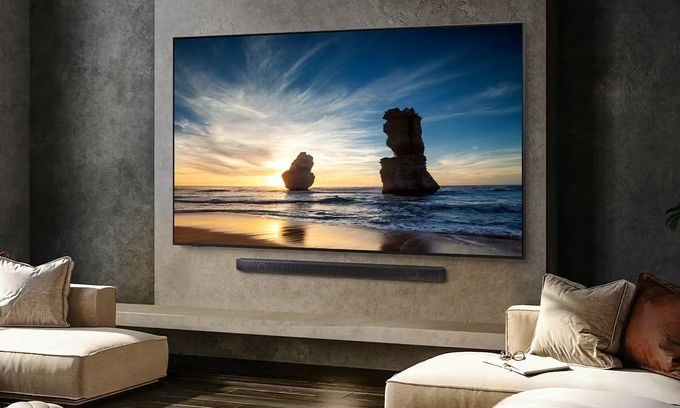


As known, the very popular Samsung Neo series uses quantum dot (QD) technology and mini LED backlight. QD expands color gamut, improves color brightness and accuracy. The mini LED backlight significantly increases общий contrast, which directly affects HDR performance, colors saturation and detail in dark scenes. In fact, several years ago, QD-miniLED models formed the premium LCD TV segment, and today, virtually all industry leaders expand their ranges annually. Some experts classify QD-miniLED TVs as upper mid-range, but their brightness and contrast are quite comparable to premium TVs.
This year is no exception, and the South Korean giant introduced the next Neo QN series, including the QN80F, QN85F and the flagship QN90F. It replaces last year’s Samsung QN90D.
The list of differences is not long, but significant. Unlike QN90D, new flagship has a matte coating and uses Samsung’s Neo Quantum 4K AI Gen 3 processor vs 4K AI Gen 2. Unlike previous processor, which uses only 20 AI neural networks, their number in the new NQ4 AI Gen3 reaches 128. Of course, this significantly increases the efficiency of video and audio processing. In addition, it has 60W 4.2.2ch audio system, 4x HDMI 2.1 ports with up to 4K@165Hz support, and uses the Samsung’s Tizen OS 2025 version. The series includes 43-, 50-, 55-, 65-, 85-, and even 98 inches models.

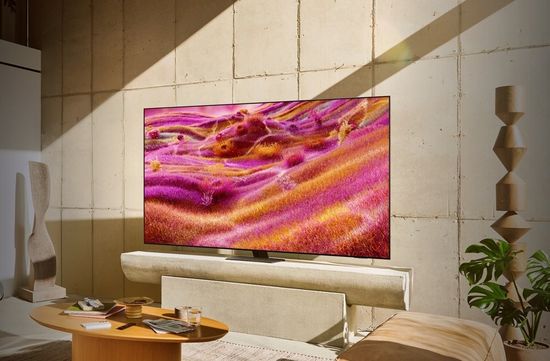
The smaller 43″ and 50″ models have 20W@2ch and 40W@2.2ch audio systems, and use Neo Quantum HDR instead of Neo Quantum HDR+. Some retailers, including Costco offer Samsung QN90FD with a longer warranty.
Brightness and contrast
HDR/SDR brightness, nits or cd/m² (QN90F vs QN90D)
– peak 2% window – 1,873/1,725 vs 2,158/1,930;
– 10% – 2,075/1,804 vs 2,087/2,032;
– 25% – 1,950/1,613 vs 1,510/1,530;
– 50% – 1,055/916 vs 894/1,009;
– 100% – 674/606 vs 619/629.
The Samsung QN90F offers amazing HDR and fantastic SDR brightness. To be fair, it falls short of the TCL QM9K, whose HDR/SDR brightness reaches an unprecedented 5,658/5,703 nits in a 2% window. But regardless of the content, QN90F easily overcomes glare in even the brightest of rooms. A comparison with last year’s QN90D shows roughly the same brightness.
Contrast
As known, contrast affects detail in dark scenes and colors saturation.
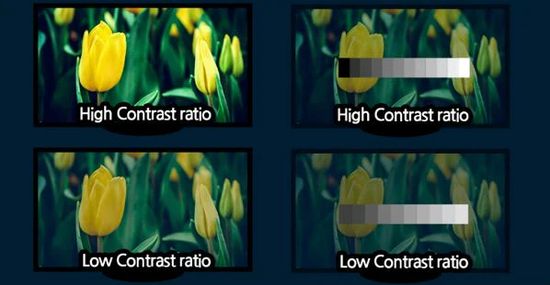
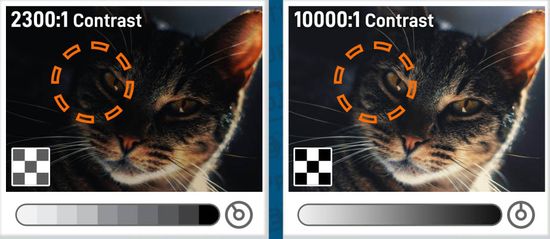


QN90F vs QN90D contrast:
– 4,854: 1 vs 3,404 : 1- native contrast;
– 135,367: 1 vs 270,333:1 – with local dimming on ‘High’.
For reference, the 65-inch models of both series use 720 local dimming zones. But in the 75-inch QN90F their number is increased to 900.
QN90F provides very deep blacks even in a dark room and with very bright little objects in the scene. Unfortunately, the lighting zone transitions are not ideal. In particular, at quickly move across the screen of bright highlights their leading edge is visibly dimmer, and there’s haloing.
Black Uniformity (good value is <0,6%, Std. Dev. and Native Std. Dev.):
– 0.562% / 0.233% vs 0.124% / 0.749%.
QN90F’s Native Std. Dev. significantly superior to the competitor and almost perfect.
As known, the black uniformity is the ability of a display to show black color without cloudiness, bright spots, or ‘dirty screen effect’, which affects the playback of dark scenes.
Std. Dev. and Native Std. Dev. are the standard deviation and a performance-optimized calculation.
Color volume/accuracy and PQ EOTF tracking
SDR and HDR Color Volume (DCI-P3 / BT.2020)
– SDR – 84.67% / 61.31% vs 90.62% / 64.05%;
– HDR (10,000 cd/m²) – 88% / 49.8% vs 88.4% / 49.4%.
Color volume characterizes a display’s color reproduction performance across the entire brightness range. SDR color volume is limited by the standard brightness of ~100 nits and не критичен. HDR uses higher brightness levels up to 10,000 nits and wider color gamut. This is more critical for HDR effect, когда display must reproduce a wider range of colors at very high brightness levels simultaneously. By this criterion, the models are almost identical, offering amazing HDR color volume.
SDR pre/post-calibration color accuracy (QN90F vs QN90D)
– White Balance dE 2000 – 5.18/0.25 vs 3.92/0.21 (good value <3);
– Color dE 2000 – 3.47/2.05 vs 3.27/1.22 (<3);
– Gamma – 2.31/2.21 vs 2.17/2.20 (2.1-2.3);
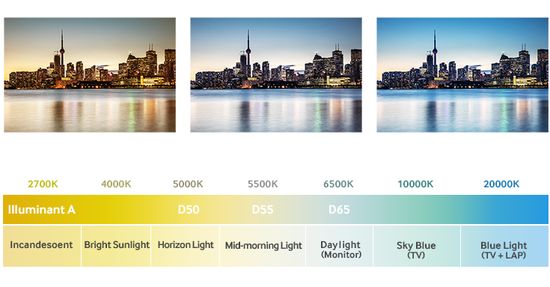
– Color Temperature – 6,694 K/6,535 K vs 5,798 K/6,565 K (6,500 K standard).

HDR pre/post-calibration
– White Balance dE ITP – 9.97/3.98 vs 9.26/5.50 (good value <9);
– Color dE ITP – 11.9/11.00 vs 6.8/5.60 (<9);
– Color Temperature – 6,418 K/6,593 K vs 5,855 K/6,686 K (6,500 K standard).
Both models have mediocre SDR/HDR accuracy ‘out of the box’, but the calibration makes them fantastic. Overall, the QN90D offers slightly better color accuracy.
PQ EOTF tracking
– 0.0035/0.0037/0.0037 vs 0.0067/0.0067/0.0056 for 600/1000/4000 nits Tracking Delta (good value <0.008).
This function characterizes the quality of the display’s conversion of HDR-video signals into the correct brightness levels. Poor tracking can lead to raised blacks, crushed dark details, or overly bright images. Both TVs are flawless, but the QN90F is slightly more accurate.
Conclusion
Pros
– superb black levels with minimal blooming;
– utra bright in SDR;
– flawless display of highlights with great HDR brightness;
– bright and vibrant colors in HDR;
– impeccable low-resolution upscaling and great PQ EOTF tracking (accurate HDR mode across the entire brightness range);
– 4x HDMI 2.1 – up to 4K@165Hz with VRR support;
Cons
– reduction of color saturation in SDR in bright rooms;
– Game Mode reduces black levels;
– blurry motion in Game Mode due to the slow pixel transitions.
Today, the price difference between the new QN90F and last year’s QN90D series is very small. For example, on the website, it’s only $100 ($1,500 vs. $1,400) for the 65-inch models. In Europe, the 65QN90D is available starting at € 1,250.
For this price, the QN90F offers a matte coating and a new Neo Quantum 4K AI Gen 3 processor with 128 neural networks, compared to 20 in Gen 2 on the QN90D. In fact, the increased processor performance is the only significant advantage of the new model, but it has improved PQ EOTF tracking. This feature to characterize the quality of the display’s conversion of HDR video signals into the correct brightness levels. This is certainly a significant bonus. Unfortunately, HDR content is currently only available through expensive subscriptions on popular streaming platforms or on 4K UHD Blu-ray discs. Operators of cable and satellite television services offer only SDR content due to bitrate limitations.
For fans of larger screens, the company offers 98-inch models. But the difference between 98QN90F and 98QN90D is significantly greater and exceeds 25% ($ 9,000 vs $ 6,650).
This video introduces the new Samsung QN90F.
