
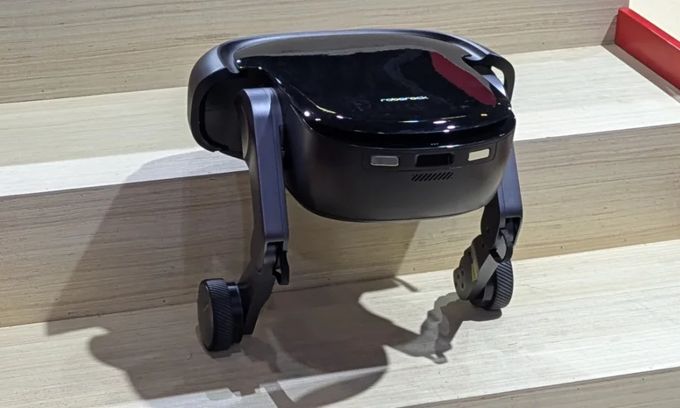


The annual January CES (Consumer Electronics Show, Las Vegas, USA) is one of the most popular venues to showcase achievements by innovative leaders. Of course, high-tech robot vscuums are always in the spotlight, and this year is no exception.
One of the main sensations of last year’s CES 2025 was Roborock Saros Z70 with 5-axis OmniGrip robotic arm.

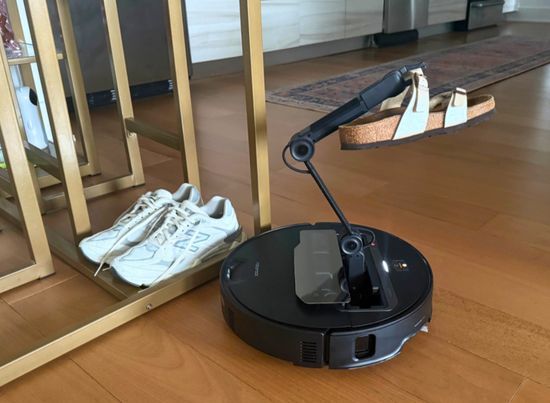
In fact, this model was the first robot with the additional function of collecting small items on the floor. Today, some sellers on Amazon offer it for only $1,300, but ~$ 2,000 is a more realistic price. For reference, the model provides up to 22,000Pa suction and has an ultra slim design with a height of up to 3.14″.
As known, the ability to clean only single-story, open-plan houses significantly limits the automation level of this process. However, its solution requires the robot cleaner to have good stair-climbing skills. Therefore, focusing the developer efforts on this direction is quite logical and predictable.
The companies have already achieved impressive success. For example, Robovac and Dreame equipped their last year’s models with ‘legs’. In particular, the Dreame Ultra X50 has two small levers that extend from under the body and lift the robot up steps.

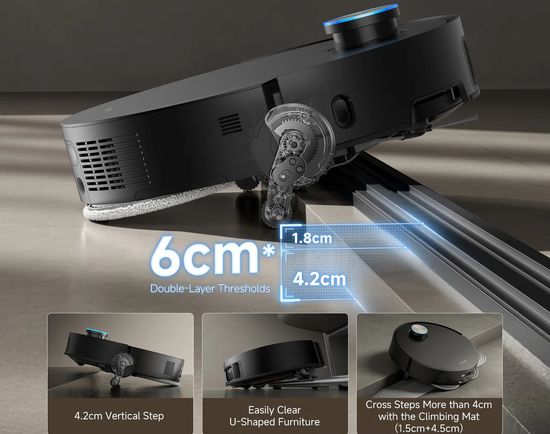
CES 2026 showcased revolutionary models, promising a complete solution for autonomous robot movement along stairs between floors.
As last year, the Chinese giants Roborock and Dreame became the leaders, presenting Saros Rover with wheeled, articulated ‘legs’ and Cyber X with a modular tracked system.
Roborock Saros Rover
Unveiled at CES 2026, the flagship Roborock Saros is the first climbing robot in the new Saros line.

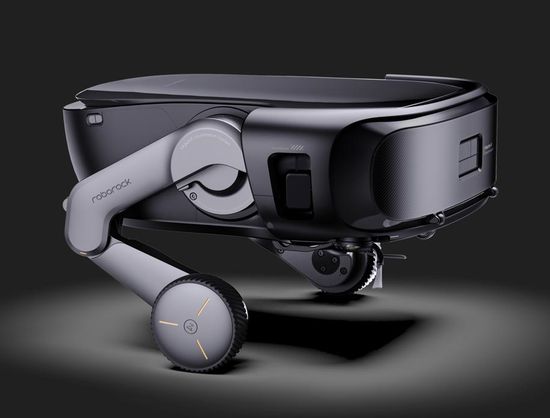
It’s an innovative prototype of climbing robot vacuums, which specializes in navigation and cleaning in multi-floor spaces. Saros has an AdaptiLift 3.0 chassis with unique two-legged wheel system, and AI algorithms that use active camera and sensor data for balancing and navigation. Its suction power reaches 19,000 Pa, which is enough to clean even long-pile carpets. The company hasn’t yet announced its price, but industry forecasts suggest it will likely cost around $ 3,000.
When folded, the legs function as regular wheels. When unfolded, they lift the robot above the surface, enabling it to overcome obstacles of considerable height. Specifically, the AdaptiLift 3.0 chassis of Saros series overcomes single thresholds up to 4.5 cm (~1.77″). For double-layer obstacles, the total height can reach up to 8.5 cm (4.5 cm + 4 cm). In fact, they are more complex obstacles that combine a horizontal barrier (such as a threshold or carpet) and a protruding vertical part (such as the bottom shelf of a cabinet). Of course, overcoming such obstacles requires more complex AI algorithms.
Modes:
– climbing stairs – having approached the bottom step, the robot activates its legs, climbs to the required level, leans forward, shifting its CG (center of gravity) forward, and climbs onto it using additional small wheels at the bottom.

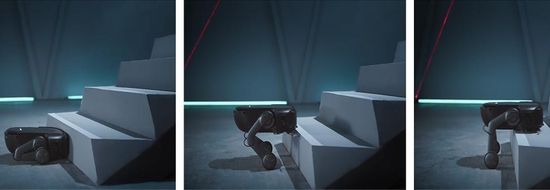
Once on the step, the robot pulls up and folds its lever-legs.

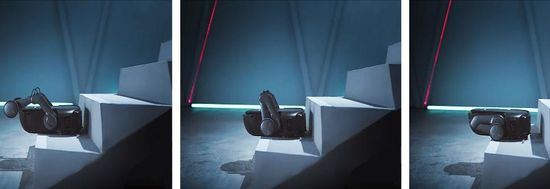
– stair steps cleaning – the robot folds one lever-leg, turns 90 degrees and moves along the step, vacuuming its surface.

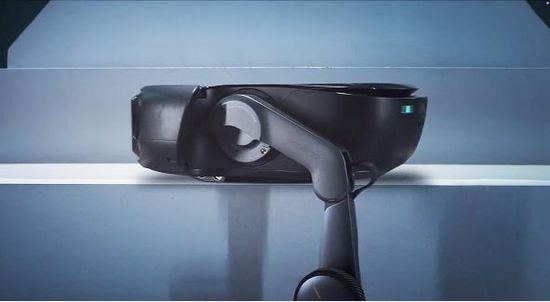
The very low profile (7.98 cm) ensures cleaning under furniture with low clearance.
Dreame Cyber X
Dreame, which is also part of the group of innovative industry leaders, offers a fundamentally different conceptual solution to this problem. At IFA 2025 and CES 2026, it unveiled the Dreame Cyber X complete with the Bionic QuadTrack platform.

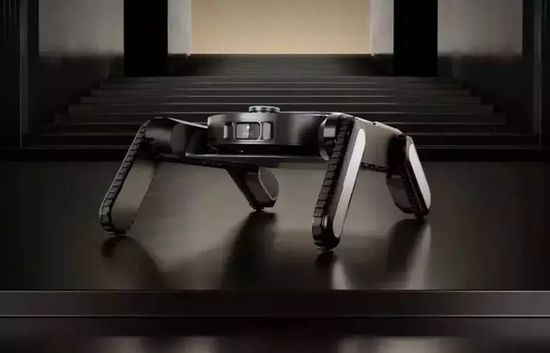
In fact, it’s a specialized, separate robot chassis to transport a standard vacuum cleaner. The tracked legs can climb steps up to 25 cm / 9.8″ high (stairs at an angle of up to 42 degrees). Essentially, the Bionic QuadTrack functions as a vehicle for the Cyber X robot, enabling its movement between floors at speeds of up to 0.2 m/s.

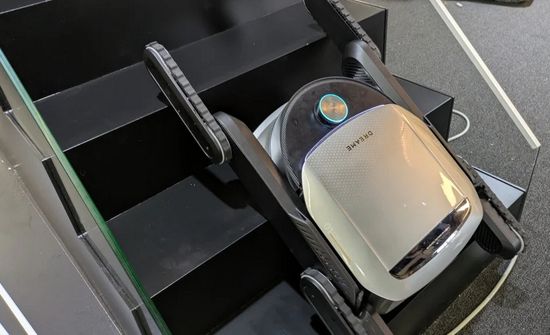
Cyber X’s 6400 mAh battery is designed to clean up to 5 floors. Triple Braking Protection prevents falls using a mechanical lock and stability sensors. Model uses a dual-line laser system and Smart 3D Adapt visual system as AI camera. It scans and creates a 3D view of its surroundings and stairs, planning safe climbing paths. The company hasn’t yet specified the model’s height, but similar to the Dreame X20+ or D9, it could be around 9.7 cm. Of course, robot supports both dry vacuuming and wet mopping functions.
Unlike the Roborock Saros Rover, the Dreame Cyber X does not clean the surface of stairs. But it uses more reliable traditional wheels during cleaning and will likely be significantly cheaper.
The model is aimed at the premium segment for private multi-storey buildings. Currently, the Bionic QuadTrack is listed as part of the Dreame Cyber X system and is not intended for use with previous robots. However, the company promises compatibility with future models.
Dreame X60 Max Ultra
In addition to the Cyber X, Dreame also introduced the X60 Max Ultra, which claims to have an unprecedented suction power of up to 35,000 Pa.

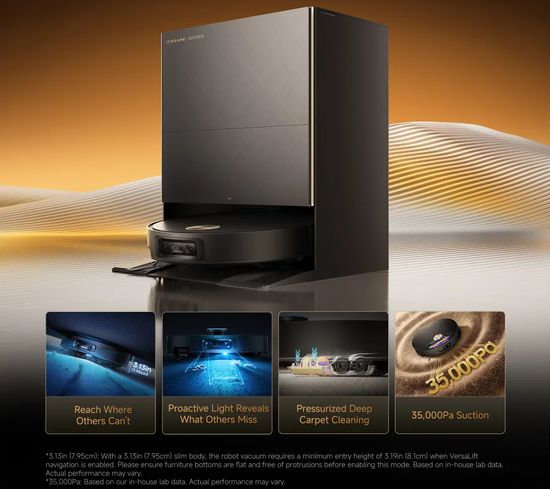
For comparison, the suction power of the previous X50 series reaches only 20,000 Pa.
Several years ago, experts actively debated this aspect. Indeed, the actual suction power delivered to the floor by the nozzle during a cleaning is significantly lower due to air resistance, the cleaning head design, and surface type. However, the current industry standard requires information only about the maximum potential suction power of the motor itself, measured in a laboratory setting without a load. However, superb real suction power has already become the hallmark of Dreame’s robots.
Cyber X uses a high-performance brushless motor with the latest Dreame’s Vormax suction system technology. The company is not disclosed specific internal engineering details are not publicly disclosed. But the upgrade likely involves advancements in motor design that include several most aspects:
– optimized air duct design.
The optimized duct with a streamlined design minimizes turbulence and reduces pressure loss, allowing the motor-generated suction power to reach the floor surface with virtually no loss;
– filtration and brush.
For example, the tangle-free TriCut suction brush prevents pet hair, ensuring maximum airflow.
The high suction fits harmoniously into the overall ‘CarpetForce Vacuuming System’ that includes:
– HyperStream Detangling DuoBrush 2.0 – upgraded dual-rubber brushes with thicker strips designed to improve agitation and prevent hair tangles;
– Retractable Pressure Plate – a semi-sealed chamber enhances sealing and concentrates the airflow in the suction zone above the floor or carpet;
– Proactive Light Dirt Detection – recognizes pet hair, liquid, and small particles using sensors to automatically adjust power and cleaning mode depending on the type of dirt.
Conclusions
Innovative industry leaders have demonstrated yet another leap forward in automated cleaning. Just a few years ago, robot vacuums were expensive, fun toys that pets loved to ride on.
Unfortunately, low suction power, ineffective navigation and obstacle avoidance, lack of a mopping function, limited battery life, small on-board dust bin capacity, and other cons prevented them from fully competing with traditional vacuums. Today, virtually all these issues have been successfully addressed. Furthermore, multifunctional docking stations have reduced the need for external monitoring to a minimum. For example, last year’s 3i S10 Ultra with a water recycling system even supplies the station with water without connecting to a water supply or sewer system, condensing moisture from the air. The climbing robots further enhance the automation level, eliminating the limitations of cleaning multi-story buildings. Over time, the lucky owner of such a miracle will only need to set a cleaning schedule and change the dry waste bag at the station once every few months, enjoying cleanliness and order in the house. To be fair, companies haven’t yet introduced combined climbing robots with a water recycling system and a robotic arm. But competition is a terrible force, and the emergence of such monsters is just around the corner.
This video presents the first climbing Roborock Saros Rover vacuum robot.
