
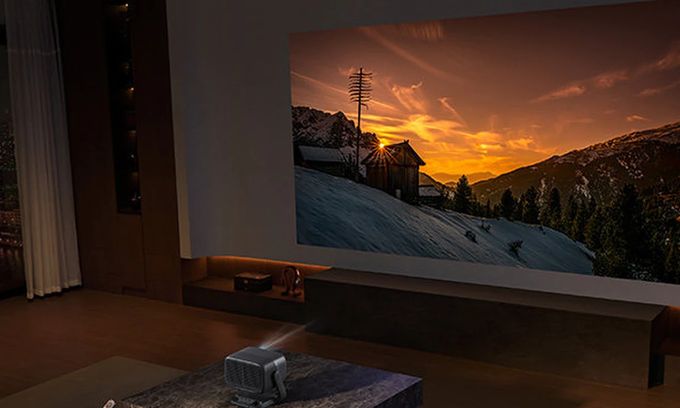


As known, successful competition requires the constant expansion of the product lineup. All industry leaders utilize this marketing tool, and JMGO from Celestial Empire is no exception. This brand is less familiar in Europe and the US but is very popular in Asia.
This year, the JMGO IRIS and XGIMI AURA 3 took center stage. These DLP 4K projectors are the first to use the innovative Dual-DLPC tech from Texas Instruments (TI). For reference, modern DLP projectors use a single DLP Digital Controller (DLPC) to process the incoming video signal and manage the switching the millions of DMD chip’s micromirrors. Unfortunately, its bandwidth is insufficient to handle the massive volume for 4K@120fps playback. The new architecture utilizes two specialized TI DLPC display controllers. In fact, the Dual-DLPC setup doubles the bandwidth. As a result, the processor instantly splits the 4K frame into sub-frames and manages pixel shifting without latency, achieving a record-breaking input lag of just 1 ms in gaming modes. According to the companies, the performance of their parallel operation improves the playback quality of 4K@120fps to the level of much more expensive LCoS projectors with native 4K resolution.
However, the JMGO did not stop there and in the summer of 2026 launched a line of laser projectors called N5 series.

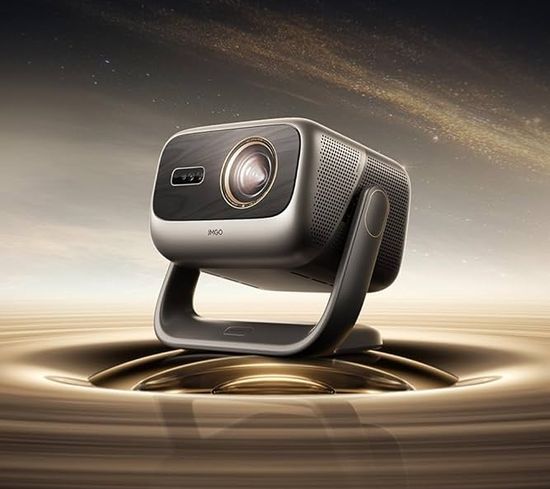
It includes:
– JMGO N5, N5 Pro, N5 Ultra, N5 Ultra Max (summer 2026) – a base version with improved optics and autofocus.
The base model first became available in the autumn of 2025. Its global and updated versions were released during IFA 2026;
– N5S Pro / Pro Max / Ultra / Ultra Max / N5S Turbo (mid-2026) – an updated gen featuring extended dynamic range, improved contrast, and flagship-level performance.
Both series are built on a common platform.
JMGO QuaLas 42 and MALC 6.0
Unlike the flagship JMGO IRIS series, the JMGO N5S line does not have a Dual-DLPC structure or the high-end HyperPulse Actuator. Nevertheless, in terms of innovation, the N5S models are nearly on par with the flagship series. Given the abundance of new terminology, this aspect requires clarification.
This series incorporates JMGO QuaLas 42 and MALC 6.0.
QuaLas 42 consists of laser diodes serving as the light source.

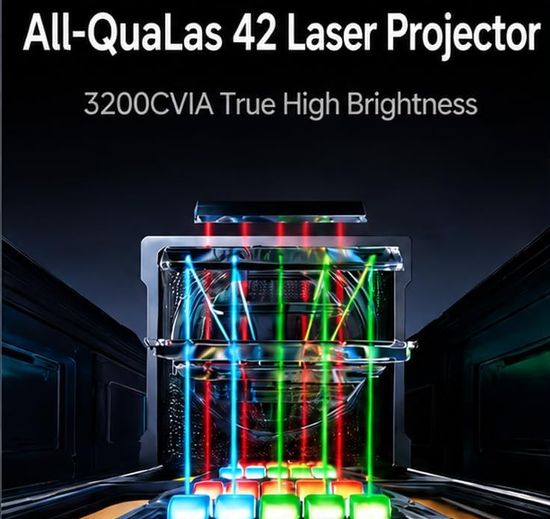
The MALC 6.0 optical engine is a system of lenses, prisms, and apertures.

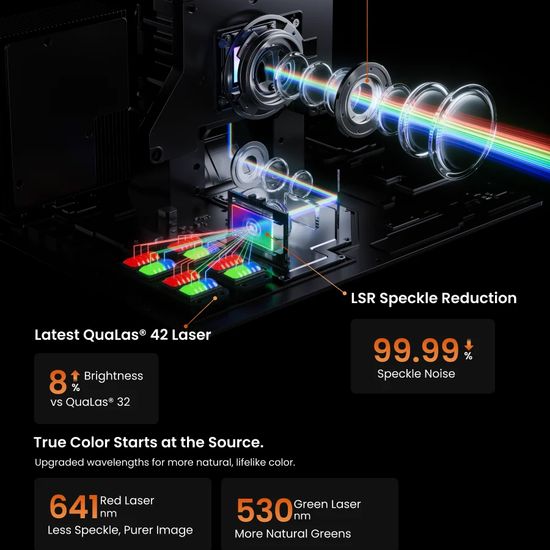
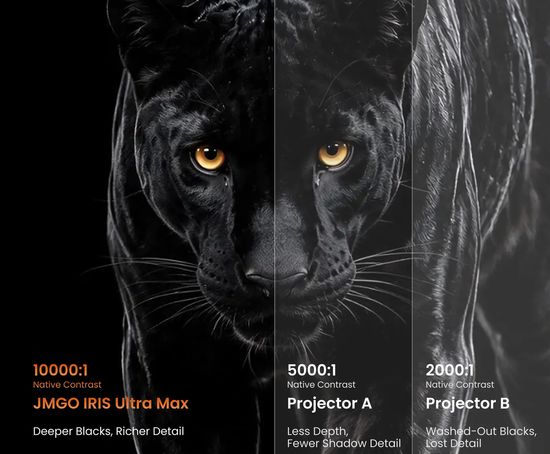
The diodes generate pure, distinct light across Red, Green, and Blue (RGB) channels. MALC directs and calibrates the light, eliminating defects, and projects the final image. These components replace the earlier QuaLas 32 and the MALC 2.0/3.0/5.0 systems. They improve overall energy efficiency by 40%, and drastically enhance contrast. Simply put, the improved QuaLas boosts brightness and spectral purity, while MALC enhances contrast up to 10,000:1, and suppresses speckle.
The QuaLas 42 diodes provide a higher luminous flux density, increasing brightness by approximately 8%. Furthermore, improved energy efficiency enables a higher peak brightness. It reaches 3,600–5,000 CVIA lumens. This is a new standard established by the China Video Industry Association. For reference, 1 ANSI lumen ~ 0.5–0.7 CVIA lumens. Additionally, this upgraded version employs more effective eye-protection algorithms by shifting the blue light spectrum into a safer range (about 460–465 nm).
According to the company, the MALC 6.0 version almost completely eliminates the laser speckle effect (image graininess) and minimizes the ‘rainbow effect’ (RBE).
As a result, the new JMGO N5S with QuaLas 42 and MALC 6.0 provides:
– native-like 4K@120Hz in high quality;
– high contrast (up to 10,000:1 native contrast ratio);
– 120Hz/240Hz variable refresh rates (VRR) for seamless gaming and motion.
JMGO N5S Specs
All models support 4K UHD (3,840 x 2,160) resolution, are equipped with QuaLas 42, MALC 6.0 and the same built-in audio system, which includes:
– audio – 2x 12.5W;
– Dolby Audio and DTS:X support;
– low-frequency (bass) reproduction down to 35 Hz;
– Bluetooth 5.2 / 5.4;
– HDMI 2.1 with eARC (Enhanced Audio Return Channel) support.
However, the new N5S Turbo has the high-end drivers from Wisdom Audio with a power of 2x 10W.
In addition, the JMGO N5S supports AI Gimbal and is equipped with optical zoom and lens shift.
In fact, brightness and contrast are the primary differences between the models (N5S Pro vs N5S Pro Max vs N5S Ultra / Ultra Max vs N5S Turbo):
– brightness (CVIA lumens) ~3,400 vs 4,000 vs 5,200 / 5,600 vs 3,600;
– native contrast ~ 10,000:1 vs 8,000:1 vs 10,000:1 / 11,000:1 vs 5,000:1.
List of hardware and functional differences:
– N5S Ultra Max and N5S Turbo offer a full-fledged 4K@120Hz mode, VRR support, and minimal input lag for gaming. Specifically, the Ultra Max delivers 1ms@up to 240Hz. The new Turbo model supports 8–12ms for 4K@60Hz and 4–5ms for 4K@120Hz;
– Ultra and Ultra Max models feature advanced aperture systems and multi-chip processing (for example, an MT9681 paired with dual DLPC8545 controllers), delivering deep blacks and a contrast ratio of up to 10,000:1.

– N5S Ultra is equipped with a dynamic aperture system (Dual Iris Light Control);
– N5S Ultra Max features upgraded Wi-Fi 7 and Bluetooth 5.4;
– with an estimated price of ~8,000 yuan (just under $ 1,200), the new N5S Turbo is focused on gaming (4K@120Hz with VRR support) and can be positioned as an intermediate model between the Pro versions and the Ultra-tier flagships.
Conclusion
Overall, the N5S series serves as a worthy expansion of JMGO’s projector lineup. Unfortunately, unlike the JMGO IRIS, these models do not feature Dual-DLPC controller or the proprietary HyperPulse Actuator. According to the company, they enable full-fledged 4K@120Hz playback in JMGO IRIS. Nevertheless, the inclusion of JMGO’s QuaLas 42 and MALC 6.0 technologies also significantly elevates the innovation level in N5S models.
Furthermore, the company has promised a full-fledged 4K@120Hz mode in the N5S Ultra Max and N5S Turbo. In any case, the advanced aperture systems and multi-chip processing found in the N5S Ultra and Ultra Max models promise a substantial improvement in image quality.
Finally, while the JMGO IRIS Ultra and Ultra Max are priced at $ 2,400 and $ 3,500 respectively, the N5S Turbo is expected to retail for just over $ 1,000 in international markets. But to be fair, the flagship N5S Ultra and Ultra Max currently retail in China for approximately €1,500 / $ 1,760 and € 1,880 / $ 2,200, respectively.
Regardless, JMGO’s new 2026 lineups spell trouble for manufacturers of high-end LCoS projectors. While those devices certainly offer superb contrast and native 4K resolution, the ‘budget-friendly’ price of entry-level Sony VPL-XW5000ES currently reaches $ 6,000. Whereas the JMGO IRIS with Dual-DLPC tech delivers comparable quality at half the price. For reference, the list of DLP projectors featuring this technology also includes the XGIMI AURA 3 UST projector.
Overall, consumers get a significant increase in quality in relatively inexpensive DLP projectors.
This video shows the unboxing and performance test of JMGO N5S Pro projector.
