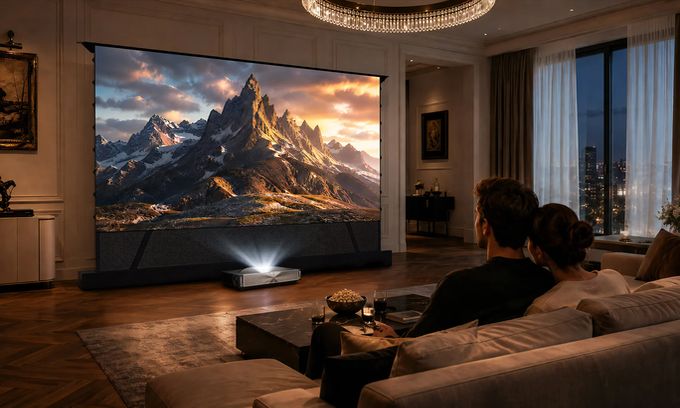
Annual updates to the most popular models have long been considered an effective marketing technique. Almost all industry leaders use it, and Chinese giant Hisense from Heavenly Empire is no exception. This year, the company introduced the Hisense PX4-Pro UST laser projector, which is an improved version of last year’s PX3-Pro.
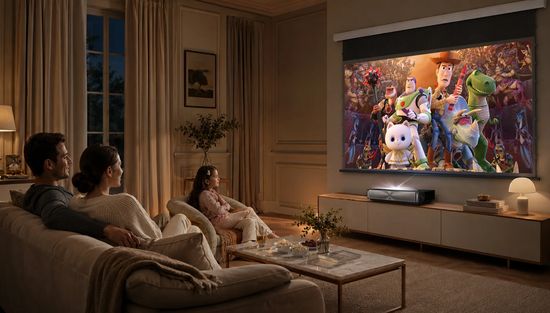
Typically, updated versions offer more functionality and higher specs, but, unfortunately, are more expensive. However, sometimes companies cut less successful innovations in new versions and reduce the price. But Hisense PX4-Pro falls into the former category. It went on sale July 21, 2026, priced at $ 3,998.
PX4-Pro
Specs
– brightness and contrast ~3500 ANSI lumens and increased native contrast up to 6,500:1 with the dynamic mechanical iris;
– color gamut and accuracy – up to 118% BT.2020 coverage with Delta E ≤ 0.9 color accuracy;
– processing – advanced real-time AI analys for each scene and 4K@HDR upscaling to dynamically adjust tone mapping frame-by-frame;
– (120″-200″) image size@11.7″/30 cm throw distance@0.20:1 throw ratio;
– gaming – world’s first AMD FreeSync Premium certification, 1ms input response at 2K@240Hz and 4K@120Hz support, ‘Designed for Xbox’ feature, HDMI 2.1 inputs, and upcoming support for Xbox Cloud Gaming with the VIDAA interface.
Unlike portable projectors designed for convenient rotation between rooms and the veranda, the Hisense PX3/PX4-Pro are positioned as an alternative to traditional TVs in the living room. Therefore, the developers did not strive to reduce dimensions at the expense of quality. As a result, the dimensions and weight reach an impressive (21.3 x 5.6 x 11.3 inches)/(540 x 142 x 288 mm)@18.3 lb/8.3 kg). However, it will fit in the living room without a problem. But esthetes can use a special cabinet with a pull-out section for a projector.
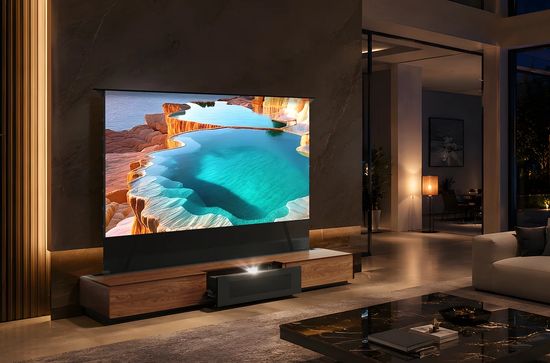
Honestly, fans of huge screens should take another aspect into account. According to ophthalmologists’ recommendations, the optimal viewing distance is the image diagonal multiplied by 1.3. Therefore, a 150-inch image is comfortably perceived from ~5 meters away. Of course, placing the projector in a cozy oceanfront mansion is no problem. However, this task may become a challenge in a standard city apartment living room.
In addition to the HDMI ports for games, the model has USB 3.0/2.0, optical audio output, Gigabit LAN, Wi-Fi 7, Bluetooth 5.4, AirPlay, Miracast, and Control4. The VIDAA OS provides access to Netflix, Disney+, Hulu, Prime Video, and YouTube.
PX4-Pro vs PX3-Pro
The PX4-Pro is a first UST projector in the world to earn AMD FreeSync Premium certification. Moreover, a full suite of Hollywood certifications, including Dolby Vision, Dolby Atmos, IMAX Enhanced, and Dolby Vision Gaming, will satisfy any movie buff.
List of main improvements (Hisense PX4-Pro vs PX3-Pro):
– brightness – 3,500 ANSI lumens vs 3,000 ANSI lumens;
– lens / contrast control – a 7-level iris lens (superb black levels and fine-tuned light control);
– CineBlack Pro system, Dynamic Grayscale technology, and EBL (Enhanced Black Level) algorithm to get more detail out of darker scenes;
– FreeSync Premium;
– Dolby Vision Gaming;
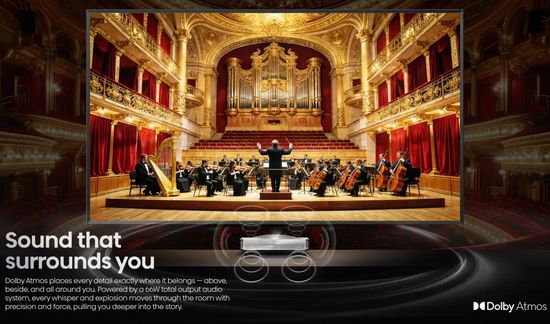
– sound – 66W 4.0.2ch built-in multi-channel Dolby Atmos system upgraded via a partnership with Devialet vs 50W Harman/Kardon system (2x 15W + 2x 10W).
– price ~ $ 4,000 vs $ 3,000.
Same specs:
– 4K UHD (3,840 x 2,160) resolution with XPR (Expanded Pixel Resolution) tech;
– TriChroma RGB laser module with 107% – 118% coverage of the BT.2020 (Rec. 2020) color space or up to 147% of the DCI-P3 cinema standard;
– gaming – 4K@120Hz and 2K/1080p@240Hz, FreeSync VRR / FreeSync Premium (no frame tearing), input lag ~1 ms at high frequencies, maintaining clarity when scaling up to 150–200 inches with improved LPU 3.0 digital laser engine. For reference, the LPU is a proprietary hardware and software complex for image and light control.
It provides:
– precise spectrum control.
The laser wavelength control accuracy reaches 1 nanometer, ensuring pure RGB colors without the use of filters;
– eye protection by blocking blue light in the 400–455 nm range;
– AI optimization of brightness, contrast and noise reduction;
– auto calibration adjusts image geometry, focus, and colors to the projection surface (screen or wall).
Hisense PX4-Pro vs competitors
The image quality of modern projectors and TVs increasingly relies on AI processing. In fact, the algorithms intelligently manage contrast, tone mapping, motion and real-time scene adaptation. Of course, brightness, contrast, and color gamut remain crucial. But without smart features, even delivering content to a projector would be a huge challenge.
Therefore, the developers’ efforts in developing the processing platform are well-founded. The list of modern solutions:
– AWOL Vision Aetherion Max/Pro – MediaTek MT9655 (Pentonic 800), off-the-shelf SoC architecture;
– NexiGo Aurora Pro MKII – ALPD 5.0 platform (lasers+ LEDs) and software-driven Scene Adapt Engine (SAE);
– XGIMI Aura 2 – 0.47″ DMD DLP Chip and Dual Light 2.0 Hybrid Light Source.
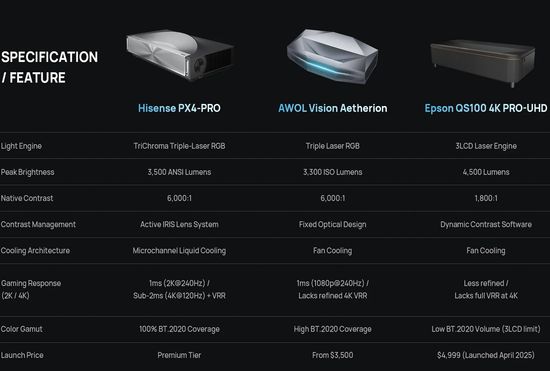
Hisense PX4-Pro uses LPU 3.0 and AI chipset with real-time frame analysis. The company has invested billions of dollars into developing its own chips, known as the Xinxin AI Picture Quality Chip family. Today they successfully compete with the best analogues in the industry.
Xinxin AI Chip Family:
– dual-drive power plus algorithm models;
– innovative ‘Light and Color Co-control’ simultaneously synchronizes backlight luminance and color pixels;
– the latest H7 and H7 Pro versions in flagship lines provide color precision up to 134-bit and supports up to 330Hz refresh rates.
Hisense Xinxin AI Family (H7/H7 Pro) vs proprietary chips (Samsung/Sony) vs SoCs MediaTek etc:
– dedicated secondary co-processor vs vedicated proprietary silicon (Sony Cognitive Processor XR or Samsung Neural Quantum) vs integrated single-chip solution (handling OS, decoding, and basic logic);
– light/color control – simultaneous multi-dimensional ‘co-control’ up to 134-bit precision vs advanced multi-zone processing vs sequential or basic zone-dimming control;
– scene/depth recognition – real-time pixel optimization with focus/depth tracking vs visual cross-analysis-based high-end cognitive/perceptual mapping vs basic contrast and noise reduction algorithms.
Triple-Laser Engine
The PX4 Pro uses Hisense’s LPU Digital Laser Engine 3.0, a single-chip DLP design with a 0.47-inch DMD chip and time-sequential RGB laser modulation. The DMD modulates three colors in rapid time-sequential passes without using the phosphor color wheel. As known, the cons of color wheel include the rainbow effect (color fringing), reduced color saturation due to loss on the wheel, and degradation over time.
According to specs, color volume reaches 118% BT.2020. For reference, this standard covers almost 76% of all colors visible to the human eye. By comparison, the DCI-P3 digital cinema standard covers only 54%.
Contrast is adjustable with a seven-level adjustable iris in the light path. For dark content, the projector restricts the aperture opening, increasing contrast to 6,500:1. In the case of both dark and bright zones in the frame, iris slightly reduces peak brightness. The projector also supports Hisense’s Dynamic Grayscale Technology and Enhanced Black Level Algorithm for additional shadow detail recovery.
Of course, LPU 3.0 with a fully upgraded AI-enabled chipset can be positioned as the main bonus of premium Hisense models.
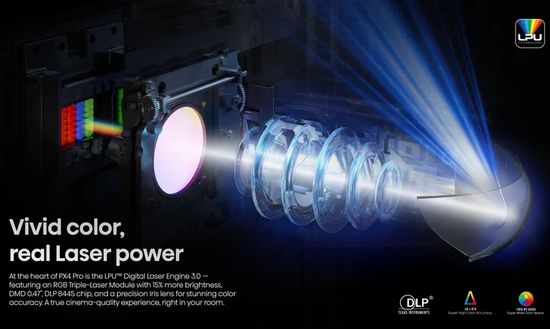
This chipset is designed for laser projection with dedicated AI accelerators and specialized algorithms for tri-color laser light sources. Like any highly specialized solution, it offers higher performance compared to, for example, the more versatile MediaTek. Its functionality includes:
– Real-Time Scene Analysis – AI analyzes the incoming video signal and automatically instantly adjusts the mechanical aperture of the lens, optimizing contrast frame-by-frame;
– AI-Powered Upscaling – the system supports AI 4K/HDR Upscaler, automatically increasing the resolution of low-resolution content. Importantly, the algorithms use more efficient deep learning-based reconstruction instead of traditional pixel doubling;
– End-to-End Color Optimization – proprietary algorithms optimize brightness, contrast, and noise calibration simultaneously.
FreeSync Premium
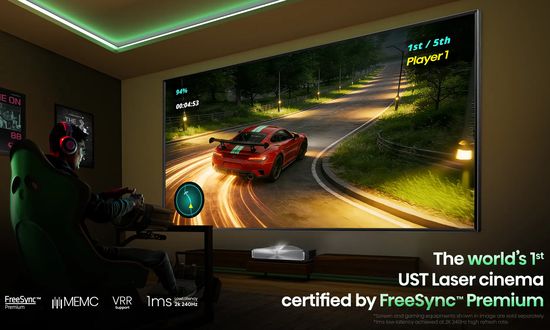
For reference, AMD FreeSync Premium is the mid-level adaptive sync certification. It requires:
– display refresh rate from Full HD@120Hz;
– maintaining low latency;
– support for Low Framerate Compensation (LFC).
If the GPU frame rate drops below the display’s minimum supported VRR threshold, it duplicates frames in a controlled pattern. This keeps the refresh rate within the adaptive sync window, preventing the picture ‘stutter’.
In the process of obtaining certification, Hisense has successfully fulfilled all requirements. Specifically, the PX4 Pro DLP projection requires no liquid crystal stabilization time or OLED pixel-switching delay. Almost instantaneous tilt of the DMD mirror provides ~1ms input lag (frame processing time) at 2K@240Hz. As a result, the adaptive sync quality in gaming on a 200-inch screen is equal to that of a 144Hz monitor.
Other gamer options:
– 2K@240Hz operation;
– 4K input is supported at 120Hz;
– Variable Rate Refresh (VVR) and MEMC (Motion Estimation and Motion Compensation) with blur reduction;
– Xbox Cloud Gaming directly via VIDAA smart OS;
– 2x Ultra High-Speed HDMI 2.1 ports with Auto Low Latency Mode (ALLM), 2x HDMI 2.0 ports, and ARC support.
The PX4 Pro offers a full suite of modern, popular options, including Dolby Atmos/Vision/Vision Gaming, IMAX Enhanced, HDR10+, HDR10, HLG, and Filmmaker Mode certifications.
The projector uses a Devialet-tuned 4.0.2ch audio system with six speakers (two up-firing speakers), 66W of power and Dolby Atmos support. For reference, the expensive premium Phantom wireless speaker is also a product of this French company.
Smart TV platform uses Hisense’s VIDAA OS with built-in streaming apps support, Apple AirPlay, and Bluetooth.
Conclusion
The PX4 Pro is ~$ 1,000 more expensive than its predecessor (~ $ 4,000 vs $ 3,000). However, the increased price is fully justified by the upgraded triple-laser module, mechanical iris, FreeSync Premium certification, and Devialet audio tuning. For example, the price of Samsung’s The Premiere (LSP9T) with similar specs and functionality ranges from $ 5,000 to $ 6,000 for a 130-inch system without FreeSync Premium certification.
In fact, the company is positioning the PX4 Pro as an alternative to huge 100-inch TVs in the living room. Despite excellent specs and a very reasonable price, the Hisense PX4 Pro faces a tough battle with massive 100-inch TVs 2026, which range in price from $ 1,400 to $ 6,000. Ironically, the PX4 Pro will compete with the excellent 100-inch Hisense 100U7SG, 100U8SG, and 100UR9S TVs, which range in price from $ 4,000 to $ 6,000. Of course, the PX4 Pro offers a picture size of up to 200 inches. However, the price of professional stationary motorized screen systems can reach several thousand dollars, significantly increasing the cost of the projector. Furthermore, according to ophthalmologists’ recommendations, the comfortable viewing distance for such a screen should be approximately 6.5 meters. This may not be a problem for a spacious mansion, but it could be challenging in a standard living room. These considerations may make choosing a traditional TV for the living room more appealing. But among UST projectors, the PX4 Pro is a very attractive option.
The video showcases the new Hisense PX 4 Pro 4K UST triple-laser projector.