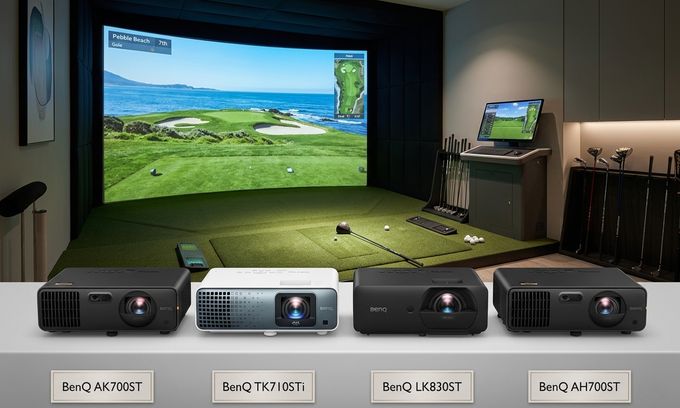
In 2001, BenQ (Bringing Enjoyment and Quality) was founded by Acer from its Acer Communications & Multimedia division. The development and manufacture of computer equipment and electronics was the purpose of its creation. Five years later, Acer sold the shares of BenQ. Its management announced the rebranding to Qisda (Quality Innovation Speed Driving and Achievements).
Today, BenQ functions as its own global brand. However, its parent corporation handles massive OEM/ODM operations. For reference, OEM (Original Equipment Manufacturer) is manufacturing based on the customer’s drawings and specifications, which owns the intellectual property. In this case, the OEM acts solely as a contractor. ODM is the purchase of a finished product from a manufacturer, including its own design and technology, which is then released under the manufacturer’s brand or with minimal modifications. ODM is convenient when a finished design is not available and for reducing development time.
Projectors are one of the company’s most successful products. Today, it ranks among the industry leaders, offering excellent mid-focal and UST (ultra-short-throw) models. The company expands its product range annually, and 2026 was no exception.
The list of new products includes the short-throw BenQ LK830ST (Throw Ratio 0.50:1 ~100″@1m) and the ultra-short-throw BenQ LU895UST (0.25:1 ~ 100″@0.5m).
BenQ LK830ST
Pros
– 4000 ANSI lumens of brightness;
– 4K UHD (3,840 x 2,160) resolution with pixel-shift;
– Golf mode;
– multi-projection mode;
– IP6X dust proof sealed engine.
Cons
– no smart features and including native apps;
– black levels are average;
– no Wi-Fi;
– no optical zoom or image shifting.
The model uses the time-tested Laser Phosphor light engine, which is based on ALPD 3.0 technology (Advanced Laser Phosphor Display). The high-performance BenQ Blue Core lasers have a 20,000-hour rated lifespan or 30,000 hours in its Eco mode.
ST design (100″@1.1m) and 4K imaging with factory white level calibration make this model one of the best all-around small commercial projectors on the market. It’s perfect for schools and businesses. In fact, the LK830ST is a compact business laser projector with several additional premium features. Moreover, 4,000 ANSI lumens of output, 4K and Golf mode are excellent for home use, including as an alternative to TV.
The projector’s 0.496:1 Throw Ratio provides (70″-300″) / (178 cm – 762 cm) diagonal image size from a distance of (0.8 m – 3.3 m).
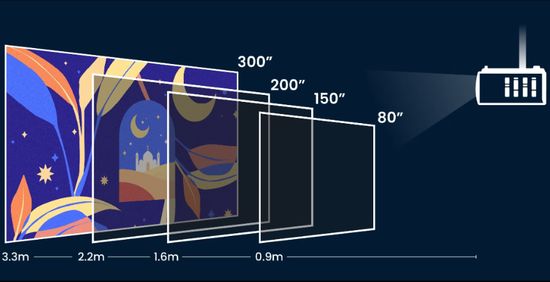
The short-throw design radically simplifies projector placement due to the possibility of installation close to the screen. While it can’t compete with UST (Ultra Short Throw) models with Throw Distances of several tens of inches, 100″@1.1m is still impressive. In addition, the company offers an inexpensive $ 80 CM00G3 ceiling bracket.
Unfortunately, the LK830ST doesn’t offer an optical zoom lens or mechanical image shifting, but digitally shrinking and slightly moving the image solves the installation problem quite well. The angles are adjustable up to 30° horizontally and vertically.
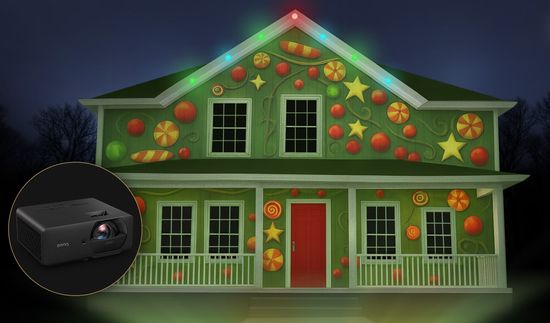
Model also supports projection mapping to project custom visuals onto the exterior of a building.
Picture modes
The LK830ST offers seven picture modes, including:
– Bright ~ 3,780 Lumens (ISO 21118 standard);
– Entertainment ~ 3,410 Lumens;
– sRGB ~ 3,165 Lumens;
– Presentation ~ 3,675 Lumens;
– Vivid ~ 3,520 Lumens;
– Golf ~ 3,600 Lumens;
– Cinema ~ 3,150 Lumens.
The Bright mode is traditionally the least accurate, with a yellow-green bias. It’s suitable for business graphics. However, the Presentation setting eliminates this problem by providing a compromise between brightness and color balance.
The Vivid significantly increases color saturation, but is perceived as a bit cartoonish. It’s well suited for infographics in presentations.
The sRGB setting is the most accurate and offers the best color balance.
The slightly warmer Presentation mode is ideal for slide shows.
Cinema, Entertainment and sRGB modes covers 93% of the Rec.709 color gamut.
Of course, Golf mode is one of the main bonuses.
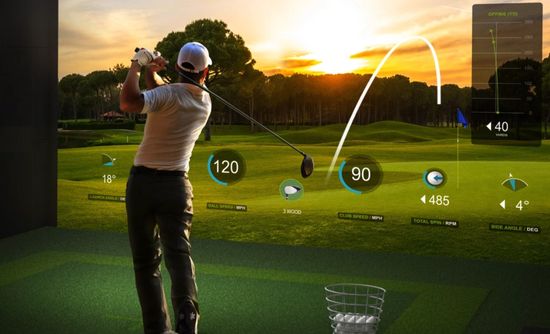
The short-throw lens, excellent input lag of 33.6 ms and smooth, accurate reproduction of the ball’s trajectory make it one of the best simulators in the industry. Light output up to 3,600 lumens provides rich green hues, creating the illusion of a real golf course.
Golf mode adjusts colors in real time for a more visually appealing view of obstacles and green types.

This feature makes ball tracking easier and brings the visualization closer to actual afternoon at the golf club. Furthermore, the projector can project a square 1:1 aspect ratio that is convenient for tee-off simulations. It also supports a 5:4 aspect ratio for a shooting simulator.
This model also supports multi-projection mode. It combines images from multiple projectors and is convenient for creating a picture wall or a school digital art project. Factory-calibrated white levels ensure a roughly uniform color palette, simplifying edge blending.
Resolution
The projector creates 4K image using a 0.65-inch DLP imaging chip, whose native resolution is only Full HD (1080p). To increase resolution, the developers DMD with XPR tech (pixel shifting) from Texas Instruments. Its operating principle is simple and elegant. The projector receives 8 million pixels of 4K content, divides them into four parts of 2 million each, and sequentially displays four 1080p images, shifting them diagonally by half a pixel relative to each other. Due to the high frequency, our brain perceives them as a single image with a higher resolution. Pixel shift is carried out by tilting the lens using 4 XPR module electromagnets.
Unfortunately, the projector does not use a chipset with the new High Efficiency Pixel (HEP) architecture architecture from TI, which was introduced in a SPIE conference on March 13, 2024.
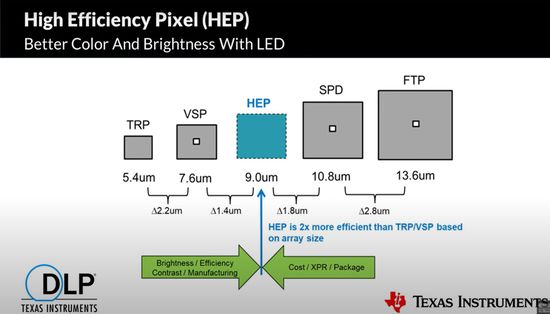
It’s the first new pixel architecture for DLP models since 2013. It was developed to optimize LED and RGB light engines in DLP projectors by increasing optical efficiency and expanding the color gamut. The improved architecture uses a slightly larger pixel pitch of 9.0 µm and supports micromirror tilt of ±14.5° for maximum light capture. The larger mirrors, wider tilt angles, and higher stiction margins allow developers to use more powerful LEDs and lasers.
Pros
– improved light throughput with larger pixel area and wider mirror tilt (5000+ lumen LEDs);
– enhanced contrast & color (up to 123% of the Rec. 709 color space in Digital Projection’s E-Vision series);
– resolution increase from 1080p up to UHD/4K with four-way pixel shifting;
– hermetic package and higher operating margins suppot higher optical power density.
Today this technology is implemented only in premium home theater and professional projectors, including, for example, XGIMI’s Titan.
BenQ LU895UST
Pros
– 5,000 ANSI Lumens brightness (IT7.228);
– compact – (13 x 33 x 33 cm)@4.5 kg;
– bluetooth and app control.
Cons
– no Wi-Fi;
– WUXGA (1,920 x 1,200) resolution only.
Just a few years ago, $ 3,500 for a projector with brightness of up to 5,000 lumens and ultra-short throw optics and an accurate multi-projector mode was considered dumping. But competition does its useful work and today this price is quite adequate to market conditions.
The BenQ LU895UST is designed primarily for simulations, museums, and commercial installations. Therefore, the developers limited themselves to WUXGA (1,920 x 1,200) resolution only, forgoing the use of a DMD (Digital Micromirror Device) chip with XPR tech from Texas Instruments with 4K support.
As known, ambient light makes images appear dull and washed-out. The brightness compensates for its impact, producing rich and vibrant colors even in daylight. In fact, the high brightness reduces the requirement for room darkening during viewing.
The dimensions and weight (13 x 33 x 33 cm) / (12.9 x 5.2 x 12.9 inches)@4.5 kg / 9.9 lbs) are significantly lower than its UST counterparts, which often weigh over 10 kg.
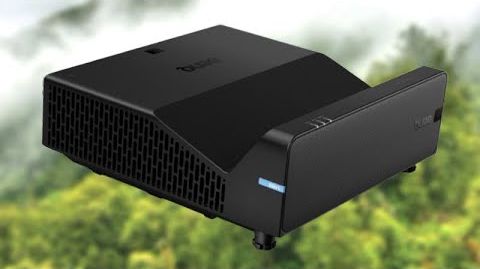
This is its main difference from similar models, including the BenQ LH890UST – (50 x 16.5 x 39.9 cm)@9.1 kg, and LU960UST with weight and dimensions (48 x 16.3 x 47.3 cm)@12 kg.
Laser phosphor light source uses ALPD 3.0 – based tech. Light output from a bank of blue lasers is directed onto the rotating phosphor disc. Part of the blue to pass through unchanged. The phosphor disc converts part of the laser output into yellow. Than all beams are directed at the color wheel that bounces sequential pulses of blue, yellow, green and red to the 0.67-inch DLP imaging chip.
Key features
Traditionally for UST projectors, the LU895UST doesn’t have optical zooming or mechanical image shifting. It has a manual focus slider and digital setting. In addition, the model offers 14° horizontal and 15° vertical keystone correction. The 0.253:1 throw-ratio optics form 100″@0.54 m / 21″.
Excellent cooling ensures 24/7 operation without overheating. However, effective cooling requires 20 inches of clearance all around. Its sealed optics don’t require an additional dust filter. However, BenQ offers an optional filter for $50.
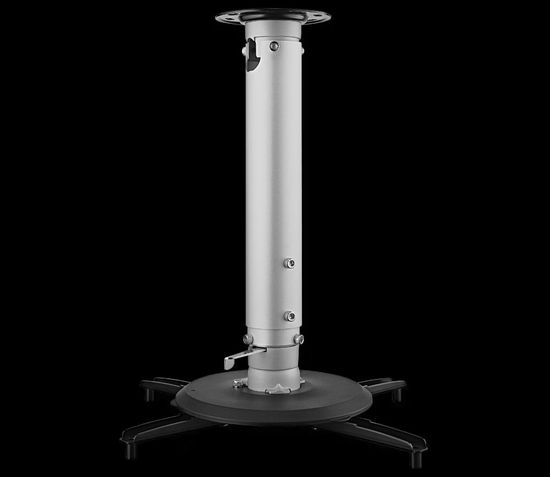
The BenQ CM00G3 Ceiling Mount, priced at $80, has a 16-23-inch extension pipe, provides 360-degree rotation, and 25-degree forward-backward tilt.
The list of picture modes includes (ISO 21118, ANSI Lumens):
– Bright ~ 5,420;
– Simulation ~ 3,980;
– sRGB ~ 3,510;
– Presentation ~ 4,580;
– Vivid ~ 4,370.
In Bright mode, the projector’s brightness is much higher than stated in the specs, but the color accuracy is traditionally distorted.
The Presentation and Vivid are designed for business or educational graphics.
The sRGB mode is traditionally the most accurate. With a slight reduction in brightness, it provides a more neutral color balance. Like the LK830ST, the model comes with factory-calibrated white level.
Support for 4:3 and 16:10 aspect ratios enhances the model’s versatility. Furthermore, it offers 21:9 format from Microsoft Teams for increasing the number of video conferencing participants in the frame.
BenQ plans to offer an optional $ 100 USB Bluetooth dongle. It will connect via USB and work with the company’s InstaControl app. According to the company, it will be able to adjust the screen, change the volume, and select the signal source. Unfortunately, the dongle won’t be able to send audio to wireless speakers.
In addition, the LU895UST supports 3D video with shutter glasses.
Conclusion
The Taiwanese company has successfully expanded its line of projectors with the BenQ LK830ST and BenQ LU895UST models, priced at $ 2,500 and $ 3,500. Both models offer superb brightness of 4,000 and 5,000 ANSI lumens, respectively, eliminating the problem of darkened viewing environments. At the very least, color dullness due to diffused daylight are virtually eliminated.
Furthermore, the short-throw LK830ST with a throw ratio of 0.50:1 and the ultra-short throw LU895UST with a throw ratio of 0.25:1 provide 100-inches image diagonal from 1.1 m and 0.54 m, respectively, significantly simplifying projector installation.
Moreover, BenQ LK830ST offers one of the best golf simulators in the industry, and LU895UST with weight and dimensions only (13 x 33 x 33 cm) / (12.9 x 5.2 x 12.9 inches) @ 4.5 kg / 9.9 lbs) has become the most compact and bright UST projector.
Finally, projection mapping and multi-projection mode triumphantly round out the list of key bonuses.
Unfortunately, the WUXGA (1,920 x 1,200) resolution of the LU895UST and the lack of Wi-Fi in both models add a small fly in the ointmentfly. But at prices of $ 2,500 and $ 3,500 for the ultra-bright model, these are insignificant. Overall, both projectors are equally good for business, education, large gatherings, and as a secondary TVs.
Video offers house projection mapping tutorial for BenQ projectors.