
China’s technology XGIMI Technology Co (formerly Chengdu XGimi Technology Co., Ltd.) was founded in 2013 and is headquartered in Shenzhen, Guangdong Province. Today, this brand is well known among experts in the modern projection systems segment. The company is listed as an innovative industry leader, and its products compete successfully in more than 100 countries and regions, including the United States, Europe, and Japan. Therefore, interest in its new products is fully justified. Of course, the HORIZON 20/20 Pro/20 Max and Titan/Titan Noir Max rightfully top the list of the most interesting new products.
Today, the 20 Max costs ~$ 2,350, delivers a maximum brightness of up to 5,700 ISO Lumens, superb contrast up to 20,000:1 with Dynamic Black Level Enhancement (DBLE) technology, and covers 110% of the BT.2020 color space with triple-laser RGB light engine. Consequently, its superb price-quality ratio earns it a place on most top lists.
Titan’s success is no less spectacular. The company presented its first full-size crossover projector Titan at IFA 2025.
It’s equally perfect for office, church, or school and as a Home Theater.
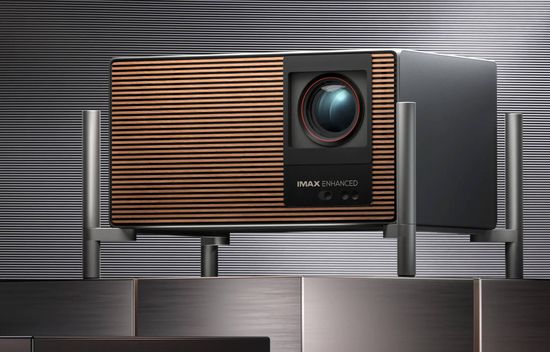
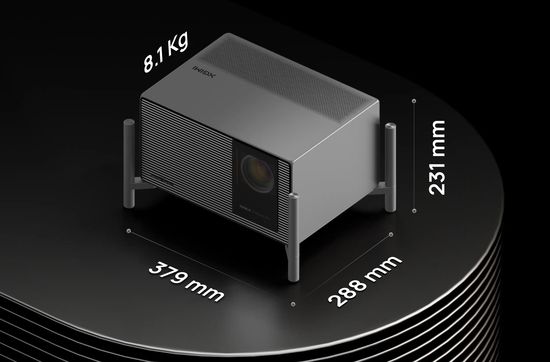
This model with dimensions and weight (15.9 x 6.1 x 12.4-inch)@25.4 lbs / (44 x 16 x 34 cm)@11.5 kg has become the largest and heaviest in XGIMI’s lineup. All black body in a strict minimalist style with screw-on outrigger legs designed for installation on a tabletop, shelf, or niche gives the projector a slightly futuristic look.
However, the company also sells Ceiling Mount Ultra and Floor Stand Ultra. Currently, the model costs ~ $ 4,000 with brightness up to 5,000 ISO lumens.
Building on this success, the company introduced the announced XGIMI TITAN Noir Max with brightness up to 7,000 ISO lumens.
XGIMI Titan Noir
This series was launched on a Kickstarter campaign in March 2026. This lineup includes the Titan Noir, Titan Noir Pro, and the flagship Titan Noir Max. The enthusiasm of potential owners enabled the company to raise an unprecedented $5 million in an hour and $10 million in the first week. According to preliminary data, the flagship Titan Noir Max is currently scheduled to begin shipping in June 2026. The special launch price is $2,999, which is 50% off the MSRP of $5,999.
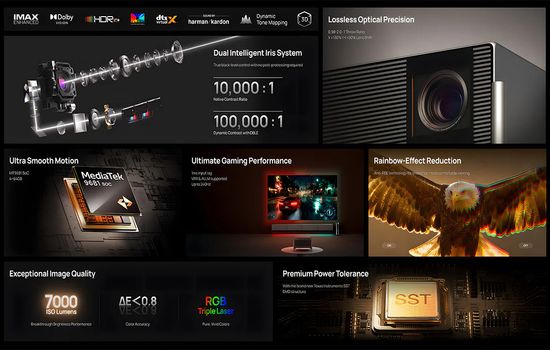
Considering the RGB triple-laser light source with wide color gamut of up to 110% BT.2020, 7,000 ISO lumens of brightness, a superb contrast with Dynamic Black Level Enhancement (DBLE) and dual iris, anti-RBE (rainbow effect), the model offers superb value-quality ratio. Variable refresh rate (VRR), motorized focus, zoom, horizontal and vertical lens shift complete the list of premium options. Finally, the company promises to add Lens Memory via an OTA (over-the-air) firmware update.
In fact, Titan Noir Max is a flagship 4K DLP projector with premium specs, RGB triple-laser light engine and new Texas Instruments’ SST 0.47-inch DLP DMD chip.
Pros
– higher contrast and brightness. Moreover, it’s compatible with the new MT9681 SoC, which supports 4K@120Hz, MEMC (motion interpolation), VRR, and ALLM;
– support for Texas Instruments’ XPR (eXpanded Pixel Resolution) technology, providing 4K UHD (3,840 x 2,160) resolution due to pixel-shifting;
– 4K@60Hz and 1080p@240Hz gaming;
– increasing brightness and compactness due to bottom and corner illumination architectures;
– 2x optical zoom and throw ratio from 0.98:1 to 2.0:1;
– compatibility with highly integrated chipsets, including, for example, the DLPA3082/DLPA3085 Power Management ICs (PMIC) and LED drivers;
– motorized focus and lens shift (±130-percent vertical and ±50-percent horizontal).
Unfortunately, autofocus is not always perfect.
Performance
The Titan Noir Max offers Standard, Movie, Sports, Filmmaker Mode, ISF Day/Night and Performance picture modes, and the ability to create Custom modes. In addition, in Custom mode, settings for each input are saved separately for SDR and HDR. In fact, the user can create separate configurations for SDR and HDR content. Unfortunately, they are not common to all HDMI inputs, requiring individual ones for each of them. In addition, the laser brightness mode is common. But ’10+’ setting is not available for IMAX Enhanced.
Basically, these names are also used for HDR modes, including HDR10 and HDR10+. For example, HDR10 also offers IMAX Enhanced mode. Additionally, Dolby Vision includes Dolby Vision Bright and Dolby Vision Dark. For gamers, the projector offers game-based Standard, FPS, RPG, RTS, and Sports modes.
Titan Noir Max uses standard controls for brightness, contrast, saturation, sharpness, and gamma. But this list does not include tint/hue control. The model uses standard gamma 2.2, 2.3, and 2.4 values.
The projector has Standard, Movie, and D65 color temperature presets.
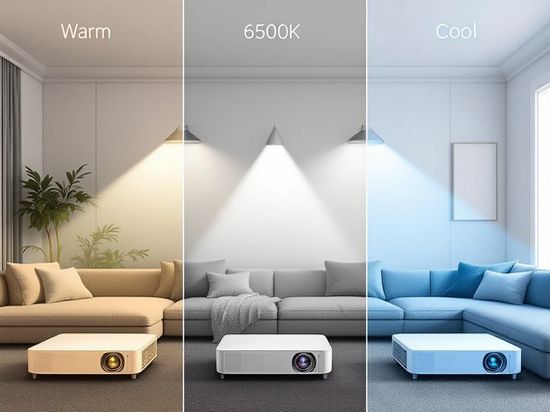
Standard produces a cooler (bluer) image, Movie offers balanced colors with a slight blue shift, and D65 adds some red and green, creating a warmer picture. Standard produces a cooler (bluer) image, Movie offers balanced colors with a slight blue shift, and D65 adds some red and green, creating a warmer picture.
The Noir Max has CMS (color management system), 2-point and 11-point white balance controls. These are unique to each picture mode, allowing calibration enthusiasts to select the ideal settings.
With the exception of heavily green-biased Performance mode, the out-of-the-box color accuracy is quite consistent with the premium segment.
Honestly, most owners can ignore the additional calibration. However, a huge number of adjustments allows perfectionists to strive for ideal.
Titan Noir Max contrast
Like Horizon 20, Titan also has a Dynamic Black Level Enhancement (DBLE) feature. Essentially, it’s AI-based software that improves perceived contrast in dark scenes. Unfortunately, DBLE can partially distort shadow detail. However, this problem is significantly less pronounced than in some dynamic dimming systems due to clipping.
DBLE pros:
– Frame-by-Frame analysis continuously scans the brightness and contrast of content to adapt in real time;
– True Blacks and Shadow Detail.
DBLE prevents dark scenes from looking washed out or noisy by modulating the light output. In fact, it brings out layered textures in shadows, eliminating their loss;
– HDR Enhancement.
In fact, DBLE acts as a dynamic tone mapping, simultaneously combining both extremely bright highlights and black areas.
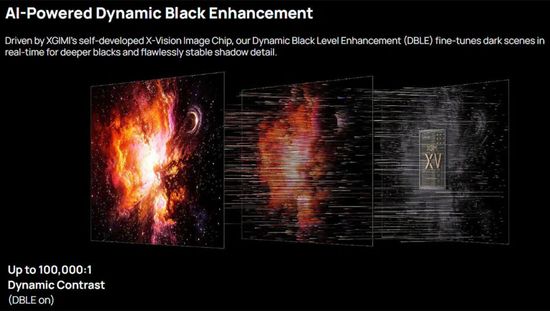
It offers cinematic contrast with suberb blacks, but can create minor color temperature shifts during rapid scene changes.
The Dual Iris system complements the DBLE effect, further enhancing contrast. Unlike DBLE’s AI-based algorithms, it regulates the physical light entering the system. The operation of the two diaphragms is synchronized with the RGB light sequence and the DMD chip. The first diaphragm controls the overall output brightness of the lasers, while the second, located closer to the lens, regulates the flow of light onto the screen.
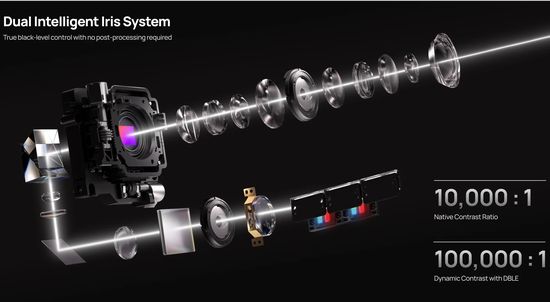
As a result, the interaction of the innovative DBLE and Dual Iris provide excellent contrast and is one of the main bonuses of the new series. The projector has a fairly high native contrast of 2,200:1, which is typical for single-chip DLP systems. The DBLE and dual iris systems increase the FOFO (full on, full off) contrast to an unprecedented 20,000:1 and even more. Specifically, depending on the throw distance, iris settings, and DBLE configuration, the model demonstrated a maximum contrast of over 20,100:1.
Main specs
The specs list a brightness of up to 7,000 ISO lumens, which formally matches the Performance picture mode test results. Moreover, the brightness in tests for this mode sometimes exceeded 8,500 and reached 9,500 ANSI lumens. However, this image quality is unlikely to satisfy most viewers due to the traditional strong green bias. Furthermore, the company does not recommend its prolonged use due to excessive stress. Depending on the power settings, the projector delivers high quality at a brightness of ~4,000 (Brightness 10) or just over 5,000 lumens (Brightness 10+).
Specifically, measured in Standard mode with brightness 10+ (‘Boost’ mode), the projector shows just over 5,100 lumens.
The declared wide color gamut is also confirmed by testing. The projector demonstrates ~ 95.5% for BT.2020 and 99.5% for DCI-P3, which corresponds to the modern premium segment. Unfortunately, coverage decreases by about 10% at lower brightness. However, overall color accuracy remains very high.
The Titan Noir Max delivers full UHD 4K (3,840 x 2,160) resolution using a relatively inexpensive Full HD (1080p) chipset, thanks to four-phase pixel shifting. This technology is known as Texas Instruments’ XPR (eXpanded Pixel Resolution). Its operating principle is simple and elegant. The projector receives 8 million pixels of incoming 4K content, divides them into four parts of 2 million each, and sequentially displays four Full HD frames offset by half a pixel diagonally.
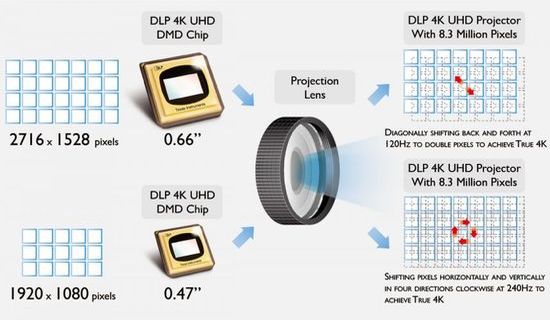
Due to the high frequency, our brain and eyes perceive the four offset frames as a single image with a higher resolution. Pixel shift is achieved by tilting the lens using four electromagnets in the XPR module.
XGIMI Titan vs Titan Noir Max
Image Processing and chip
– XGIMI Titan uses a 0.78-inch DMD chip with a ±17° mirror tilt angle;
– Titan Noir Max has a 0.47-inch chip with a ±14.5° tilt angle and more advanced optics. It more precisely controls stray light and significantly increase black levels for improved contrast.
Light Control and Contrast
– XGIMI Titan is equipped with a fixed optical system without complex additional mechanisms;
– Titan Noir Max became the first model with Intelligent Double Iris, which is matched to a laser light source. In fact, the dual aperture diaphragm system physically limits the light flux in dark scenes.
Brightness
Both models deliver an unprecedented brightness for DLP projector that exceeds 5,000 ISO lumens. Furthermore, the Noir Max can increase brightness by approximately 10% without color distortion wth optional 10+ mode.
Connectors
Both projectors have a basic set of ports, including 2 x HDMI and an optical audio output. The new model is additionally equipped with HDMI and RJ-45 ports for easier integration into smart home systems and AV racks.
The Titan models are ideal for gaming.
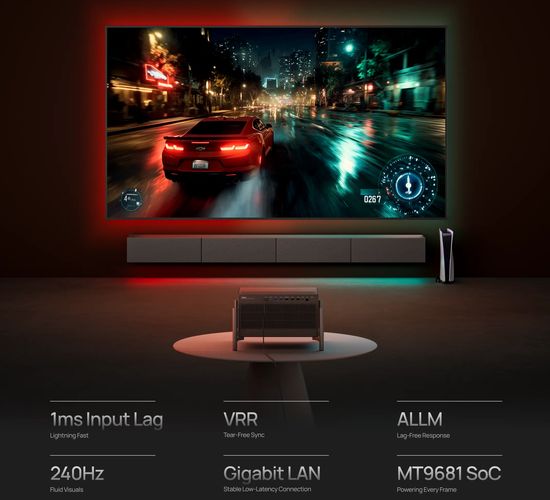
According to the specs, their input latency is only 1 ms at 1080p@240Hz. Measured для Titan Noir Max values:
~ 7 ms at 1080p@120Hz;
1 ms to 4 ms at 1080p@240Hz;
~ 9 ms at 4K@60Hz;
7 ms / 6 ms at 4K@120Hz.
It also supports VRR (Variable Refresh Rate), AMD FreeSync, and ALLM (Auto Low Latency Mode). In addition, the projector offers game modes, whose picture modes are adapted to games of different genres. In fact, this feature makes the Titan Noir Max a gaming model.
Some key features
The Titan Noir Max is a single-chip DLP projector and displays colors sequentially. As known, this technology is accompanied by a rainbow effect (RBE). But the anti-RBE feature demonstrates high performance, almost completely eliminating its visualization.
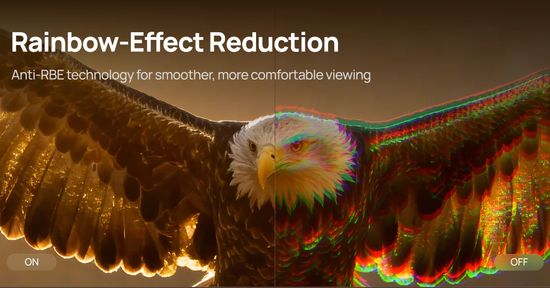
Unfortunately, activating this option can create visual artifacts that become noticeable in lower-luminance scenes.
XGIMI uses its own X-Vision chip, for which the company developed an AI-based image controller.
XGIMI’s proprietary X-Master Red Ring Lens Pro optics are rightfully considered one of the best in the industry. Its 15-element optical path and a 50-laser-chip of RGB triple-laser engine to minimize speckle. In addition, the innovative lens reduces color distortion and provide wide BT.2020 color gamut. Of course, the system does not completely eliminate does speckle, but it‘s significantly more effective in reducing them compared to other triple laser projectors.
The Titan Noir Max features Dynamic Tone Mapping (DTM), which handles bright content in the 1,000 to 2,000 nits range exceptionally well. Additionally, the model supports screen size and screen gain selection, choosing the optimal settings. As a premium projector, the Titan Noir Max supports HDR10+, Dolby Vision, IMAX Enhanced, and Filmmaker Mode.
The Titan Noir Max uses a Harman/Kardon sound system with two 12W speakers. Support for DTS Virtual:X produces a fairly full sound, the quality of which is excellent for a small model. Of course, music lovers are unlikely to be satisfied, but the built-in eARC port easily solves this problem with an external soundbar.
Conclusion
Pros
– brightness up to 7,000 ISO lumens;
– gamut coverage up to 110% of BT.2020;
– FOFO contrast up to 20,000:1;
– motorized zoom and lens shift;
– 1ms input lag at 1080p@240Hz;
– dual iris.
Cons
– DBLE crushes shadow detail;
– posterization in some scenes (visualization of transitions between shades);
– sometimes imperfect displaying 24Hz content;
– rainbow effect in some scenes and artifacts with anti-RBE.
The Chinese company has once again successfully proven its right to a place among the innovative leaders of the industry. Indeed, the innovative DBLE tech and Dual Iris system provide an unprecedented 10,000-20,000:1 FOFO (full on, full off) contrast and up to 100,000:1 dynamic contrast.
Both projectors deliver ~5,000 ISO lumens without color shift. Moreover, the new model exceeds this value in 10+ mode. Today, such brightness with high color accuracy quite reasonably lays claim to an industry record.
Newest XGIMI’s X-Vision chip, X-Master Red Ring Lens Pro optics, Dynamic Tone Mapping, motorized focus, anti-RBE system, VRR and 3D support, input lag ~ 1ms at 1080p@240Hz and other bonuses triumphantly complete the list of premium options.
Given the sale through Kickstarter, price comparison is not yet relevant. Last year’s TITAN today costs ~$ 4,000. The special launch price of the Titan Noir Max is $ 2,999, but the MSRP is $ 5,999. Thus, the bonus for Kickstarter fans reaches almost 50%. For skeptics of this sales technology, the additional $ 2,000 ($ 4,000 vs. $ 6,000) for a slight increase in excess brightness seems excessive.
The video shows XGIMI Titan Noir series with wordl’s first Dual Intelligent Iris and DBLE systems.