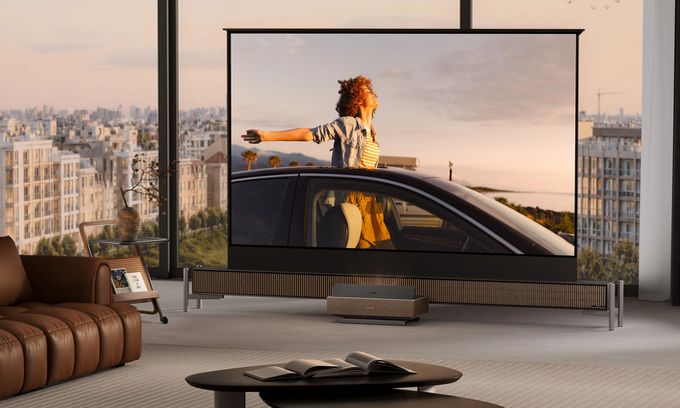
Ultra short throw (UST) design in projectors has become a important bonus in their competition with traditional televisions. In fact, they eliminated the main problem of mid-focal models, whose throw distance is several meters. Accordingly, they should be located approximately in the center of the room. But this creates the problem of wires on the floor. Of course, a ceiling mount solves this problem, but it radically limits the projector’s mobility. Laser, LED and hybrid solid-state light sources, high-efficiency screens, contrast-enhancing technologies, and wireless content transmission have further boosted the competitiveness of projectors vs traditional TVs. But above all, they were drastically uncompetitive on price. Indeed, 100-inch TVs started at $ 10,000, effectively shutting out the mass market. Meanwhile, the market was already well-stocked with excellent projectors offering high quality for just a few thousand dollars. In fact, superior brightness and contrast remained TV’s final trump card.
But the triumph of UST projectors was short-lived. Unwilling to lose a promising market segment, TV manufacturers focused their efforts on 100-inch models. Within just a few years, the market was flooded with relatively affordable TVs starting at $ 2,000.
Today, virtually all industry leaders, including Samsung, Hisense, LG, Sony, and TCL, offer a range of 100-inch TVs.
This shift largely devalued the ‘giant screen’ as the projector’s primary selling point. But projector’s manufacturers refused to give up and fought back by radically improving image quality through new technologies. Dual-DLPC tech from Texas Instruments (TI) could become a powerful trump card in the competitive landscape. Tuday it implemented in the JMGO IRIS Ultra/Ultra Max and the new flagship XGIMI AURA 3 Max/Pro.
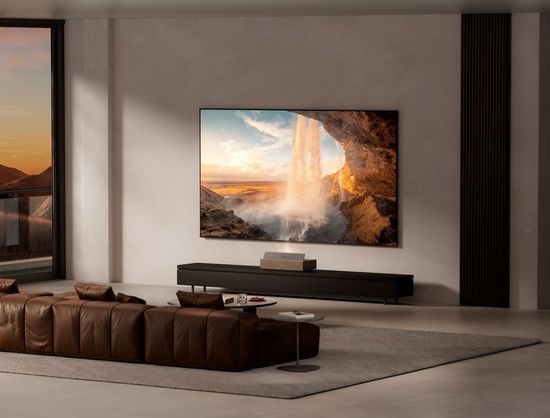
These models were announced for the US market in August 2026, with a Kickstarter launch planned next.
UST projector vs laser TV
The company markets its 4K UST (ultra-short throw) AURA 3 projectors as ‘laser TVs.’ This aspect requires some clarification.
As known, image quality depends significantly on the screen. To avoid risking their reputations by failing to deliver the promised quality, many companies initially sold UST projectors with ALR (ambient light rejecting) or CLR (ceiling light rejecting) screens. Of course, they significantly improve image quality, but unfortunately, they also substantially increase the projector price.
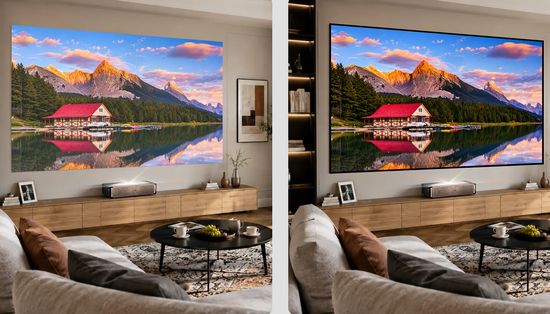
The companies began labeling these laser-based models ‘laser TVs.’ Many physicists likely winced at the term, rightly viewing it as a marketing ploy. But formally, any projector could be positioned as a TV with a screen outside the housing.
However, this practice gradually fell out of favor for obvious reasons. Indeed, the lucky owner might already have a screen from a previous projector, or have won one in a lottery or received one as an inheritance. Finally, the buyer’s budget might only be enough for the projector itself, and he could buy the screen after receiving his bonus. Today, with few exceptions, manufacturers offer the screen as an optional extra.
Nevertheless, the term ‘laser TV’ has persisted. It later came to be used for models featuring a built-in TV tuner. However, over time, most premium projectors began to come with a built-in ATSC or DVB-T2/S2, eliminating this distinction.
In fact, smart features remain the last difference. ‘Laser TVs’ run smart TV operating systems (like VIDAA or Android TV). UST projectors use external streaming devices (Apple TV, Roku, Fire Stick), cable boxes, or gaming consoles connected via HDMI to get television signals.
The XGIMI AURA 3 Max/Pro come with an ALR screen and Google TV pre-installed, but without a built-in tuner. Therefore, strictly speaking, they are laser projectors.
Key features
Of course, the new architecture became the main highlight of the new series. It utilizes two specialized TI DLPC display controllers. They operate in parallel to control a single micromirror array of the DMD (Digital Micromirror Device). TI developed this system to enable 4K@120Hz playback without compromising quality. It’s currently featured in the XGIMI AURA 3 and the JMGO Iris.
Standard DLP projectors use a single DLP Digital Controller (DLPC) to process the incoming video signal and manage the switching of the millions of micromirrors on the DMD chip. However, the bandwidth of a single chip is insufficient to handle the massive volume of data required for 4K@120fps playback.
Distributing tasks between two controllers solves this problem.
Pros:
– doubling the controller processing power enables real-time handling of even demanding, fast-paced content;
– Dual-DLPC minimizes the ‘rainbow effect’ (fest motion artifacts);
– splitting the data stream enhances the performance of VRR (Variable Refresh Rate) and ALLM (Auto Low Latency Mode) technologies;
– two controllers accelerate dynamic contrast algorithms (XGIMI DBLE tech).
According to the company, the XGIMI AURA 3 is one of the first DLP projectors to achieve 4K@120Hz playback quality comparable to that of high-end LCoS projectors with native 4K resolution. However, the latter cost twice as much. For example, the most ‘budget-friendly’ Sony VPL-XW5000ES costs ~ $ 6,000.
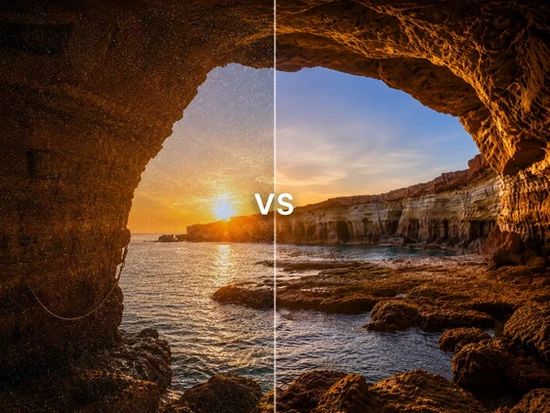
Superb contrast both models provide with a dual-iris system (frame-by-frame optical control of light) and Dynamic Black Light Enhancement (DBLE) tech. For reference, DBLE involves the dynamic control of black levels and laser illumination. It performs frame-by-frame analysis and adjusts laser power in the dark scenes.
The built-in 80W Harman Kardon audio system with Dolby Atmos and DTS Virtual:X support will satisfy most music lovers and save them money on purchasing a soundbar.
XGIMI AURA 3 vs competitors
Both models utilize identical optics (9 lenses), Harman Kardon audio system, Dual Dynamic Iris, the X-VISION AI processor and have the same form factor ((588 x 138 x 295 mm)@9.40/8.90 kg).
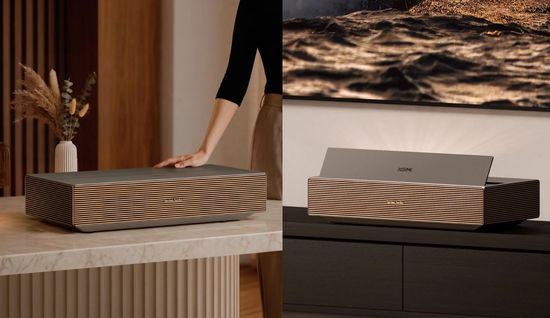
But the Max is slightly heavier due to differences in the optical unit components and the laser light source. Price (Super Early Bird $ 2,199 vs $ 1,999), brightness (5,700 vs 4,100 ISO lumens) and contrast (8,000:1 vs 7,000:1) are the main differences between the models.
Comparison of XGIMI AURA 3 with the most formidable UST rivals demonstrates their superb competitive ability.
AURA 3 Max vs Hisense L9H vs Samsung LSP9T
– Price – $4,999 (MSRP) / Super Early Bird – $2,199 / Kickstarter – $2,399 vs $5,499 / €4,990 (MSRP), Street – $4,497.97 – $5,497.97 depending on the size of ALR screen (100″ or 120″) vs $6,499 (MSRP) / $5,499 – $5,998 (USA), ~ €5,999 – €7,436 / £4,759 (Europa);
– Light Engine – Pure RGB Triple-Laser vs TriChroma RGB Triple-Laser vs Triple-Laser;
– Peak Brightness ~ 5,700 vs 3,000 vs 2,800 ANSI Lumens;
– Native Contrast ~ 8,000:1 (Dual-Iris) vs ~1,000:1 – 3,000:1 (dynamic) vs 1,500:1 (native) / 2,000,000:1 (dynamic);
– Color Gamut – 110% Rec.BT.2020 vs 107% BT.2020 vs 106% BT.2020;
– Throw Ratio – 0.163:1 (100″@12.8cm) vs 0.25:1 (100″@32.7сm) vs 0.19:1 (100″@11,3cm);
– Gaming – 4K@120Hz, 1ms, VRR, ALLM vs Standard 4K@60Hz, ~30ms lag vs Standard 4K@60Hz, Game Mode;
– Optical Glass Elements – 19 Optical Elements vs High-Grade Glass Array vs Precision Glass Assembly;
– HDR Support – Dolby Vision, HDR10+, IMAX, HLG vs Dolby Vision, HDR10 vs HDR10+, HDR10.
An analysis of prices and key specs demonstrates XGIMI’s compelling advantage in terms of the price-to-quality ratio.
Conclusion
Once again, XGIMI reaffirms its status as one of the industry’s innovation leaders. XGIMI AURA 3 and JMGO IRIS Ultra became the first DLP projectors with Dual-DLPC tech from Texas Instruments.
This architecture utilizes two dedicated TI DLPC display controllers that work in parallel to drive a single Digital Micromirror Device (DMD) array. Primarily, it’s designed to deliver lossless 4K@120Hz playback in premium laser DLP. Today, the image quality of 4K DLP models with XPR tech (pixel shift) is inferior to LCoS projectors with a native 4K resolution. This aspect partially compensates for the impressive twofold and more price difference. For example, the price of the ‘entry-level’ Sony VPL-XW5000ES SXRD (Sony’s LCoS version) stands at $ 6,000. The manufacturers of XGIMI AURA 3 and JMGO IRIS promise similar quality for 4K@120Hz at a much lower price. Superb contrast up to 8,000:1 with a dual-iris system and DBLE tech, peak brightness up to 5,700 / 3,000 ANSI Lumens and UST design triumphantly complete the list of main XGIMI AURA 3’s bonuses.
The JMGO IRIS with similar dual-DLPC display controllers and is a very serious competitor, but it’s mid-focal. Of course, its unprecedented motorized AI gimbal greatly simplifies its placement, but the problem of the power cord on the living room floor remains. Considering their approximately the same price, UST design can be a decisive argument in favor of the XGIMI model.
In any case, fans of large-screen imagery get a new class of relatively affordable DLP projectors with full support for 4K@120Hz.
This video introduces the new XGIMI AURA 3 Laser TV with 4K@120Hz support and Dual Iris.