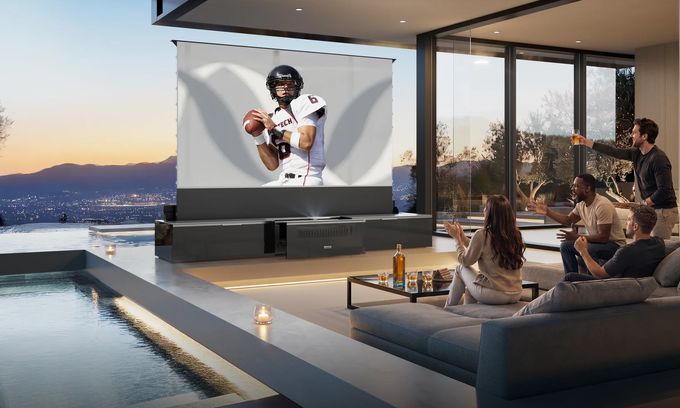
To be fair, the popularity of the American AWOL brand still lags somewhat behind industry giants such as Japan’s Epson, South Korea’s Samsung, or China’s Hisense. Nevertheless, in just a few years, the company has already established itself in the home video electronics segment.
AWOL Vision was founded in Delray Beach, Florida, in 2020. Today, it’s a prominent American brand specializing in advanced 4K ultra-short-throw (UST) laser projectors, home cinema systems, and related ecosystems (such as screens and audio equipment).
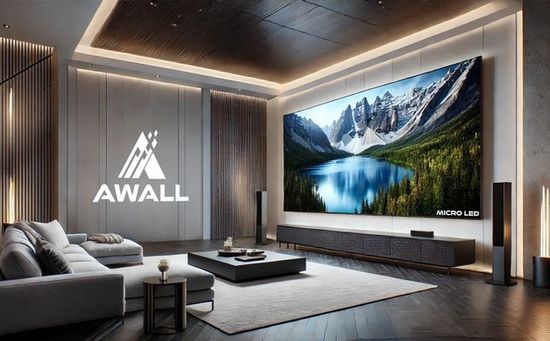
In late 2024, it created a separate brand, AWALL, under which it produces modular MicroLED Chip-on-Board (CoB) displays for luxury home theaters. Their size varies from 75 to 300 inches or more, and prices start at $16,250. For comparison, the Samsung ‘The Wall All-in-One’, which uses similar technology, costs $70,000–$80,000 (110″, 2K / Full HD).
In 2026, the company has already introduced 4K UST triple-laser DLP Vision Aetherion Pro and Max projectors with brightness levels of 2,600 and 3,300 ISO lumens. Today their prices range from approximately $ 2,700 to $ 3,500 and $ 3,500 to $ 3,600, respectively.
Not content to rest on its laurels, the company unveiled its flagship 4K UST laser projector, the AWOL LuxVision, at IFA 2026. This model features a 120Hz refresh rate, optical lens shift and provides up to 6,000 ISO lumens brightness. Its MSRP (Manufacturer’s Suggested Retail Price) is around € 6,000 / $ 6,500.
Resolution and brightness
Main specs
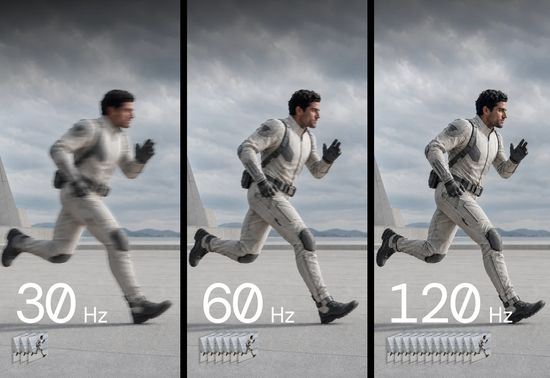
– resolution and refresh rate: 4K@120Hz – supports smooth motion without blur or artifacts.
4K resolution is achieved using a Texas Instruments (TI) DMD (Digital Micromirror Device) chip that supports XPR (Expanded Pixel Resolution) tech. Its operating principle is both simple and elegant. The projector takes an 8-million-pixel 4K image and breaks it down into four Full HD frames, each containing 2 million pixels. It then displays these frames in succession, shifting each one diagonally by half a pixel relative to the others. While the native resolution of the relatively affordable DMD chip is only Full HD (2 million micromirrors).
Strictly speaking, at any given moment, a projector displays only a single Full HD image. But due to the high frequency, the brain perceives four Full HD images as a single image with a higher resolution. This shifting is accomplished via an XPR module, which uses electromagnets to rapidly change the tilt angle of the lens;
– brightness: 6,000 ISO lumens.
As known, ambient light causes an image to appear dull and washed out.
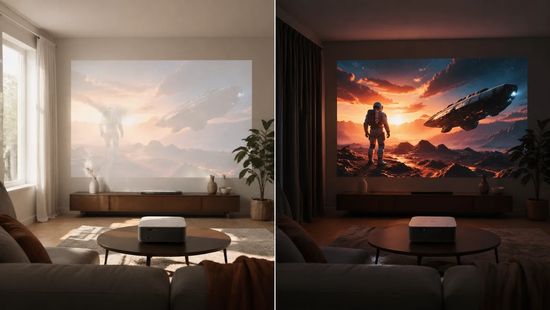
High brightness compensates for this negative effect. The watching in a dark room or with blackout curtains drawn can solve the issue, it also limits convenience. High brightness ensures a high-quality image even in the presence of ambient daylight.
For reference, current industry standards for high brightness are as follows:
– 2,000–3,000 ANSI lumens are sufficient for comfortable viewing even during the day with moderate light control (e.g., with curtains drawn);
– 3,000 – 4,500 ANSI lumens compensate for even the light being on and are sufficient when using the projector as a TV.
Furthermore, using a specialized ALR (Ambient Light Rejecting) screen can further reduce brightness requirements;
– professional-grade models: 4,000–6,000 ANSI lumens.
Key features
Other aspects of the new projector also align with a premium standard. This list includes:
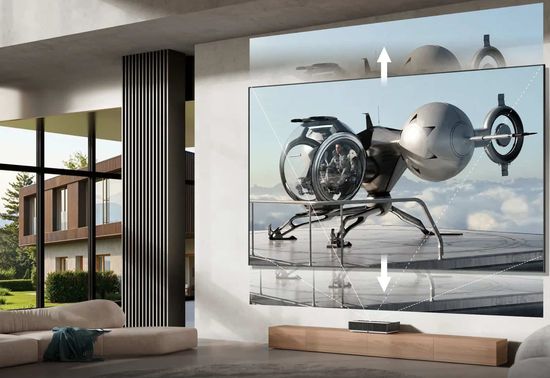
– seamless vertical optical image shift.
This feature is being used for the first time in an UST projector. It allows the projected image to be shifted vertically (range of 142–152%) without any digital scaling or cropping, and with no resulting image distortion;
– сolor gamut: 110% of the Rec.2020 color space, with support for Dynamic Tone Mapping (DTM), Dolby Vision, HDR10+, and IMAX Enhanced;
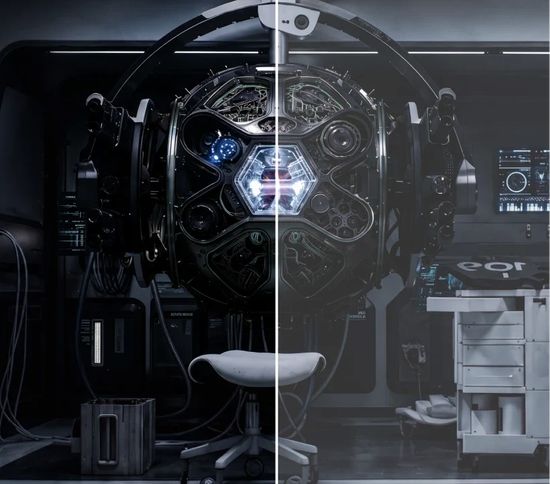
– contrast and black levels: native contrast of 10,000:1 (up to 100,000:1 dynamic), featuring a 7-level Dynamic Iris and the Gen 3 EBL algorithm to enhance the rendering of dark scenes without flickering
– multi-screen capability (MultiView): a built-in MultiView function supports display area equivalent to four 75-inch TVs.
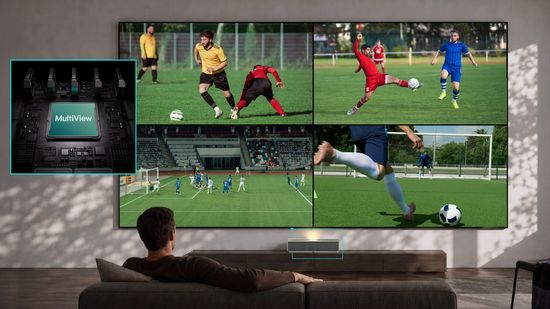
– throw ratio: 0.18:1 (minimal distance to the screen ~15–19 см).
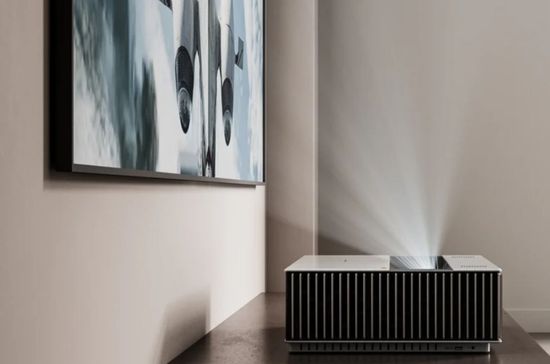
This aspect is one of the primary drivers behind the rapid rise in popularity of UST projectors. By utilizing a complex system of lenses and aspherical mirror, they create a massive projection from a very short distance. Consequently, they can be placed almost flush against the wall where the screen is mounted, eliminating one of the main drawbacks of mid-focal models. Typically they have a throw ratio ranging from 1.2:1 to 2.0:1, requiring a throw distance of several meters. But placing it in the middle of a room creates issues with power cables running across the floor. The ceiling mounting solves this problem, but radically limits the projector’s mobility. An owner is unlikely to dismantle a complex ceiling mount just to watch a baseball game in the backyard with friends. UST models fundamentally do not have placement problems.
Audio, gaming and screen
Audio
Aetherion Max has 2x 25W (full-range speakers) + 2x 20W tweeters, Dolby Atmos and DTS:X. LuxVision offers 80W Harman Kardon audio system, Dolby Atmos, DTS-HD, Dolby TrueHD, and DTS-HD Master Audio.
Gaming
Both models offer input lag of ~1 ms, with support for VRR (Variable Refresh Rate) and ALLM (Auto Low Latency Mode) via HDMI 2.1 interfaces. However, the AWOL LuxVision additionally supports Dolby Vision Gaming. This tech adapts HDR imagery to a projector’s capabilities in real time.
Key features:
– dynamic metadata: optimizes brightness, shadows, and colors on a frame-by-frame basis;
– compatibility: supports frame rates up to 120 fps and supports a ray tracing (DirectX Raytracing).
Screen
Unfortunately, the standard package for these models does not include a screen. However, for those who place a pre-order for a LuxVision, the company is offering an ALR screen as a complimentary bonus (LuxVision Cinema System Launch Offer). Furthermore, buyers can choose between:
– a next-generation Fresnel-lens ALR screen (100–150 inches);
– motorized floor-rising ALR screen (100–120 inches).
The impact of the screen on image quality is due to an objective factor. The UST projectors fire light at an extremely steep angle. The surface of a standard matte white screen reflects light toward the ceiling and walls, washing out contrast and creating a ‘ceiling glow’ effect. An ALR (Ambient Light Rejecting) screen with a CLR (Ceiling Light Rejecting) surface reflects the light back toward the viewer while absorbing light from above and the sides. This is primarily achieved through a complex, wedge-shaped texture on its surface.
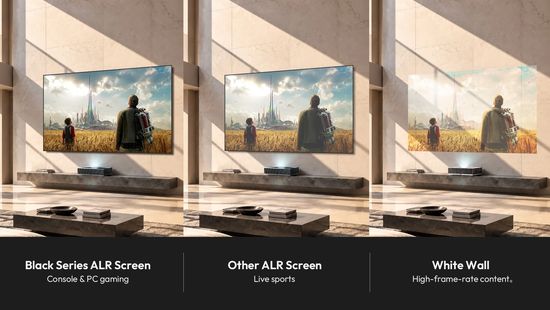
Aetherion Max vs LuxVision
In fact, LuxVision could be positioned as a more advanced version of Aetherion Max.
Both:
– Light Source: RGB Triple Laser;
– Color Gamut: 110% Rec. 2020;
– Chipset: MediaTek MT9655;
– platform and Smart TV: Google TV (based on Android 14);
– Dolby Vision Gaming, VRR (screen tearing), ALLM, and three HDMI 2.1 ports;
– RAM/Storage: 8GB / 128GB.
Differences:
– price: ~$ 5,000 vs ~$ 6,000;
– brightness: 3,300 vs 6,000 ISO Lumens;
– resolution/Refresh: 4K@60Hz vs 4K@120Hz;
– 0.47-inch DMD chip: DLP472TP with TRP (Tilt-and-Roll Pixel) architecture controlled by DLPC8445 vs DLP473TE with SST (Single-Spring Top) architecture controlled by dual controller DLPC8545 or DLPC8555;
– contrast: 6,000:1 (iris) and 60,000:1 (dynamic) vs 10,000:1 (7-level iris) and up to 100,000:1 with EBL (Enhanced Black Level);
– Optical Lens Shift: No vs Yes (vertical).
– Anti-RBE: 1st gen vs 2nd gen (Anti-RBE II).
4K@120Hz support, improved DMD chip and dual controller provide more efficient color control;
– weight and size: (562 x 323 x 139 mm) / (22.1″ x 12.7″ x 5.5″)@8.75 kg / 19.3 lb vs (616 x 357 x 148 mm) / (24.25″ x 14.06″ x 5.83″)@15.98 kg / 35.05 lb.
The LuxVision is larger and heavier due to the inclusion of a motorized optical lens shift and a more powerful cooling system;
– Input Lag: 1ms@240Hz vs ~1ms@120Hz.
An additional payment of $ 1,000 provides the following benefits:
– roughly double the brightness;
– optical lens shift;
– 4K@120Hz support (fluid motion without the judder).
Conclusion
The AWOL LuxVision is, admittedly, an expensive projector. However, its price and specs are well-aligned with the premium segment. Ultimately, its fortunate owner gains the ability to enjoy vibrant landscapes of the Serenget or the depths of the underwater world on a massive screen.
Until recently, its market prospects appeared very promising. But market conditions are shifting. Unwilling to cede this high-potential segment without a fight, TV manufacturers have focused their efforts on the category of enormous, 100-inch displays. As a result, the market is now flooded with massive 100-inch TVs, priced anywhere from $ 2,000 to $ 6,000. While a projector can deliver an image up to 200 inches, this introduces a different challenge. According to ophthalmologists, the optimal viewing distance is calculated by multiplying the screen diagonal by 1.3. Consequently, a comfortable viewing experience for a 150-inch image requires a distance of nearly 4 meters. While this might not be an issue in the lounge of a cozy oceanfront villa, accommodating such a setup in the living room of a typical urban apartment can prove quite difficult. This factor somewhat diminishes the primary advantage that projectors hold over TVs. But for consumers, healthy competition is always a joy.
The video presents AWOL LuxVision 4K@120Hz laser projector with optical shift.