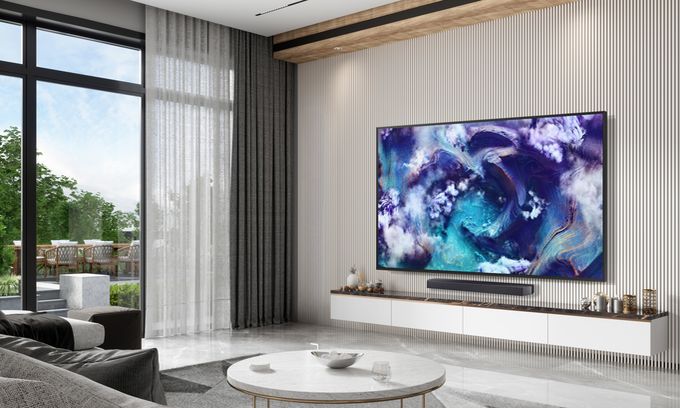
The technological boom in the high-tech TV segment continued successfully this year. Of course, the new Micro RGB technology can rightfully be positioned as an innovative breakthrough.
Samsung’s new TVs are traditionally in the spotlight. This year, the South Korean giant introduced:
– the R95H, 90H, and 85H series with Micro RGB technology.
All series have a Glare Free (matte) screen coating.
Models are available in the following sizes – 65″, 75″, 85″, 115″, 130″ vs TBA vs 55″, 65″, 75″, 85″, 98/100″;
– OLED 2026 lineup with a hybrid QD-OLED panel.
It includes flagship S99H, high-end S95H, mid-range S90H and base S85H TVs. With the exception of the S85H, all models support 165Hz refresh rates, have Glare Free 3.0 matte coatings, and are NVIDIA G-SYNC compatible.
Sizes – 55″, 65″, 77″, 83″ vs 48″ to 83″ vs 42″, 48″, 55″, 65″, 77″, 83″ vs 48″, 55″, 65″, 77″, 83″;
– the Neo QLED series (Mini-LED backlight + quantum dot technology), including QN990H (8K, up to 98″), QN80H (4K, up to 98″) with an increased number of local dimming zones, and a gaming QN70H version with Dual Line Gate technology (doubles the frequency up to 288 Hz for Full HD);
– Samsung The Frame up to 98″ and The Frame Pro with WiFi 7-based Wireless One Connect (wireless 4K video streaming up to 10 meters).
Micro RGB technology
In addition, the company introduced the Vision AI Companion intelligent assistant (personal recommendations, live translation and wallpaper creation when there is no TV signal), Tizen OS 10.0 with a 7-year upgrade guarantee, Eclipsa Audio (enhanced surround sound system), and several huge models, including a giant 130″ Micro RGB.
Micro RGB could be positioned as a new generation of the top-of-the-line Neo QLED series, which uses individual red, green, and blue LEDs instead of traditional white LEDs with filters.
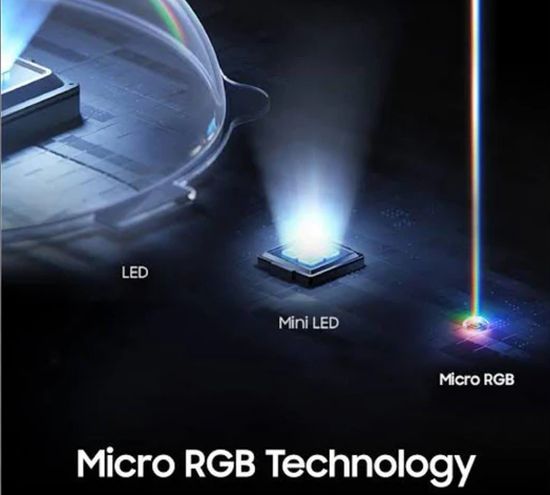
At CES 2026, virtually all industry leaders presented their own versions, including:
– Samsung Micro RGB;
– Sony True RGB (or Sony General RGB LED);
– LG Micro RGB evo;
– Hisense RGB mini-LED (1st gen, 2025) and RGB MiniLED evo (2nd gen, 2026).
According to the developers, the new technology will deliver purer colors and higher brightness.
Pricing is still unknown, but the balance between technologies is unlikely to change. For reference, current prices are (65-inch, 2025 model):
– Samsung S95F/S90F/S85F – $ 2,300 / $ 1,400 / $ 1,200 vs QN90F/QN85F/QN80F – $ 1,600 / € 1,180 / $ 900.
Thus, the current model lineup will include the top-of-the-line premium Micro RGB series, the premium OLED S95F/S90F/S85F TVs with hybrid QD-OLED panels, and mid-range Neo models (mini-LED backlight + quantum dot technology).
R95H vs R90H vs R85H
Flagship R95H and premium R90H have a gallery style Timeless Frame design and integrated audio systems tuned to the panel scale. All series have a Glare Free (matte) screen coating. The 130″ model uses arrays of microscopic red, green and blue LEDs for backlight, paired with an AI driven Micro RGB image pipeline, including Micro RGB AI Engine Pro processor, Micro RGB Color Booster Pro, Micro RGB HDR Pro and a certified Micro RGB Precision Color 100 with VDE verified 100% BT.2020 coverage.
In addition, it supports Wireless One Connect.
The R90H uses the same top-tier AI chip, supports HDR10+ Advanced, but it probably doesn’t include the Wireless One Connect Ready feature. Entry R85H is the base Micro RGB model and has ‘AI Soccer Mode Pro’ feature for picture optimization and uses Standard Micro RGB Core processor (2025). It does not support HDR10+ Advanced and uses fewer local dimming zones.
The earlier ‘Core’ version of the processor is one of the main differences of the R85H. The new Micro RGB AI Engine Pro was introduced in 2026 and is a next-generation chipset for Samsung’s Micro RGB TVs. It provides improved real-time frame-by-frame processing with superb image clarity, color, and motion.
Pros:
– advanced next-generation AI chipsets analyze content in real time for more detailed frame-by-frame optimization;
– Color & Brightness Control – the Pro engine uses enhanced ‘Color Booster Pro’ and ‘HDR Pro’ algorithms, improving vividness and contrast;
– AI Capabilities – it’s integrated with 4K AI Upscaling Pro and AI Motion Enhancer Pro for improved picture quality, which is especially important for larger Micro RGB models;
– Targeted Enhancements – color accuracy at the OLED panel level. 100% BT.2020 color gamut coverage with Precision Color 100.
Samsung S99H vs S95H vs S90H vs S85H
The S99H/S95H are up to 35% brighter vs last year’s model S95F. According to the company, their peak brightness can reach ~2700 nits. The S90H brightness increase is ~15%.
The flagship comes with a Wireless One Connect Box. The S95H also supports this option, but the wireless box is optional extra.
The S99H has a metal bezel, the S95H offers ‘Zero Gap’ flush-mount design.
The S99H/S95H/S90H have a new NQ4 AI Gen3 Processor with 128 neural networks. The S99H features NQ4 AI Gen2 (2024) with 20 neural networks.
Gen3 vs Gen2:
– GPU Performance – 40% faster;
– CPU Performance – 15% faster;
– NPU Performance – 2x faster;
– Max refresh rate – 165 Hz vs 144 Hz;
– enhanced upscaling (4K AI Upscaling Pro) – more accurately displays details when upscaling low-quality content to 4K;
– new AI Auto Game Mode feature automatically recognizes game genres and optimizes picture and sound settings.
New AI-features (Vision AI):
– Vision AI Companion – an intelligent assistant for searching content and managing your home;
– Live Translate – real-time subtitle translation for live broadcasts;
– Color Booster Pro – more dynamic color enhancement without distortion;
– improved power efficiency.
Panel
– S99H – Tandem WOLED for 83″ and QD-OLED for 55-77″;
– S95H – Tandem WOLED for 48″, 83″ and QD-OLED for 55-77″;
– S90H – QD-OLED / WOLED depending on size;
– S85H – basic OLED with a refresh rate of 120 Hz on WOLED panels.
Conclusion
The South Korean giant has once again successfully confirmed its status as one of the industry’s innovative leaders by presenting all the latest technologies. Today, its lineup includes the R95H/90H/85H series with ultra-innovative Micro RGB technology, the S99H/S95H/S90H OLED series with a hybrid QD-OLED panel, and several Neo QLED series (Mini-LED backlight + quantum dot technology), including 8K and 98″ TVs.
Micro RGB TVs are likely to attract the attention of progressives willing to pay a little extra for innovation. Indeed, the updated Micro RGB AI Engine Pro processor, HDR Pro, and Wireless One Connect represent the highest technological level in modern TVs. The Neo QLED series, with its superb price-quality ratio, will appeal to pragmatic buyers. The S99H, S95H, S90H, and S85H OLED TVs with hybrid QD-OLED panels could be positioned as the golden mean. While offering premium specs, they will likely be significantly cheaper than Micro RGB models.
Overall, the company offers excellent TVs in all price segments, making the optimal choice simple and quick.
This video introduces the Samsung Micro RGB TV.