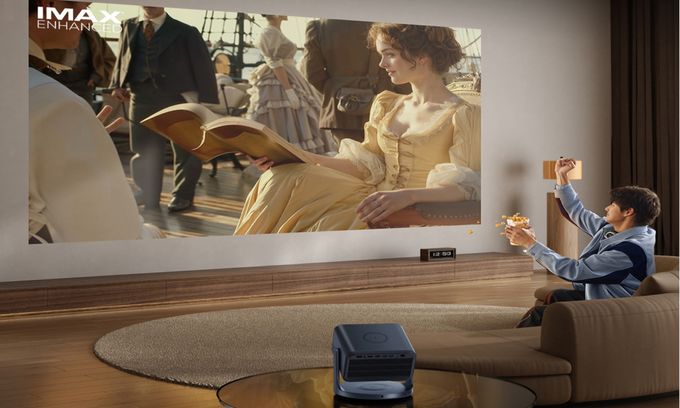
Shenzhen-based JmGO was founded in 2011 by Eric Hu. Today, it’s a leading high-tech manufacturer specializing in intelligent projection equipment with advanced optical technology. JmGO holds over 400 patents and innovations, including the triple-laser MALC optical engine, Bonfire OS, and more.
At CES 2025, company announced the mid-focal N3 Ultra Max and the compact ultra-short-throw (UST) JMGO O2S Ultra projectors.
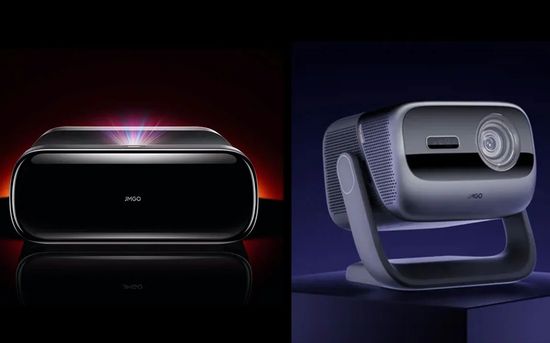
The global version of the N3 went on sale in November 2025. For an introductory period, it’s down from $ 1,399 to an early bird price of $ 1,099. The company promises to announce the full price on December 31.
The new series expands the popular JmGO N1 and N1S (2023 and 2024) families, which include the N1, N1 Pro, N1 Ultra, and N1S, N1S Pro, N1S Ultra, N1S Ultimate, respectively. Brightness, and therefore price, are their only significant differences. The flagships offer slightly expanded functionality. Other specifications are identical.
The new models of N3 series also offer different brightness:
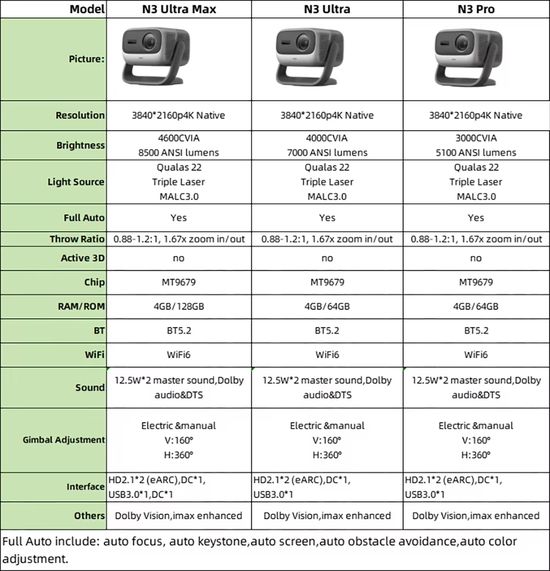
– basic JmGO N3 ~ 1,700 ISO lumens;
– N3 Pro ~ 3,000 CVIA lumens (~ 1,700 ISO/ANSI lumens);
– N3 Ultra ~ 4,000 CVIA lumens;
– flagship N3 Ultra Max ~ 4,600 CVIA lumens.
In some regions, retailers are already offering the new N5 series, which includes the N5 (2,800 CVIA lumens), N5 Pro (3,100 CVIA lumens), N5 Pro Max (3,600 CVIA lumens), N5 Ultra (4,400 CVIA lumens), and N5 Ultra Max (5,000 CVIA lumens). The N5 features a more luxurious front panel and, most importantly, Lens Shift. Its price varies between $ 1,300 and $ 2,000 in different regions.
However, given its availability, the JmGO N3 Ultra Max is more relevant. Its price is $1,700 – $1,800 at the end of 2025.
Key Features
N3 Ultra Max uses triple-laser MALC 3.0 Qualas 22 (Multi-Axis Laser Color) light engine based on ALPD 4.0 (Advanced Laser Phosphor Display) technology.
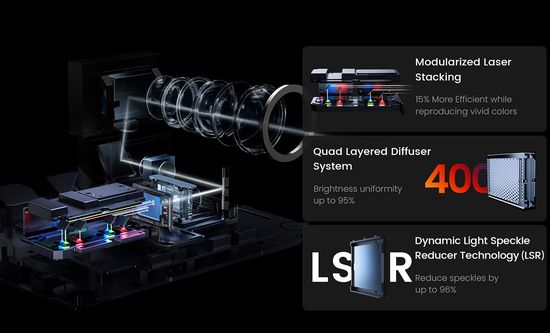
It provides:
– 110% coverage for BT.2020 and more accurate colors;
– high brightness;
– SGS-certified (Société Générale de Surveillancelow) speckle performance.
Projector utilizes:
– LSR (Laser Speckle Reduction) dynamic dissipation module to enhance black levels and picture uniformity;
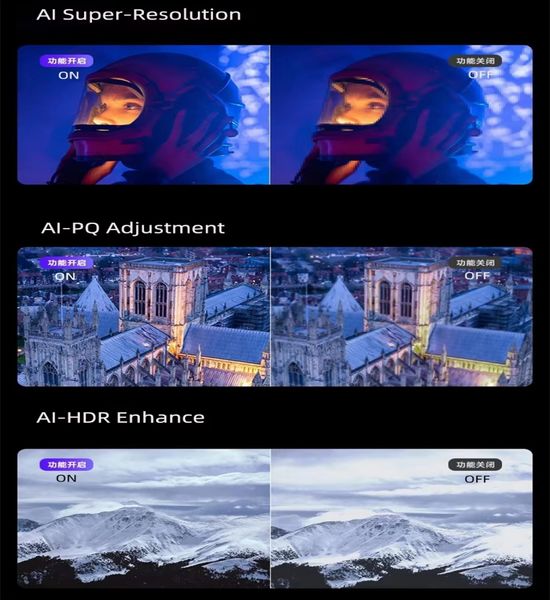
– AI Super Picture Quality 3.0 with AI-HDR enhancement, AI Super Resolution, and AI-PQ algorithms.
– AI-powered autofocus, keystone correction, obstacle avoidance, and auto screen fitting.
The projector has a 0.47″ DMD DLP chipset with 4-phase pixel shifting-based XPR (eXpanded Pixel Resolution) technology. For reference, DMD is acronym for Digital Micromirror Device.
This technology enables playback of 4K content using a relatively inexpensive chipset with native Full HD (1080p) resolution. Its operating principle is simple and elegant. The projector divides the 8 million pixels of the 4K input signal into four parts of 2 million each. Then, using only 2 million DMD micromirrors, it sequentially displays four Full HD images, shifting them diagonally by half a pixel relative to each other. Pixel shift is achieved by tilting the lens using 4 electromagnets of the XPR module.
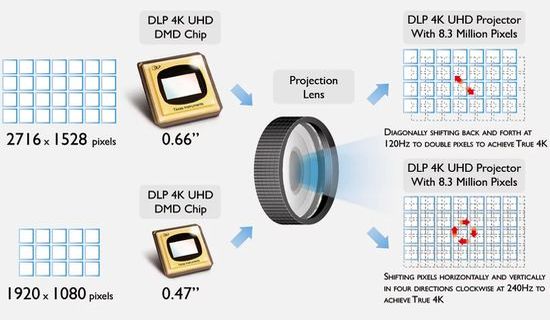
Strictly speaking, the projector displays only one 1080p image at any given time. But due to the high frequency, the brain perceive them as a single, higher-resolution image.
The image contrast affects:
– detail in dark areas;
– color saturation and accuracy due to the effective reproduction of color gradients;
– a sense of 3D due to the separation of objects from the background.
Сontrast specs:
– FOFO (full-on/full-off) contrast – 5,000:1;
– Dynamic Contrast – 1,000,000:1.
Main specs
The projector uses the new MediaTek MT9679. This is a premium 64-bit, quad-core chip based on the Arm Cortex-A73 architecture (frequency up to 1.3 GHz). This SoC is designed for premium 4K@120Hz displays with AI and HDR features, including Dolby Vision and HDR10+.
Google TV with built-in Netflix radically solves the problem of providing a projector with content.
The company positions the JmGO N3 Ultra Max as a portable projector, and its dimensions & weight of (245 x 195 x 223mm/9.65″ x 7.68″ x 8.78″)@(6.3 kg/13.23 lbs) are quite consistent with this classification. However, it’s heavier than the previous JmGO N1 Ultra Max, which weighs only 4.49 kg/10 lbs.
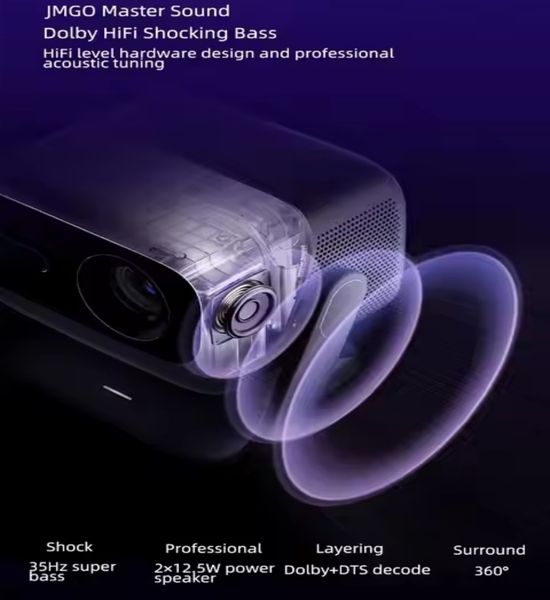
Despite its compact size, the model offers great sound with JmGO Master Sound (2x 12.5W, 35Hz bass, surround 360°, Dolby and DTS).
For music lovers, the N3 Ultra Max offers an HDMI 2.1 port with eARC (Enhanced Audio Return Channel) support for streaming lossless digital audio to an external soundbar.
Gamers will be pleased with the low input lag, the measured value of which does not exceed 20ms for real-time apps.
The focusing range varies between 80 and 180 inches diagonally (100″@1.9m), but the company recommends an optimal size of 100″- 150″.
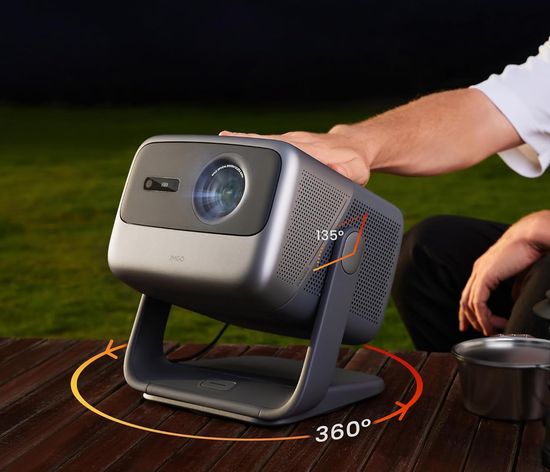
1.3x optical zoom supports a throw ratio of 0.88-1.2:1, providing the adjustment of projection size without quality loss. The optical zoom, AI-powered motorized gimbal with 360° rotation, auto-focus, keystone correction, and obstacle avoidance radically simplify projector installation and setup.
In addition, the model supports the popular Smart Eye Protection (automatic reduction of laser power when a person or pet is detected) and Wall Color Adaptation functions.
The projector has superb deltaE≈0.85 color accuracy ‘out of the box’. For reference, deltaE < 3 is a good value.
JmGO N3 Ultra Max and competitors
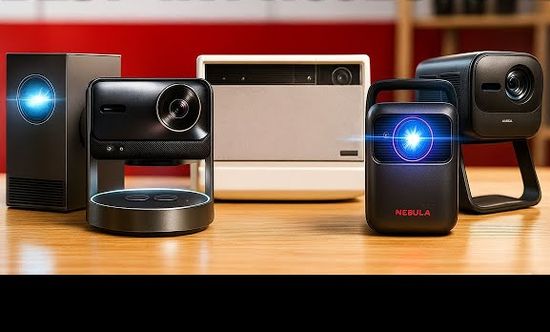
For comparison, current prices for bright (over 3,000 lumens) 4K mid-focal projectors:
– Valerion VisionMaster Max (3,500 ISO Lumens) and Pro 2 (3,000 ISO Lumens) – $ 5,000 and $ 3,000, November 2025/December 2024, RGB Laser, 5,000:1 FOFO contrast (full on/off), 50,000:1 dynamic contrast (dynamic iris), and 15,000:1 ‘viewing’ contrast with Enhanced Black Level (EBL) technology;
– BenQ W4100i (3,200 ANSI Lumens) – $ 2,700, July 2025, LED light sourse, and BenQ W2720i (2,500 ANSI Lumens) – $ 2,100, January 2025, LED;
– XGIMI Horizon 20 Max (5,700 ISO Lumens) – $ 2,700, October 2025, RGB laser, ~1,500:1 native contrast, 1,000,000:1 dynamic contrast, and 20,000:1 ‘viewing’ contrast with Dynamic Black Level Enhancement (DBLE) feature, and Horizon S Max – $ 1,215 (3,100 ISO Lumens), October 2024, Laser/LED Hybrid light engine (Dual Light 2.0 technology);
– Anker Nebula X1 (3,500 ANSI Lumens) – $ 2,200, May 2025, RGB Laser;
– Hisense C2 Ultra (3,000 ANSI Lumens) – $ 1,900, October 2024, RGB Laser;
– Optoma UHZ55 (3,000 ANSI Lumens) – $ 1,600, February 2024, Laser Phosphor;
– NexiGo TriVision Ultra (2,600 ANSI Lumens) – $ 1,500, January 2025, Laser/LED Hybrid;
– Dangbei DBOX02 Mars Pro 2 (2,450 ISO Lumens) – $ 1,000, May 2024, Laser Phosphor.
With the exception of the models with innovative contrast-enhancing technologies (Valerion’s EBL and XGIMI’s DBLE) and models with cheaper laser/LED hybrid light engines (XGIMI Horizon S Max and NexiGo TriVision Ultra), prices in this segment range from $ 1,600 to $ 2,700. $1,000 of Dangbei DBOX02 Mars Pro 2 feels like a sale discount. Therefore, the $ 1,700-$ 1,800 price of the JmGO N3 Ultra Max is very competitive.
Conclusion
Pros
– superb price-quality ratio;
~ 4,600 CVIA lumens brightness, 5,000:1 FOFO contrast and 110% BT.2020 color gamut with improved MALC 3.0 Qualas 22 light engine;
– great δE≈0.85 color accuracy ‘out of the box’;
– AI-powered motorized gimbal;
– Google TV.
Cons
– limited availability information.
The ‘viewing contrast’ of JmGO N3 Ultra Max may be slightly inferior to the Valerion VisionMaster Max or XGIMI Horizon 20 Max, which use AI-based EBL and DBLE technologies, respectively. However, the nearly 2x price difference compensates for this. However, the 5,000:1 FOFO contrast is also excellent for DLP technology.
The Optoma UHZ55 and NexiGo TriVision Ultra are slightly cheaper, but they use Laser Phosphor and Laser/LED Hybrid light sources. In fact, the JmGO N3 Ultra Max is currently the cheapest Home Theater projector with a triple-laser light engine, which provides a color gamut of 110% for the BT.2020 color space.
Google TV, excellent sound, δE≈0.85 color accuracy ‘out of the box’, and a motorized gimbal complete the list of its bonuses.
As a result, the superb price-quality ratio due to premium specs at the $ 1,639 launch price promises excellent marketing prospects for the flagship JmGO N3 Ultra Max projector.
Announcement of JmGO N3 Ultra Max projector at CES 2025.