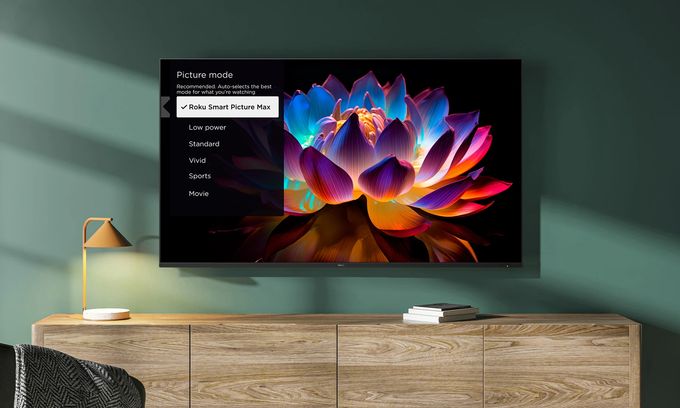
Some experts were skeptical when Roku announced it would produce its own TVs. Indeed, popular TCL and Hisense TVs with Roku OS are more than serious competitors. But the company has managed to create several competitive series with superb price-quality ratio (PQR), including Select, Plus, and Pro.
Since late summer, Roku Pro Series 2025 TVs have been available at major retailers, including Best Buy, Walmart, and Amazon. They have re-engineered mini-LED backlight with local dimming, Roku Smart Picture Max for scene-by-scene adjustments, improved motion clarity, factory-calibrated colors, Dolby Atmos, and HDMI 2.1 with VRR (FreeSync) for gaming. In fact, this is Roku’s flagship series of 4K mini-LED QLED TVs with a 120Hz refresh rate.
The Roku Pro supports Dolby Vision and HDR10+, and has 2x HDMI 2.1 ports with bandwidth for 4K@120Hz gaming with VRR. TVs run latest version 15 of the Roku TV OS, which supports smart features including voice control. The series offers 55-, 65-, and 75-inch models called the Roku 55R8C5, 65R8C5, and 75R8C5 (US model), costing ~$600, $800, and $1,000, respectively. Roku Smart Picture Max feature, increased brightness, better SDR color, improved upscaling, enhanced Dolby Atmos audio with side-firing speakers, and faster Wi-Fi 6 are the main differences from last year’s Roku Pro 2024, which now costs ~$500 for the 55″ model.
The new Roku Smart Picture Max feature was one of the key improvements. Like Dolby Vision, it adjusts picture quality frame-by-frame, optimizing color, sharpness, and contrast in each scene.
Of course, the Roku Pro is slightly inferior in brightness and contrast to the Hisense U8N and TCL QM8, which use 2,000 and 5,000 local dimming zones in their 65-inch models. But at prices of ~$800 vs $950 vs $1,000 for the 65″, the difference is ~20%, which is a significant bonus.
Key Features
Roku has focused on smart TV OS and its efforts have yielded great results. In fact, Roku TVs extend the Streambar’s philosophy by aiming to become ‘StreamTVs’. To be fair, instead of buying a Roku Pro, fans of the Roku streaming interface can use the $40 Roku Streaming Stick 4K.
With the exception of Twitch, Roku’s smart TV platform supports all popular streaming services, including Netflix, Hulu, Apple TV Plus, YouTube, Amazon Prime Video и Disney.
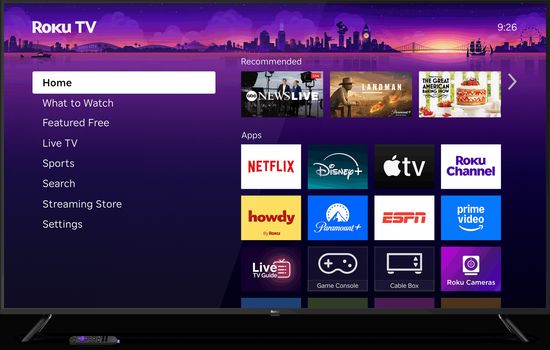
It’s also compatible with Apple AirPlay for local streaming from iPhone, iPad, or Mac. Unlike Google Assistant on Google TV or Alexa on Fire TV, Roku’s voice features are more media-focused. For example, weather forecast or schedule check are not available.
Unfortunately, for over-the-air broadcasts, the Roku Pro uses an outdated ATSC 1.0 tuner. For reference (ATSC 1.0 vs ATSC 3.0):
– HD (1,280 x 720), standard audio, without a direct network connection vs 4K UHD (3840 x 2160), HDR, Dolby Atmos, interactive apps, content personalization, support for streaming channels within the guide menu, internet operation.
The Roku Pro Series 2025 uses improved built-in Roku Soundstage Audio with side-firing speakers and Dolby Atmos support, delivering a robust 50W sound with good dialogue clarity. Unfortunately, deep bass is mediocre. TV also offers Dolby Audio and Bluetooth Headphone Mode.
The sound can be adjusted using the treble and bass EQ sliders, depending on whether you use a wall mount or stand. The sound presets include a Dialog mode to make dialogue more intelligible, and Night mode which blocks loud sounds when viewing at night.
For gamers, the new Roku Pro offers 4x HDMI ports, including two HDMI 2.1 signals with 120Hz refresh rates from external sources. In addition, the measured input latency in Game mode does not exceed 10 ms.
Testing
HDR/SDR brightness (nits or cd/m²):
– peak 2% window – 860/1,090;
– 10% – 1,430/1,500;
– 25% – 1,600/1,600;
– 50% – 1,200/1,145;
– 100% – 690/690.
The phenomenal SDR brightness easily overcomes glare from even in a bright room.
Contrast:
– native contrast – 6,060: 1 (good value > 5,500: 1);
– with local dimming – 88,300: 1 (good value > 80,000: 1).
The Roku Pro Series TV offers great contrast with deep blacks, ensuring good detail even in dark scenes. Unfortunately, Roku Pro reproduces the leading edge of fast-moving objects with duller colors.
Black Uniformity – Std. Dev./Native Std. Dev. – 0.26% / 0.63% (good value < 0.6).
With ‘High’ local dimming TVs have perfectly uniform of blacks across the screen.
SDR/HDR Color Volume (DCI-P3 and BT.2020) – 87.4%/78.4% (1,000 nits) and 65.4%/39% (10,000 nits).
Color volume characterizes a display’s ability to reproduce colors across all brightness levels.
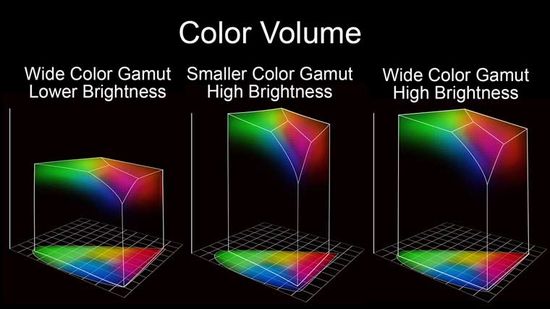
It’s not particularly important for SDR (Standard Dynamic Range), which uses limited brightness of ~100 nits and 8-bit color depth. However, when displaying HDR, with peak brightness up to 10,000 nits, it significantly impacts color accuracy. The Roku Pro has good HDR color volume and correctly displays all colors even at high luminance levels.
Pre/post calibration color accuracy
SDR
– white balance dE 2000 – 1.55/0.18 (good value < 3);
– color dE 2000 – 1.39/0.85 (< 3);
– gamma – 2.26/2.21 (2.1-2.3);
– color temperature – 6,665K/6,495K (6,500K).
HDR
– white balance dE ITP – 23.8/13.7 (good value < 9);
– color dE ITP – 28.6/8.6 (< 9);
– color temperature – 7,145K/6,695K.
The Roku Pro is ideal for SDR ‘out of the box’, but requires calibration for HDR.
Conclusion
Pros
– superb SDR brightness;
– good color vibrancy;
– great contrast with deep blacks;
– great interface;
– HDMI 2.1 bandwidth;
– 4K@120Hz and VRR (FreeSync).
Cons
– mediocre handling of direct reflections;
– no Google Assistant;
– sound has limited bass;
– narrow viewing angle;
– no ATSC 3.0 support.
Roku Pro Series 2025 TVs fit perfectly into the budget-friendly segment of the new premium class of LCD TVs with quantum dot (QD) technology and innovative mini-LED backlighting. Of course, it’s inferior to more expensive models with these technologies from key competitors, including Hisense U8N, TCL QM8 or Samsung Neo QLED QN90F. But Roku OS as ‘Stream TVs’, fantastic SDR brightness, superb contrast with deep blacks, great audio, and perfect SDR presets ‘out of the box’ at a price of under $800 for a 65″ are very good bonuses.
This video introduces the new Roku Pro Series TV.