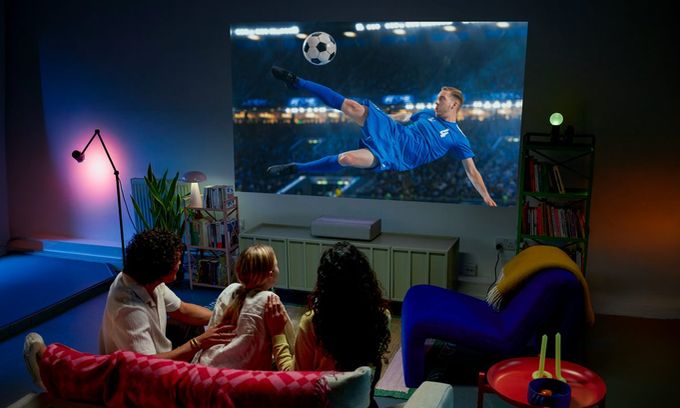
Annual product line expansion by industry leaders has long been an effective business practice, and China’s XGIMI from the Heavenly Empire is no exception. The flagship mid-focal Titan Noir Max and compact XGIMI Vibe One have successfully expanded XGIMI’s lineup. However, the company hasn’t forgotten about the ultra-short-throw (UST) projector segment, introducing the Mira 4K/4K Pro models in April 2026. While they are currently only available on the Chinese market, the appearance of their global ones in other regions is unlikely to be delayed.
The XGIMI Mira 4K launch price was $ 900–$ 950, with the Pro version priced between $ 1,120 and $ 1,170. Current prices (Mira vs Mira Pro):
– € 1,699 (https://eu.xgimi.com/) vs € 1,999 (European MSRP) / 7,999 CNY (~ $ 1,170) / up to € 2,650 including local VAT (import/third-party retail).
The popularity of UST models as living room TVs has been steadily growing for several years. Traditional mid-focal projectors project 100″ or more from a distance of several meters. Consequently, the projector must be placed in the center of the living room, creating the problem of a power cord on the floor. Of course, ceiling mounting solves this problem, but it radically reduces the projector’s mobility. It’s unlikely that its owner will dismantle a complex mount to watch a baseball game in the backyard with friends and a beer. The UST projector uses aspherical lenses and creates a 100″ or larger image from a distance of several inches, radically simplifying its placement.
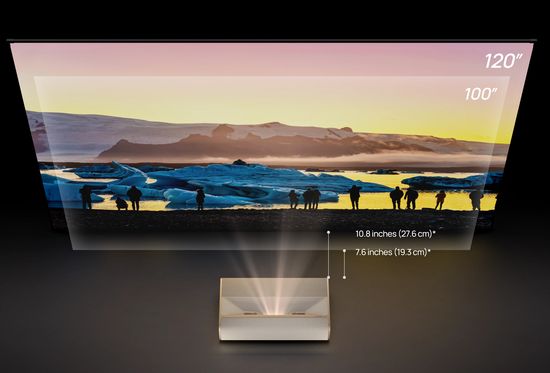
XGIMI Mira and Mira Pro
Differences (XGIMI Mira vs Mira Pro):
– brightness – 3,000 ISO lumens vs 2,000 ISO lumens (ISO 21118 standard);
– AI processing – support for AI-SR (resolution enhancement), AI-PQ (parameter correction), and AI-HDR (dynamic range) vs standard processing algorithms.
Both models provide a 100″@19cm. Mira Pro has 36W built-in audio system tuned by Harman Kardon. It delivers 2.1-channel sound with deep bass down to 55Hz, 360-degree sound projection, and support for Dolby Audio and DTS:X.
The 0.39-inch DMD chip with pixel-shift-based XPR (Expanded Pixel Resolution) tech ensures playback of 4K (3,840 x 2,160) content. This tech is simple yet elegant:
– the projector divides 8 million pixels into four parts of 2 million each;
– using 2 million micromirrors of a Full HD DMD (Digital Micromirror Device) chip, it sequentially reproduces 4x 1080p images, shifting them diagonally by half a pixel;
– due to the high frequency, the brain perceives them as a single image with higher resolution;
– the pixel shift is achieved by tilting the lens using four electromagnets of the XPR module.
Mira models provide up to 20,000:1 contrast ratio with DBLE On. DBLE (Dynamic Black Level Enhancement) is a proprietary tech that dynamically improves black levels with intelligent laser or LED brightness control and image calibration. In effect, DBLE makes dark scenes deeper and more contrasty while preserving detail in bright areas.
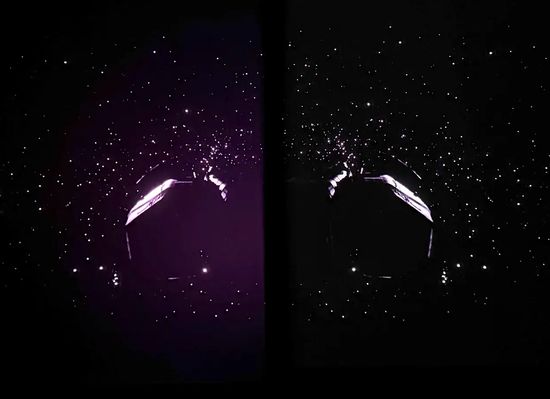
It’s most effective when reproducing dark scenes without bright elements.
Both models use Google TV with direct access to Netflix, Hulu, Amazon Prime Video, and of other popular streaming apps.
XGIMI Mira/Mira Pro (2026) vs Aura 2 (2024)
The Mira series can be positioned as a compact and cheaper version of the Aura 2.
Both models:
– 4K (3,840 x 2,160) resolution with XPR;
– contrast up to 20,000:1 with DBLE;
– High Light Transmission Coated lens;
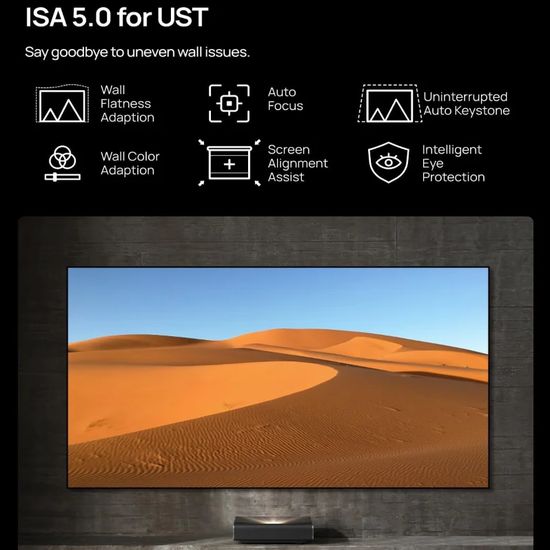
– ISA 5.0 (Intelligent Screen Adaptation).
It automatically adjusts the geometry, sharpness and colors of the image, eliminating the need for manual calibration for the user. It automatically adjusts image geometry, sharpness, and color, eliminating the need for manual calibration. ISA includes:
– auto focus;
– uninterrupted auto keystone (image alignment);
– wall flatness/color adaptation;
– screen alignment assist (adjusts screen and image sizes);
– intelligent eye protection (reduces laser beam power when an obstacle is detected in front of the lens).
– 3D option;
– MEMC;
– HDMI eARC port (Audio Return Channel);
– WiFi 6 Dual-band 2.4/5GHz, 802.11a/b/g/n/ac/ax, Bluetooth 5.2/BLE.
Differences:
– price ~$ 1,700 / $ 2,000 vs $ 2,700;
– light source – RGB Triple Laser vs Dual Light 2.0 (Laser + LED);
– display chip – 0.39″ DMD vs 0.47″ DMD;
– HDR – HDR10, HLG, Dolby Vision vs HDR10, HLG, Dolby Vision, IMAX Enhanced;
– gaming (Game Mode, VRR on, AK off) – 1ms at 1080p@240Hz vs 20 мс at 4K@60Hz;
– brightness – 2,000/3,000 ISO Lumens vs 2,300 ISO Lumens;
– color gamut – 110% in BT.2020 vs 99% in DCI-P3;
– Image Size and Throw Ratio – (80″ – 120″)@0.175:1 (100″@19.3 cm/7.6″) vs (90″ – 150″)@0.177:1 (100″@17.8 cm / 7″);
– Google TV vs Android TV 11.0;
– audio – 36W Harman/Kardon (2x 8W speakers + internal 20W subwoofer) vs 4x 15W Harman/Kardon;
– (122 x 464 x 268 mm)@4.8 kg/10.6 lbs vs (144 x 510 x 270 mm)@9 kg/19.8 lbs.
Conclusion
The superb price-to-quality ratio promises this series a great marketing outlook. Indeed, just a few years ago, any sufficiently bright 4K UST projector with a RGB light source (wide color gamut up to 118% coverage for the BT.2020 standard) priced under $ 2,000 was positioned as dumping. But competition is doing its job, and 4K UST laser models under $ 2,000 are becoming a reality.
The TV manufacturers aren’t wasting any time either. Just a few years ago, many experts predicted that UST projectors would displace traditional TVs in living rooms. Indeed, with 100-inch TVs costing over $ 10,000, a projector for a few thousand was a great alternative for those who prefer huge screens. But over the past few years, industry leaders have flooded the market with a wide range of relatively inexpensive 100-inches TVs, with prices now ranging from $ 1,400 for the TCL 98Q651G to $ 6,000 for the Hisense 100U8SG, etc.
Moreover, TVs are brighter due to direct light output from the screen surface vs reflected light in projectors, and have higher contrast. To be fair, the contrast of LCoS (Liquid Crystal on Silicon) projectors is also superb, but their prices start at $ 6,000.
Of course, the projector offers a larger image size. But according to ophthalmologists’ recommendations, the optimal viewing distance is equal to the screen diagonal multiplied by 1.3. Therefore, the ideal viewing distance even for a 150-inch screen is 6 meters. Its placement is unlikely to be a problem in a cozy villa, but it’s more challenging for the living room of an ordinary apartment.
Video introduces the new XGIMI Mira 4K triple-laser UST projector.