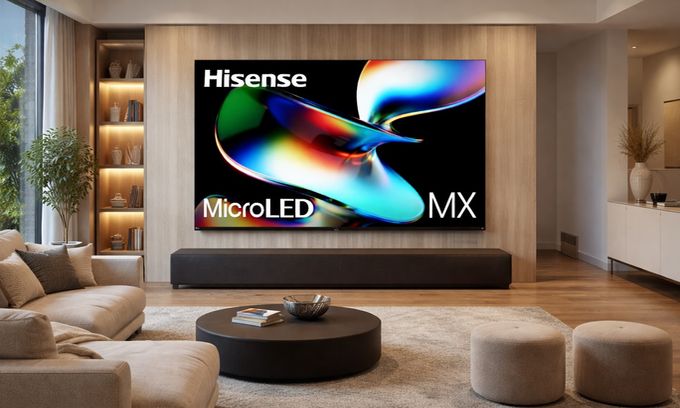
Traditionally for industry leaders, at CES 2026 Hisense presented updated lines featuring the most popular TV technologies. The 2026 list includes:
– the massive 163-inch Hisense 163MX RGBY MicroLED.
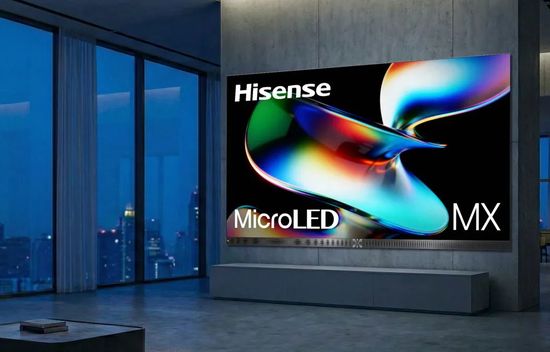
– the flagship 116-inch 116UXS RGB MiniLED evo, UR9S, and UR8S with innovative RGB backlight;
– 4K miniLED TVs.
Probably, the industry’s first four-primary architecture could likely be positioned as one of the main innovations of this year from the Chinese giant. In fact, Hisense has added a fourth color channel to the red, green, and blue. As a result, new use models:
– an additional yellow subpixel in the latest Micro LED panel (RGBY).
The company promises 100% covering the BT.2020 color space and richer warm tones, for example, for amber and gold. At CES 2026 163MX RGBY MicroLED received the Best of Innovation Award;
– additional cyan into RGB Mini LED backlight system (RGB Mini LED Evo tech).
According to the developer, this solution will increase coverage to 110% of the BT.2020 color space, improving HDR performance.
All RGB MiniLED series support refresh rates up to 180 Hz and have 6.2.2ch Devialet – tuned audio system (116UXS provides up to 100W power). For reference, the French Devialet Opera De Paris produces premium speaker systems.
According to the company, the 116UXS uses ‘tens of thousands of dimming zones’ powered by the Hi-View AI Engine RGB system. Flagship has Anti-Reflection Pro coating and comes with Google TV in the US or VIDAA Smart OS in other regions.
MicroLED technology vs RGB Mini LED backlight
Despite the similar names, MicroLED technology has nothing in common with the new RGB Mini LED backlight.
The 163-inch MicroLED panel uses self-lit pixels, where each subpixel is an LED, eliminating the need for an LCD panel. It essentially functions like an OLED, providing ‘infinite’ contrast due to the perfect black levels achieved by the backlight absence.
Modern MicroLED panels offer fantastic image quality at an fabulous price and are used primarily in advertising. Furthermore, their modular design eliminates size limitations. Last year, Hisense launched a 136-inch MicroLED TV priced at $ 100,000. The price of the new 163-inch 163MX MicroLED with RGBY architecture is still unknown, but it is unlikely to be affordable for students and newlyweds.
The RGB MiniLED backlight system uses red, green and blue LEDs combined into RGB clusters. They replace traditional white or blue LEDs, which create colors using quantum dot (QD) technology. The RGB clusters eliminates the need for an RGB filter, however this technology still uses a liquid crystal layer to modulate the color flux intensity. It expands color gamut, enhances brightness and contrast. In fact, RGB backlight claims to be an improved generation of MiniLED backlight.
To be fair, at CES 2026 TCL presented the flagship X11L with SQD-MiniLED technology (super quantum dots and MiniLED backlight), and with innovative UltraColor Filter (5-nanometer color pixels).
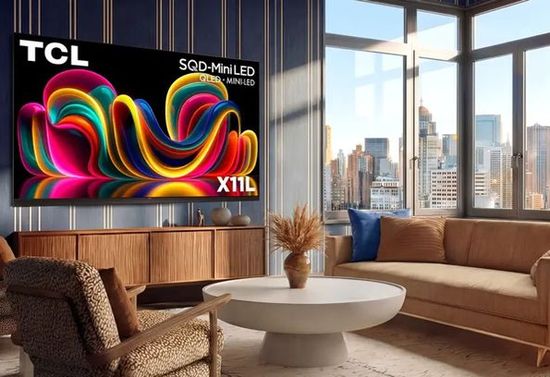
Of course, $7,000, $8,000, and $10,000 for the 75-, 85-, and 98-inch sizes evokes mixed feelings, but its image quality is impeccable. Therefore, the competition results between the improvement TCL’s MiniLED backlight and the new RGB MiniLED system are mixed.
Hisense RGB MiniLED
New Hisense RGB MiniLED family includes three series:
– flagship 116-inch 116UXS RGB MiniLED evo with four-color architecture (red, blue, gtrean and additional cyan);
– UR8 and UR9 RGB MiniLED with traditional three-color architecture.
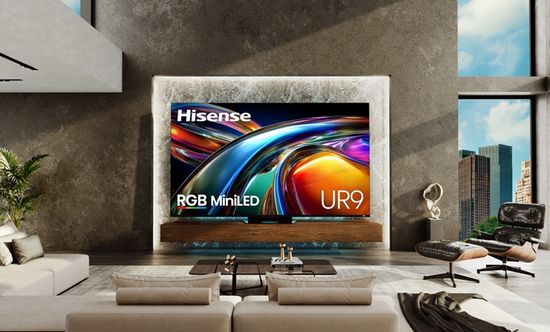
All series utilize Hisense’s proprietary Hi-View AI Engine RGB picture enhancement technology.
Hi-View AI Engine RGB features:
– AI Local Dimming with RGB MiniLED;
– better motion handling up to 180Hz/330Hz;
– near 100% BT.2020 color gamut coverage;
– Intelligent Processing frame-by-frame optimization;
– 4-color technology in ‘evo’ models;
– high refresh rates up to 4K@180Hz and faster response times for smooth gaming.
It uses the MediaTek’s Pentonic 800 chipset with next-generation Dolby Vision 2 support. This chipset has a 4-core Cortex-A73 processor up to 1.8 GHz and Mali-G57 MC1 graphics. In addition to Hisense, TCL and Philips also announced plans to use the new Pentonic 800.
Of course, Hisense models also support other major HDR formats, including Dolby Vision, Dolby Vision IQ, HDR10, HDR10+, and HLG.
Differences (116UXS vs UR9 vs UR8):
– peak brightness up to 8,000 nits (~5,000-5,500 nits for HDR highlights in accurate Filmmaker Mode) vs 4000 nits vs 3500 nits;
– quad-color architecture vs traditional three-color RGB backlight;
– DV2 Max vs DV2 support (UR8/UR9’s version is currently unknown);
– 3x HDMI 2.1 (4K@165Hz support) and USB-C vs 4x HDMI 2.1.
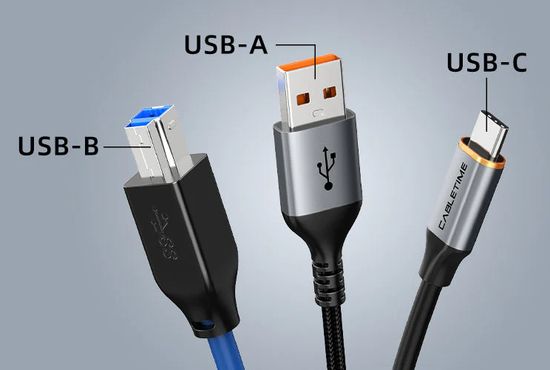
A modern, universal, oval-shaped, reversible USB-C connector provides high-speed data transfer and replaces older USB types, such as A, B, Mini or Micro. It supports multiple protocols, including USB, Thunderbolt and DisplayPort for video transmission via DisplayPort Alt Mode;
– size – 116 inches vs from 55 to 100 inches.
Dolby Vision 2
AI features:
– Content Intelligence;
– bi-directional tone mapping, precision black;
– Expanded Metadata with i-directional tone mapping and granular motion control;
– Authentic Motion control through its dedicated image engine;
– AI Picture – AI-Super Resolution 3.0, AI-Contrast 2.0 and AI Picture Quality (object recognition and optimization);
– VRR up to 4K@165Hz (smooth gaming);
– HDMI 2.1a and Wi-Fi 7 support (with advanced MediaTek’s Filogic chipset);
– hardware decoding of popular codecs, including H.266 (VVC) and AV1;
– enhanced cloud gaming thanks to low latency and high throughput.
Advanced processing of Hi-View AI Engine RGB (MediaTek MiraVision Pro PQ Engine):
– real-time scene/face recognition;
– AI algorithms to dynamically optimize color, contrast, sharpness, and motion.
The new HDR Dolby’s format is a powerful software engine for TVs that uses AI and enhanced metadata to optimize images.
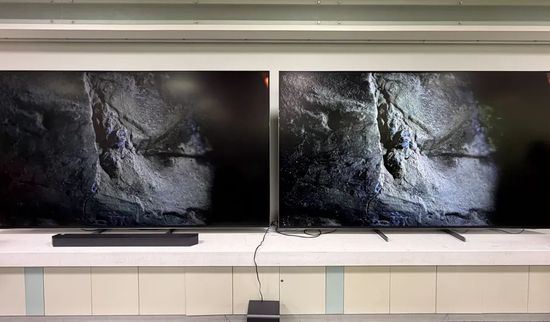
Features list includes Authentic Motion (granular motion control), Precision Black (shadow detail), Light Sense (lighting adaptation), Bi-directional Tone Mapping (improves brightness and contrast), and optimization for sports and games with Dolby Image Engine.
It’s developed in two versions, including Dolby Vision 2 (DV 2) and Dolby Vision 2 Max.
DV 2 vs DV2 Max
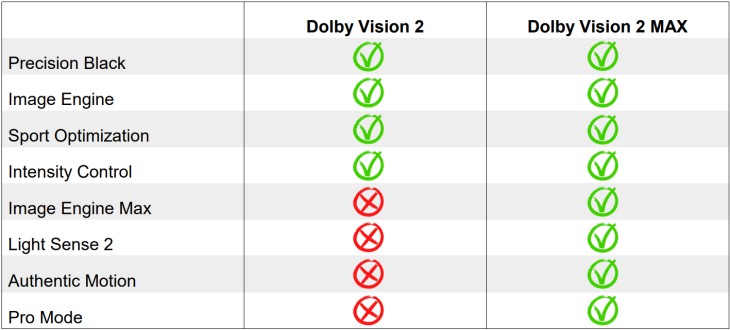
– mainstream vs flagship/premium TVs;
– fixes ‘too dark’ HDR problems in mid-range segment vs max performance on ultra-bright displays;
– display – varies vs panels with 120 Hz and higher and 12-bit -capable pipelines;
– basic motion improvements vs authentic motion (granular motion control to eliminate judder without the ‘soap opera effect’);
– standard bi-directional tone mapping vs advanced tone mapping optimized for extreme peak brightness up to 10,000 nits;
– basic light adaptation vs light sense (evolved ambient-aware system with dedicated sensors).
The 116UXS comes with DV2 Max. A version for UR8/UR9 models requires clarification when purchasing.
Conclusion
Once again, the Chinese giant successfully confirms its status as one of the innovative industry leader. According to the developer, the RGBY-based Micro LED panel and additional cyan into Mini LED backlight system of RGB Mini LED Evo tech will expand the color gamut to 100% and 110%, respectively. In turn, the significant improvement in color accuracy could well be positioned as a technological breakthrough. Therefore, the four-color architecture may well become one of the directions for further improvement of TV panels.
New Hi-View AI Engine RGB picture enhancement technology, 6.2.2ch 110W Devialet – tuned audio system, MediaTek’s Pentonic 800 chipset with Dolby Vision 2 support and a USB-C port harmoniously complement the premium options.
Of course, TCL X11L with SQD-MiniLED technology and 5nm UltraColor Filter, Samsung Micro RGB and LG Micro RGB evo are very formidable competitors. However, the competition is unlikely to frighten the Chinese company, but will certainly please consumers.
In addition to innovative flagships, the company traditionally offers a wide range of lower-cost models. This year’s lineup includes LCD TVs with miniLED local dimming and 144Hz or 165Hz refresh rates, such as the U7S Pro (up to 3000 nits brightness), U7SE (up to 1400 nits), and E8S (up to 600 nits).
The U7S Pro will be the least expensive series to support Dolby Vision 2. It also uses a Devialet-tuned audio system. The series includes 55-, 65-, 75-, 85-, and 100-inch models.
This video shows Hisense’s product presentation at CES 2026.