The annual January CES (Consumer Electronics Show, Las Vegas, USA) is one of the most popular venues to showcase achievements by innovative industry leaders. Of course, high-tech TVs are always in the spotlight, and this year is no exception.
CES 2021 could be positioned as the birth date of miniLED backlighting, paving the way for LCD TVs with stunning contrast. Today, proprietary versions of this technology are used in the Samsung Neo, LG QNED, TCL OD-Zero (Optical Depth Zero), and Hisense ULED series.
At CES 2022, Sony introduced the A95K with Samsung Display’s innovative QD-OLED hybrid panel. This year, Samsung introduced the third generation of this technology, implemented in the new Samsung S95F/S90F/S85F models.
RGB Mini/Micro LED
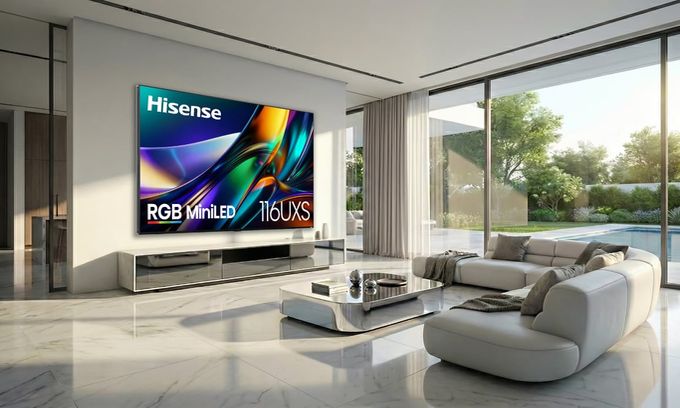
The innovative RGB miniLED technology in the Hisense 116UX was a sensation at CES 2025.
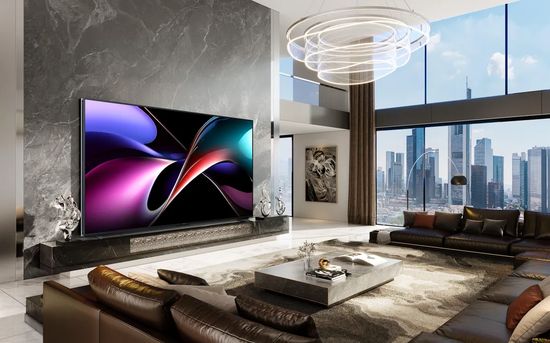
Unfortunately, the similarity of abbreviations from different companies has created confusion, so even a simplified classification can be useful.
Companies use the following names for this technology:
– Samsung Micro RGB;
– Sony True RGB (or Sony General RGB LED);
– LG Micro RGB evo;
– Hisense RGB mini-LED (1st gen, 2025) and RGB MiniLED evo (2nd gen, 2026).
TCL hasn’t yet officially named its version of this technology.
But the abbreviations RGB Mini/Micro LED are present in all names. Due to the lack of clear explanations from the developers, some experts initially perceived it as a version of Micro LED panels, which is incorrect.
Of course, both technologies are quite close. LEDs for MicroLED and RGB Mini/Micro LED are made from nitride-based semiconductors Indium gallium phosphide (InGaN) for blue and green light, and aluminum indium gallium phosphide (AlInGaP) for red light. They are ‘self-emitting’ and generate light directly from the semiconductor material when current passes through them. But unlike organic materials used in OLED panels, they are more heat-resistant and, therefore, brighter due to higher voltage. The main technological difference lies in the size of the individual diodes and their integration method. MicroLED panels use diodes several tens of microns in size and each diode being an independent pixel. New Samsung Micro RGB panel is equipped with LEDs up to 100 µm. Other companies use diodes up to 0.2 mm.
MicroLED vs RGB Mini/Micro LED
Each MicroLED pixel consists of red, green, and blue microLEDs, the combination of whose intensities creates any hue. Perfect black, due to the absence of a backlight, provides ‘infinite’ contrast. The modular design with magnetic mounts eliminates screen size limitations.
As a result, the Micro LED panel delivers fabulous picture quality, but unfortunately at a fantastic price of over $100,000. They are mainly used in outdoor advertising.
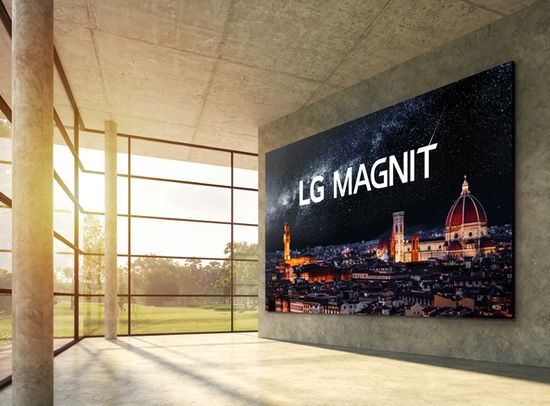
To be fair, at InfoComm 2025, AWALL presented CoB MicroLED display, priced at ‘only’ $ 16,600 for a 75″ panel. But so far this is hardly a mass segment.
RGB Mini/Micro LED technology
The new RGB Mini/Micro LED technology can be positioned as a radically improved backlight for LCD TVs. It uses RGB-modules instead of traditional white or blue LEDs. Samsung, for example, uses independently controllable RGB units with red, green, and blue LEDs up to 100 µm in size.
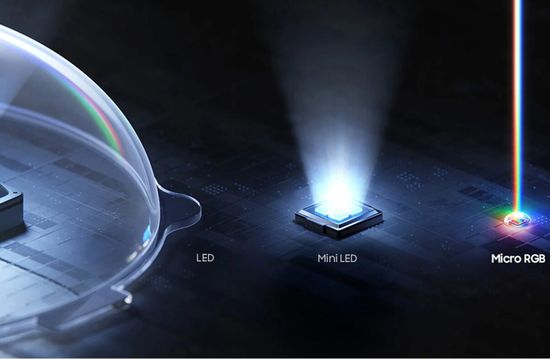
The RGB clusters generate the red, green, and blue colors for each subpixel, eliminating the need for RGB filters. However, RGB Mini/Micro LED technology continues to use liquid crystals layer to control brightness and contrast. In fact, it modulates the red, green, and blue flows, generating all possible shades.
Pros:
– Superior Color – purer, spectrally narrow RGB light provides a wider color gamut;
– Enhanced Contrast – individual pixel-level control provides better contrast through more precise local dimming;
– Increased brightness due to the absence by RGB filter losses.
Samsung Micro RGB and Sony True RGB
130-inches Samsung Timeless Frame TV Micro RGB (R95H)

– Micro RGB Precision Colour 100 – 100% of the BT.2020 wide colour gamut (certified by the Verband der Elektrotechnik) and precise colour reproduction;
– AI features – Micro RGB AI Engine Pro, Micro RGB Color Booster Pro and Micro RGB HDR Pro;
– proprietary Glare Free technology minimises reflections, preserving clear colour and contrast across a variety of lighting conditions;
– HDR10+ Advances and Eclipsa Audio – an enhanced picture and sound quality.
For reference, HDR10+ Advanced is the next generation of the HDR10+ standard, developed for modern miniLED TVs with peak brightness up to 4,000-5,000 nits. It uses dynamic metadata and frame-by-frame adaptive tone correction to enhance detail and to optimize the image based on ambient lighting and genre;
– enhanced Vision AI Companion – conversational search, proactive recommendations and access to AI features and apps, including AI Soccer Mode Pro, AI Sound Controller Pro, Live Translate, Generative Wallpaper, Microsoft Copilot and Perplexity.
– Timeless Frame version of Timeless Gallery design;
– built-in spacious audio system adapted to the large diagonal of the panel.
The TV runs on Tizen OS, for which Samsung has promised a seven-year software support cycle.
Sony True RGB
According to preliminary data, Mini LED RGB technology called Sony True RGB will be featured in the Sony Bravia 7 II and Sony Bravia 9 II TV series, with screen sizes ranging from 50″ to 115″ with a peak brightness up to of 4,000 nits.
LG Micro RGB evo and Hisense UXS
LG MRGB95:
– CES 2026 Innovation Awards;
– updated α (Alpha) 11 AI Processor Gen 3.0.
Dual AI Engine-based processor with Dual Super Upscaling simultaneously processes two types of AI upscaling, improving picture clarity and immersiveness;

– RGB Primary Color Ultra – superb color accuracy with 100% coverage of BT.2020, DCI-P3, and Adobe RGB, certified by Intertek. Theoretically, the widest BT.2020 standard defines the full color range for 4K and 8K;
– Micro Dimming Ultra – superb contrast with 1,000+ local dimming zones;
– webOS 26 (webOS 11.0) – Voice ID, AI Picture/Sound Wizard, a personalized “My Page” home screen, updated AI Concierge, AI Chatbot and AI Search.
LG MRGB95 will be available in 100-inch, 86-inch and 75-inch sizes.
Prices are still unknown, but competitors’ prices for TVs with similar technology are:
– 116″/100″ Hisense 116UX/100UX – $ 24,999 / $ 9,999;
– 115″ Samsung Micro RGB TV – $ 29,999.
Therefore, the price is unlikely to be less than $ 10,000.
Hisense
Key differences from last year’s 116UX:
– the second-generation RGB miniLED technology will be marketed as ‘RGB MiniLED evo’ in a 116-inch UXS model.

Hisense says the 116UXS will use ‘tens of thousands of local color dimming zones’;
– the new version uses an additional fourth cyan LED, which, according to the company, expands the color gamut to 110% of BT.2020. However, to be fair, today’s majority of HDR content is processed in the narrower DCI-P3 color space. Therefore, 110% for BT.2020 largely characterizes only the technology’s enticing prospects;
– the new Hi-View AI Engine RGB processor provides video processing, synchronizing color and brightness across the entire backlight area;
– end-to-end color management system delivers studio-quality calibration at home with AI-powered auto-tuning.
Conclusion
To the delight of progressists with a good budget, the premium TV segment is successfully expanding with innovative RGB Mini/Micro LED backlight technology. In the future, this technology could improve the picture quality of relatively inexpensive LED LCD TVs to the level of ultra-expensive MicroLED panels. At the very least, the use of RGB modules to generate pixel colors could be positioned as a giant leap in this direction.
Implementation is likely still far from perfect due to the high price, but competition is working wonders. It’s possible that the consumer market will see several models at quite affordable prices as early as this year.
This video showcases new Samsung Micro RGB TV at CES 2026.