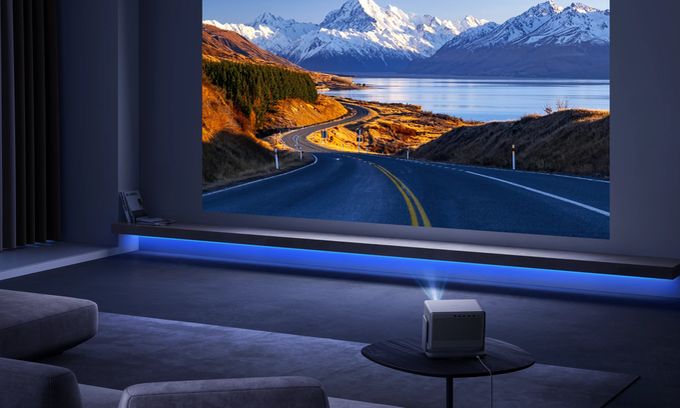
– wide color gamut (up to 110% for BT.2020 color space);
– high brightness up to 5,700 ISO lumens and great dynamic contrast up to 20,000:1 with Dynamic Black Level Enhancement (DBLE) technology;
– newest DLP472TP DMD with DLPC8445 controller;
– latest Google TV OS version;
– innovative X-Master Red Ring lens with a light transmission of up to 99.6%;
– latest MediaTek MT9679 SoC;
– motorized horizontal & vertical lens shift and zoom;
– excellent color accurate ‘out-of-box’;
– Harman Kardon audio system;
– 3D and VRR support;
– gimbal design;
– unprecedentedly input lag.
Cons
– DBLE can cause a slight color shift;
– some clipping in HDR;
– high-contrast object ‘s contours may be reproduced with a slight rainbow effect.
XGIMI Horizon 20 Series
This series, which includes the 20, 20 Pro and 20 Max projectors, became one of the sensations of the autumn IFA (Internationale Funkausstellung Berlin, Germany) exhibition.
The flagship Horizon 20 Max offers virtually the full range of premium specs, including brightness up to 5,700 ISO lumens, dynamic contrast up to 20,000:1 with Dynamic Black Level Enhancement (DBLE) technology, wide color gamut up to 110% for BT.2020 color space, 4K resolution with pixel shifting-based XPR technology, motorized horizontal & vertical lens shift and zoom, superb input latency, etc. At the same time, its price is ~$ 2,400 only.
For comparison, prices for some mid-focal laser 4K projectors with comparable specs (brightness over 3,000 lumens):
– Valerion VisionMaster Max (3,500 ISO Lumens) – $ 5,000;
– BenQ W4100i (3,200 ANSI Lumens) – $ 3,000;
– Anker Nebula X1 (3,500 ANSI Lumens) – $ 2,200.
In fact, the 20 Series could be positioned as the 4th generation of the Horizon series, an evolution of which includes:
– Horizon and Horizon Pro with LED light engine;
– XGIMI Horizon Ultra with a hybrid RGB laser-LED optical system and Dolby Vision support;
– Horizon S Max with an improved RGB laser-LED hybrid kight sourse and Harman Kardon audio system.
The XGIMI Horizon 20 Max uses a proprietary X-Master RGB Triple Laser Engine with 40 laser diodes and wide color gamut.
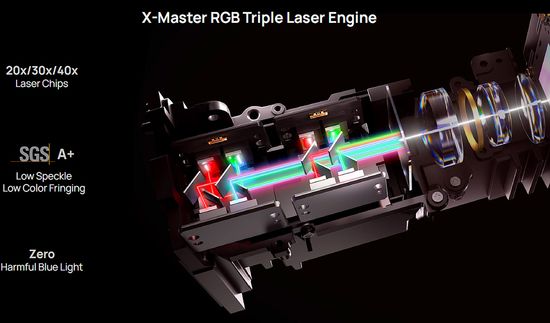
In addition to high brightness, it also effectively suppresses speckle, which is a major problem with triple-laser models.
The projector comes with the latest Google TV OS version. The Google Play Store, certified support for Netflix, Prime Video, and YouTube, makes external streaming devices like Apple TV and Fire TV unnecessary.Hardware
The new light engine controls a latest-gen 0.47″ DLP472TP DMD from Texas Instruments controlled by TI’s newest and DLPC8445 controller. The Horizon 20 Max was the first projector with this unique controller, which uses a new buffering architecture.
A traditional ping-pong (double) buffer requires that each video frame had to be fully stored in memory before being displayed on the DMD chip. This technology initially creates a delay of one frame (16.7ms@60Hz or 8.3ms@120Hz) between the incoming signal and the projected image.
The DLPC8445 uses rolling buffer, which eliminates this limitation. It streams image data line-by-line directly to the DMD as it arrives. Accordingly, the top of the picture is played instantly, while the rest follows continuously. As a result, latency is reduced to approximately 8ms@60Hz.
In addition, the developers have reduced its power consumption, heat dissipation and body size from 32 mm to just 9 mm.
For reference, DLPC8445 has a V-by-One HS (High Speed) input interface supporting up to 8 lanes at 3.0 Gbps per lane. This is important for fast processing and smooth playback of 4K content.
Variable Refresh Rate (VRR) support and ultra-low latency operation makes it ideal for joint operation with the MediaTek SoC’s in games.
In addition, Horizon 20 Max is the first projector to feature the new MT9679 SoC.
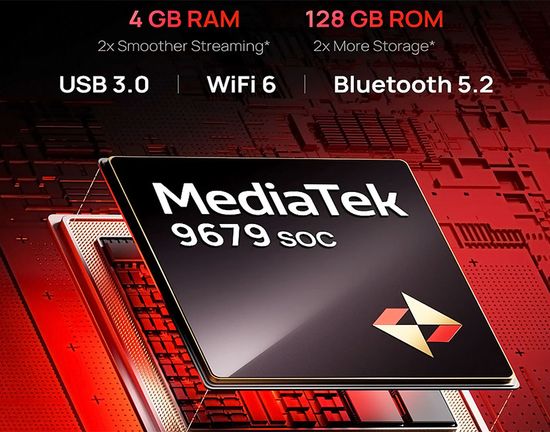
This is a 64-bit quad-core Cortex-A73 CPU with a Mali-G52 GPU. According to MediaTek, it’s designed for smart TVs, displays and high-end 4K projectors with advanced AI. In fact, it’s a newer, AI-focused chip for high-performance display devices. Combined with 4 GB of RAM and 128 GB of internal storage, it provides superb streaming performance even for 4K HDR.
X-Master Red Ring Lens
The lens became another important improvement.
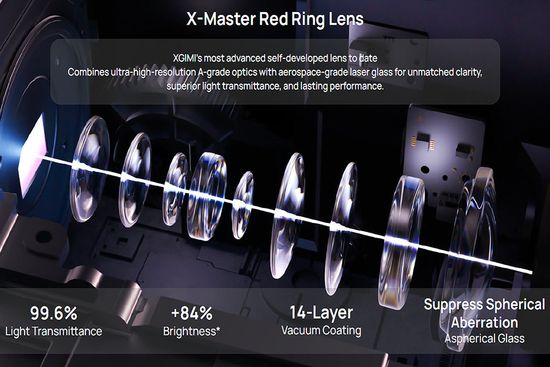
It provides a 1.2-1.5:1 optical zoom ratio and fully motorized controls for zoom, focus, and lens shift.
The company used several new technologies, achieving impressive results. First, it uses an A-grade optics with aerospace-grade laser glass specifications. The aspherical glass elements significantly reduce spherical aberration, prividing great light and color uniformity.
In addition, all aspherical lenses have a 14-layer vacuum coating. Coating films are made from oxides, fluorides or metals. Typically glass surface without coating reflects up to 4–5% of the light passing through it. The multi-layer vacuum coating reduces reflections to below 0.5%, significantly increasing light transmission.
For example, lens with eight elements has sixteen glass surfaces. With reflection losses of approximately 3%, the total light transmission reduction reaches 48%. With reflection losses reduced to 0.5%, they decrease to 8%. XGIMI claims a light transmission of up to 99.6%, an industry record. In fact, the lens operates virtually without brightness loss due to internal reflections.
Combined with the advanced X-Master RGB triple-laser engine, the projector provides the complete elimination of chromatic aberration.
Of course, motorized lens shift via remote control is another significant bonus of the optical module. It reaches an impressive ±120% and ±45% vertical and horizontal, radically simplifying optimal projector installation.
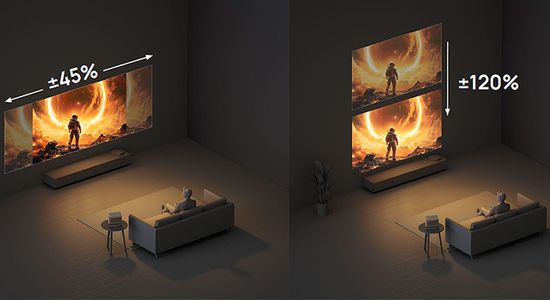
Optical zoom produces a 100″ @ 2.7-3.3 meter projection without digital zoom.
Finally, the radical reduction of internal reflections also improves native ANSI contrast due to the absence of ‘veil’ of scattered light washing in the blacks, improves color accuracy, eliminates the rainbow effect and enhances sharpness by reducing micro-reflections.
Picture Modes
The Horizon 20 Max has 5 modes for SDR, 6 for HDR, 2 for Dolby Vision, and 7 for HDR10+. This list does not include High Power picture mode due to a green shift and overheating. In fact, it’s only useful for short-term viewing in bright ambient light.
The model offers Standard, Movie, Vivid, Game and Sports. HDR option also has IMAX Enhanced. Dolby Vision has Dolby Vision Bright and Dolby Vision Dark sub-modes. All modes have the same names, with the addition of ‘SDR’, ‘HDR’, or ‘Dolby Vision’.
Custom settings are saved for SDR and HDR content, which is convenient for optimizing their configurations.
But the Projector Light Output setting is global, applies to all picture modes. When switching between modes, the user can change the setting manually; otherwise, the last setting remains.
The number and range of settings will please perfectionists with calibration skills and the appropriate equipment.
The list of standard global controls includes Brightness, Contrast, Saturation, Sharpness, and Gamma. The gamma settings use the Dark, Middle and Bright options, which roughly correspond to 2.35, 2.15 and 1.95 in traditional units.
The preset color temperature options include Color Temperature 1, Color Temperature 2, D65 and Movie. The first two settings produce a cooler image with a blue tint. The D65 and Movie provide a warmer tone with a red shift.
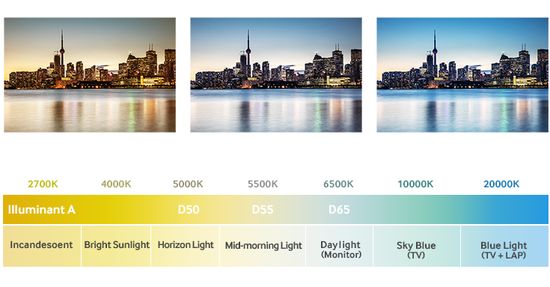
Finally, the 20 Max offers 2-point and 11-point white balance controls. The 11-point controls being global across all modes, but the 2-point is unique to each of them. Of course, the projector also has a full Color Management System (CMS).
Out-of-the-box color accuracy is optimal in the Movie and Standard modes for SDR, and IMAX Enhanced and Movie modes for HDR. Unfortunately, it decreases when Dynamic Black Level Enhancement is turned on.
Key Features
XGMI lists the brightness as high as 5,700 ISO lumens, and testing confirms this. In particular, it reached almost 5,350 ANSI lumens. However, operation in the High Power picture mode is accompanied by a strong green bias, noisy fan operation, and projector overheating. These issues disappear at a brightness level of 3,000 lumens, which is sufficient for high image quality even in diffuse daylight and impressive 3D performance. For reference, the Luminance Boost feature increases light output by about 10-15%.
The test results are also close to the stated color gamut, reaching 95.5% (xy) / 97% (uv) coverage of BT.2020 standard, and 98.8% (xy) / 99.4% (uv) in DCI-P3 color space.
Unfortunately, playback of highlights and subtitles can sometimes be accompanied by a slight rainbow effect (RBE), which is a traditional problem with DLP technology.
The 20 Max supports Dynamic Tone Mapping (DTM), which is effective for HDR content with up to 4000 nits of brightness in highlights. It effectively adjusts the tone mapping curve frame by frame to optimize HDR playback. Simply put, the algorithm analyzes the brightness and adjusts the image in real-time, expanding the enhance perceived dynamic range.
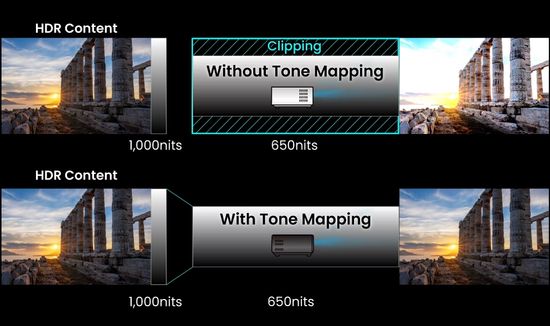
Of course, model supports all HDR formats, including Dolby Vision, HDR10+, IMAX Enhanced, and Filmmaker Mode.
The projector has Harman Kardon sound system. It includes two 24W stereo speakers and a 630cc acoustic chamber with bass extension down to 55Hz.
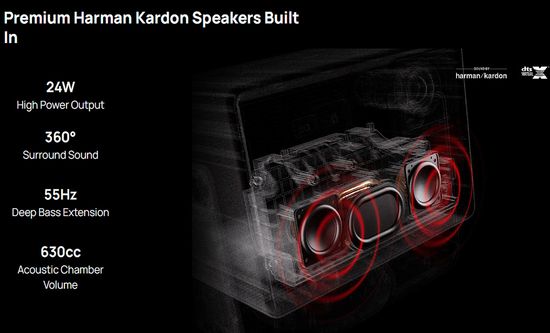
The projector supports both Dolby Audio and DTS Virtual:X. Sound quality and volume are sufficient for most users. However, for music lovers, the model has an eARC port, which enables lossless digital audio streaming to an external soundbar. In addition, it has a 3.5mm audio jack and SPDIF optical port.
Gimbal, resolution and DBLE
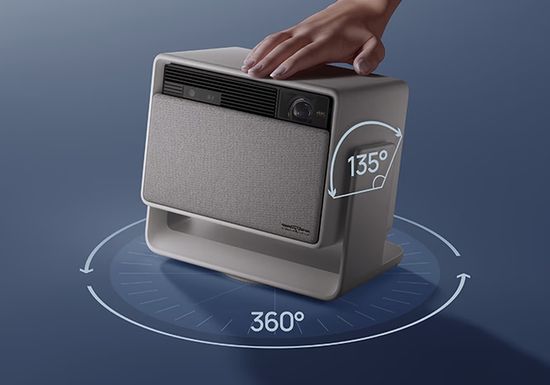
The built-in two-axis gimbal and a rotating base plate provide adjustments ranging ±135° of vertical and ±360° of horizontal, radically simplifying installation.
A Texas Instruments 0.47-inch native 1080p DMD DLP chip with four-phase pixel shift-based XPR (eXpanded Pixel Resolution) technology delivers a full UHD 4K (3,840 x 2,160) resolution. Its operating principle is simple and elegant. The projector divides the 8 million pixels of the 4K input signal into four parts and sequentially reproduces four Full HD images using 2 million micromirrors. Electromagnets in the XPR module adjust the lens tilt, ensuring that the images are offset diagonally by half a pixel. Strictly speaking, the projector only displays one Full HD image at any given time. However, due to the high frequency, our vision and brain perceive them as a single, higher-resolution image.
Of course, the new Dynamic Black Level Enhancement (DBLE) feature has become one of the main projector bonuses. In fact, it provides laser dimming to enhance perceived contrast in dark scenes. The developers claim a contrast increase of up to a 20,000:1. Testing shows a max 20,800:1 – 25,400:1 and a native contrast 1,400:1 – 1,640:1 depending on throw distance.
To be fair, DBLE sometimes causes a visible color shift toward blue in darker scenes and toward green when transitioning from dark to bright content. However, the color balance stabilizes almost instantly. In addition, DBLE only works with a laser power setting of 10 and is disabled when Dolby Vision or Luminance Boost are activated.
Image size, ISA and gaming
The projector’s focusing range varies from 80 inches to 300 inches diagonally.
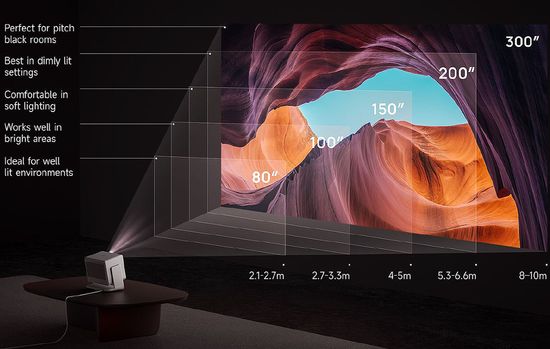
But, of course, image size affects picture quality. Maintaining color saturation while increasing image size requires darkening the room or increasing the projector’s brightness, since the light flux is evenly distributed across the entire screen area.
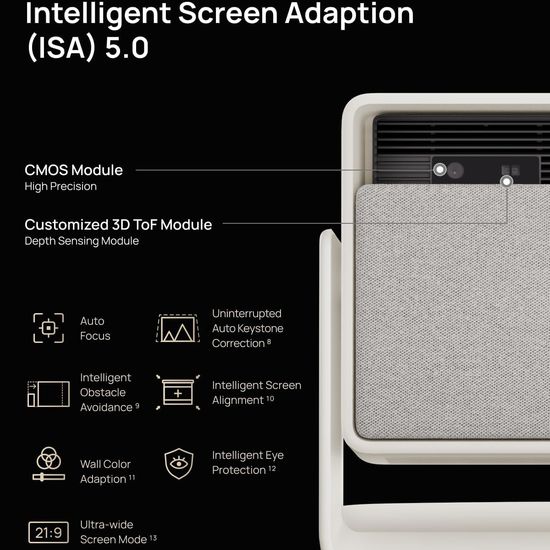
XGIMI ISA (Intelligent Screen Adaptation) technology is rightfully considered one of the best in the industry. It automatically and instantly adapts the projector image to room conditions without manual adjustment.
ISA 5.0:
– auto setup – focus (ToF LiDAR and CMOS sensors) and keystone up to ±40°;
– Intelligent Screen Alignment adjusts the image to fit any screen or wall shape perfectly;
– Obstacle Avoidance detects furniture or decor and shifts the projection;
– Wall Color Adaptation adjusts image color and white balance to match the wall’s hue;
– Memory Function remembers optimal settings for different locations or walls.
This projector is the first to support full VVR. In addition, according to the specs, Horizon 20 Max has an input latency of only about 1 ms. Measured input latency (in Game Mode with ALLM):
– 1080p@60Hz – 8ms (Projector Super Frame – off);
– 1080p@120Hz – 6ms (Projector Super Frame and VRR – on);
– 1080p@240Hz – 2ms (Projector Super Frame and VRR – on);
– 4K/60Hz – 8ms (Projector Super Frame – off).
In the future, the company promises an over-the-air (OTA) update for 20 Max with Game Picture Mode. It will provide access to presets for genres including Assassin’s Creed, FPS, RTS, RPG and Sports.
Conclusion
Just a few years ago, Home Theater projectors confidently outperformed TVs, offering huge images at a very affordable price. Indeed, even premium, bright, UST projectors started at $ 2,000-$ 2,500. For comparison, the 98-inch TCL 98R754, with an announced price of $ 8,000, became the dumping sensation of 2022.
But unwilling to lose this promising market segment, TV manufacturers focused their efforts on developing huge models, and within a few years, the situation changed dramatically. For example, this year, fans of huge TVs already have an excellent choice, including:
– Samsung 4K Crystal UN98DU9000 – $ 2,000;
– TCL 98QM6K – $ 2,200;
– Hisense 100U8K – $ 2,740.
Furthermore, these TVs offer higher quality due to their higher brightness (direct vs reflected light output) and higher contrast (‘infinite’ OLED contrast or mini LED backlight in LCD).
But the XGIMI Horizon 20 Max’s superb price-quality ratio could reignite the competitive battle. Indeed, the projector incorporates virtually every innovation, including:
– Improved X-Master RGB Triple Laser Engine with 40 laser diodes;
– 0.47″ DLP472TP DMD from Texas Instruments controlled by TI’s newest DLPC8445 controller;
– Innovative X-Master Red Ring Lens with light transmission of up to 99.6%;
– Dynamic Black Level Enhancement (DBLE) feature.
As a result, for about $ 2,400, the projector offers huge image with great brightness and contrast, high processing speed, and no chromatic aberration or speckle. In addition, the latest Google TV OS version, motorized horizontal and vertical lens shift, two-axis gimbal, Harman Kardon audio system, VRR support and an unprecedentedly low input lag of about 1 ms are also significant bonuses.
Video introduces new mid-focal laser 4K HORIZON 20 Max projector.