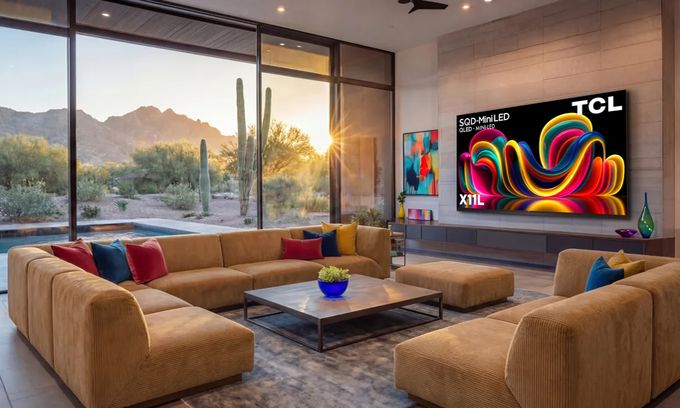
The negative image of Chinese brands as producers of low-quality products is long outdated. Today, Chinese giants confidently occupy the top positions in virtually all segments, and consumer electronics are no exception. Hisense, JmGO, Dengbui, and many others offer excellent projectors, the list of smartphone, vacuum robots, other home appliances from companies in the Heavenly Empire is also impressive. Of course, they don’t forget about TVs either. Today, Hisense and TCL compete equally successfully with South Korean Samsung and LG, Japanese Sony and Panasonic, American Roku and Vizio.
TCL TVs 2026
Traditionally for industry leaders, companies update their product lines annually, introducing models with innovative technologies. This year was no exception, and TCL introduced three innovative series, including QM8L/QM7L/QM6L, RM9L, and the flagship X11L series.
The price is traditionally one of the key characteristics. It influences the price-quality ratio, which determines a product’s competitiveness. Approximate prices for TCL TVs in 2026 are:
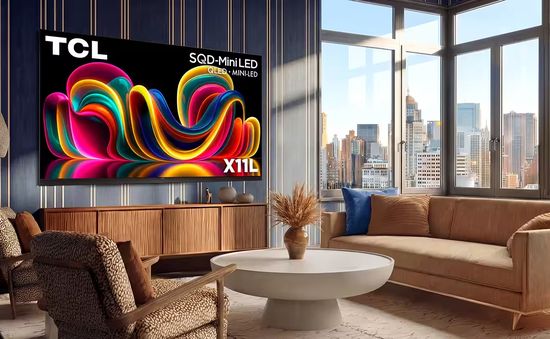
– USA and European (75″/85″/98″) – $ 3,800 / $ 6,000 / $ 10,000 MSRP and ~ € 4,000 / ~€ 5,700 / ~€ 9,000.
TCL RM9L
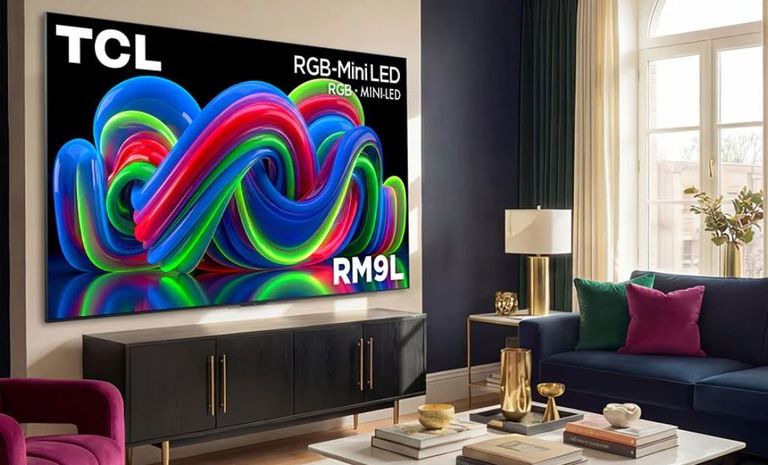
– USA and European (85″/98″/115″) – $ 5,000 / $ 8,000 / $20,000 and ~€ 5,000 for 85″.
TCL QM8L
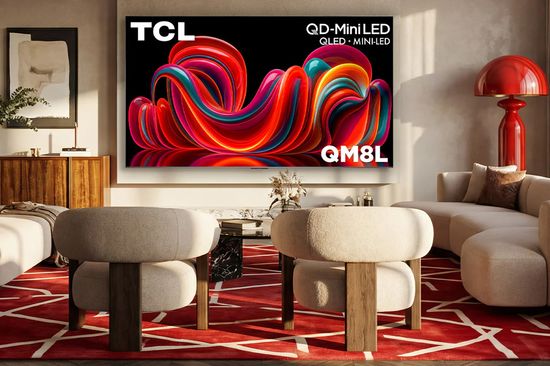
– 65″/75″/85″/98″ – $ 1,500 / $ 1,700 / $ 2,800 / $ 4,500.
Of course, the comparison is only valid for models of the same size. In this case, the TCL X11L vs RM9L vs QM8L (85″ and 98″):
– $ 6,000 / $ 10,000 vs $ 5,000 / $ 8,000 vs $ 2,800 / $ 4,500.
As the comparison shows, the X11L is approximately 20% more expensive than the RM9L, which, in turn, is almost twice as expensive as the QM8L. Such a significant price difference is ambiguous and requires analysis.
As a rule, the technologies used are the most important differentiators, directly impacting image quality and price. Unfortunately, they sometimes create confusion in terminology, so this aspect requires a little clarification.
TCL technologies
The X11L uses SQD (Super Quantum Dot) with WHVA 2.0 panel, RM9L got WHVA 2.0 panel with innovative RGB-MiniLED version (each LED emits red, blue, or green), and all QM series are equipped with SQD panels.
For reference, WHVA 2.0 or WHVA 2.0 Ultra is an advanced panel technology developed by its subsidiary CSOT (China Star Optoelectronics Technology). It combines the deep blacks and high contrast of VA panels with improved viewing angles and color reproduction. Additionally, the Ultra Color Filter increases the color gamut by 33%, and proprietary coatings reduce reflections to 0.5%.
SQD (Super Quantum Dot) is an innovative backlight tech that uses advanced quantum dots to create ultra-pure white light. According to the company, it improves color accuracy, brightness, and stability while maintaining a thinner panel design.
In fact, TCL’s SQD and WHVA 2.0 are complementary technologies working together in flagship MiniLED TVs.
Key Features
– WHVA 2.0 panel uses bionic microstructures to deliver high native contrast up to 7,000:1, expands viewing angles and improves the performance of anti-reflective filters;
– SQD panel uses advanced quantum dots and ultra-color filters to produce purer colors.
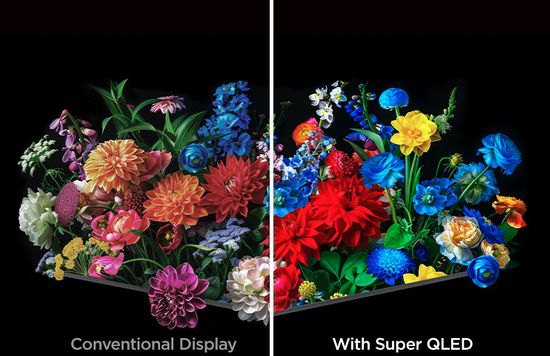
It cover 100% of the BT.2020 standard, and eliminate color cross-talk;
– TCL SQD with WHVA 2.0 combines these wonderful bonuses.
WHVA 2.0 vs Panel SQD vs Panel SQD with WHVA 2.0 (Combined)
– great contrast and viewing angles vs good color purity and volume vs high peak picture performance;
– technology – Liquid Crystal (VA type) vs Quantum Dots + UltraColor Filters vs Mini LED backlight + WHVA 2.0 + SQD;
– pros – deep blacks and reduced glare vs vivid colors abd zero blooming vs max brightness up to 10,000 nits and ultimate color.
Dimming zones
The image quality depends primarily on brightness (ambient light compensation), contrast (reproduction of gradations in dark scenes), and color gamut (the range of colors reproduced and their accuracy). Of course, viewing angles, screen reflections, ghosting, input lag, and other factors are also important, but their impact is significantly less. Therefore, the developers’ emphasis on brightness and contrast is entirely justified.
In turn, Mini LED backlit technology has become a breakthrough in enhancing the contrast of LED TVs. Essentially, developers replaced traditional LEDs with miniature ones, dramatically increasing their number. Arranged into arrays, they provided a dramatic increase in the number of local dimming zones with independent control. This solution provided a radical increase in control of brightness precision in different parts of the frame, depending on the content.
For reference, TCL is a pioneer in this area. The mini LED backlit was first implemented in the TCL 6 Series Roku in 2018. In less than a decade, the company has introduced several generations. The QM8L and flagship X11L series use updated SQD-MiniLED or Super QLED MiniLED (quantum dots made from a new material), while the RM9L comes with an innovative RGB-MiniLED version (each LED emits red, blue, or green).
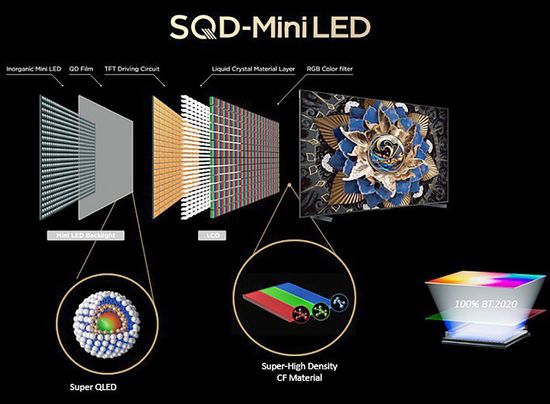
The number of zones affects color accuracy and depends on screen size.
TCL X11L:
– 98″ – 20,736 dimming zones;
– 75″ ~11,500.
RM9L RGB-MiniLED TV:
– 115″ – 16,848 zones;
– 98″ – 11,520;
– 85″ – 8,736 color zones with over 3,800 discrete dimming zones.
QM8L:
– 65″ TCL 65QM8L – 2,040 zones;
– 75″ – 2,584;
– 85″ – 3,200;
– 98″ – 4,032.
For models of the same 98-inch size:
– 20,736 vs 11,520 vs 4,032.
Innovative backlit
Essentially, the analysis can be boiled down to a comparison of SQD miniLED and RGB LED technologies. Hisense, Samsung, and Sony position RGB LED tech as the most innovative and advanced. But flagship TCL series is equipped with SQD-miniLED.
In short, RGB LED is the industry umbrella term for ‘micro RGB’, ‘RGB miniLED’, and ‘TrueRGB’. Of course, they have nothing in common with Micro-LED panels, which offer fantastic quality but, unfortunately, are monstrously expensive and are used primarily in outdoor advertising.
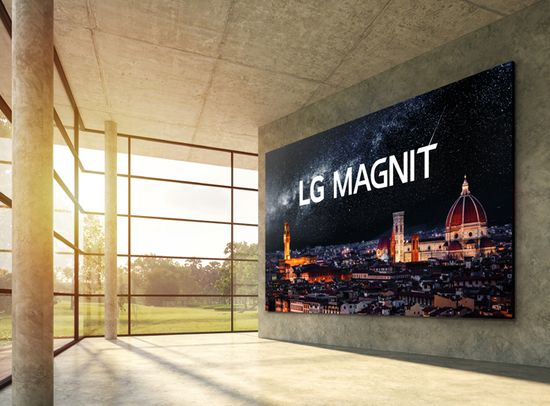
It uses millions of RGB LEDs (24.88 million@4K resolution) instead of an LCD layer, delivering phenomenal brightness, perfect black, and an ultra-wide color gamut. Moreover, panel size is virtually unlimited because they are assembled from multiple modules that are connected magnetically.
RGB LED is a new backlit, which uses a few thousand of red, green and blue LEDs and still requires an LCD panel in front. SQD miniLED is an improved version of MiniLED. It use the new quantum dot materials, which deliver purer colors.
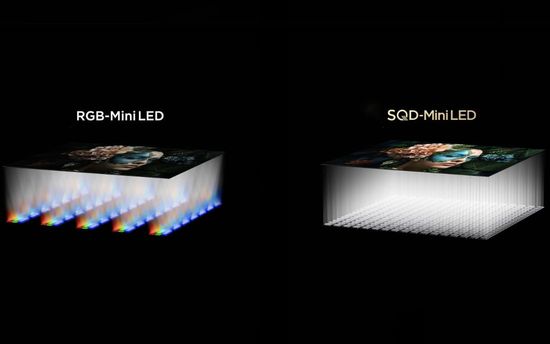
In traditional MiniLED backlit, light from blue LEDs is directed onto a film coated with microparticles, which re-emit green or red light depending on their size. As known, color depends on the frequency of the wave, which in turn depends on the microparticle size. Behind the film, the luminous fluxes combine with partially transmitted blue, generating high-quality white, which is directed onto the LCD panel to produce the picture.
In fact, the new SQD technology eliminates the need for high-quality white generation by improving the quality of QD materials.
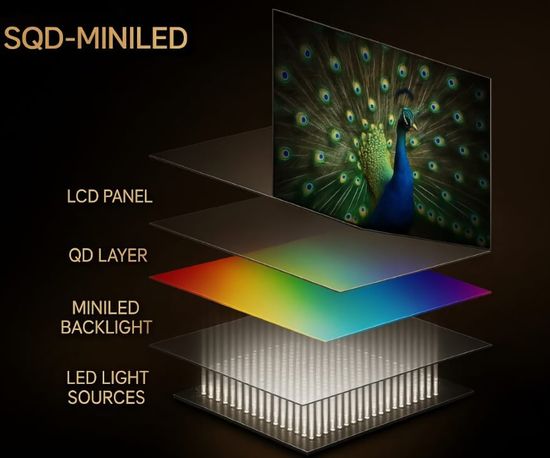
Furthermore, the new panel features local dimming, which further enhances contrast by individually controlling each zone depending on the content.
SQD-miniLED vs RGB LED
Curiously, prices depend little on these technologies. Indeed, the 85-inch TCL X11L with SQD miniLED costs $ 6,000, the similarly sized TCL RM9L costs $ 5,000, and the 85-inch TCL QM8L with SQD miniLED is offered for only $ 2,800. Therefore, additional information may be useful.
The RGB LED increases color saturation in red, green and blue, расширяя color gamut почти to the BT.2020 color space. This is the main and, unfortunately, the only bonus of the new technology. However, according to TCL, the new ‘super quantum dots’ achieve almost the same coverage.
At the same time, mini LED tech supports more dimming zones, due to objective reasons. The each zone of RGB LED contains red, green and blue LEDs with individual controlled, which requires space for driver electronics, heat management, processing power and increases the price. Formally, the company estimates the required number of RGB LED zones with a multiplier of ‘x3’, but this seems somewhat optimistic.
Additionally, ‘crosstalk’ can also be a problem for RGB LED tech. In particular, LEDs colors can ‘bleed’ into nearby image details, significantly degrading color accuracy. For example, a bright object on a black background can create a halo in the same color.
Moreover, crosstalk can reduce color saturation due to white elements, which depends on the content of the scene.
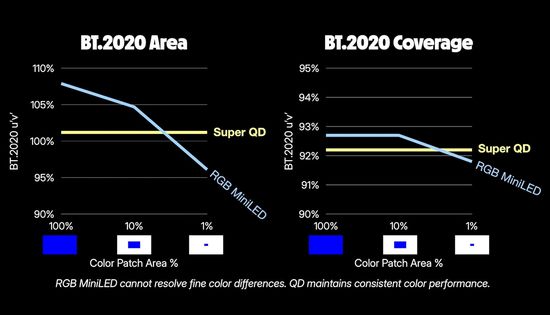
The mini LED remains more color consistent for any scenes.
Conclusion
This year has seen the start of a competition between two new backlit technologies in LED TVs. Nearly all the industry leaders have introduced new series with RGB LED technology. But TCL, in addition to a similar RGB mini LED series, has also introduced TVs with SQD miniLED backlit. This is essentially a significantly improved version of MiniLED backlit, which uses more efficient materials for quantum dots. Of course, the comparison of these technologies is already being hotly debated among experts. However, the final decision, as usual, will be up to consumers.
The results of comparing TCL X11L with RM9L and QM8L TVs are also mixed. For the same 85- and 98-inch X11L, RM9L and QM8L models prices are $ 6,000 / $ 10,000 vs $ 5,000 / $ 8,000 vs $ 2,800 / $ 4,500. The ~20% difference between the TCL X11L and RM9L seems quite adequate for the higher brightness and contrast, which are achieved, in part, by the larger number of local dimming zones (20,736 vs 16,848 for 98″ TVs). However, the nearly twofold difference ($ 5,000 / $ 8,000 vs $ 2,800 / $ 4,500 for 85″ and 98″ models) between RM9L and QM8L seems excessive.
Of course, brightness is important for displaying fine bright details, especially in HDR format, and contrast ensures detail in dark scenes. But given the redundancy of these specs even in the QM8L, the quality gain for basic content is unlikely to be noticeable. Therefore, the QM8L’s price-quality ratio is significantly higher.
This video introduces TCL X11L SQD-Mini LED TV as an Ultimate Home Theater.