
In September 2025 Epson announced five new Lifestudio models. Today this family includes the Flex, Pop, and Grand series. All Lifestudio prolectors have a sound system by Bose, Epson’s 3LCD technology with equal white and color lumens, and comes with Google TV. In addition, they support the new Epson’s Projection Studio app. It’s designed for wireless creation and sharing of interactive photos/videos by projecting them from phones. Additionally, the app supports adding music and playback control.
The Grand series has expanded with Lifestudio Grand laser UST model with white/CLO brightness up to 3,600 ISO lumens and costing ~$ 2,200.
Other series were supplemented by Flex EF-72/EF-71 and Pop EF-62/EF-61 models.
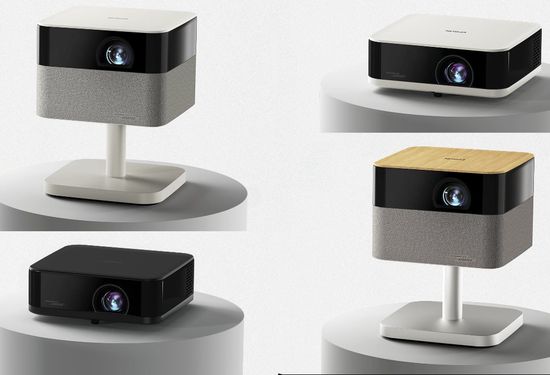
But these names may be relevant only for Europe. For example, in the US market the flagship Flex EF-72 is called the Flex Plus.
The Lifestudio Pop EF-61 is the entry-level model with brightness up to 700 ISO lumens and without support for pixel-shifting 4K Pro-UHD technology, which increases resolution. Its price is ~$630 / £540 / €660. With the same brightness, the Lifestudio Pop EF-62 supports 4K Pro-UHD and costs ~$750 / £750 / €860.
The Lifestudio Flex EF-71 projector also offers brightness up to 700 ISO lumens and does not support 4K Pro-UHD, but unlike the Pop EF-61/EF-62, it has a built-in tilt stand and costs ~$780 / £870 / €900. The flagship Lifestudio Flex Plus (EF-72) also has stand, offers maximum brightness up to 1,000 ISO lumens, supports 4K Pro-UHD, and costs ~$1,000 (MSRP) / £1,000 / €1,090. However, some sellers are already offering it for ~$850.
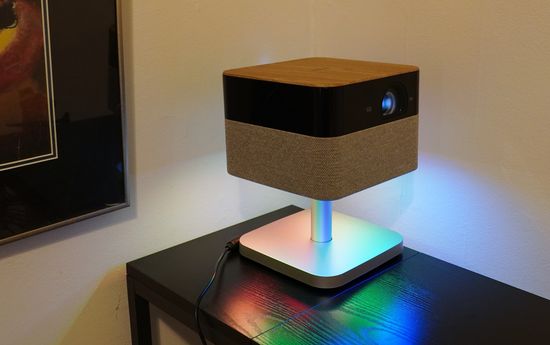
The Flex Plus has an ambient light feature with multiple color settings and can replace a bedside or living room lamp.
Key Features
The Epson Flex Plus has brightest of up to 1,000 ISO lumen. This aspect requires clarification. As known, DLP projectors use a color wheel, which acts as a color filter, passing only one primary or secondary color at a time. In this case, the brightness of other colors is lost. Epson 3LCD technology operates without a color wheel and, therefore, without loss. As a result, 3LCD projectors always provide equal white and color lumens, significantly increasing perceived brightness and colors saturation.
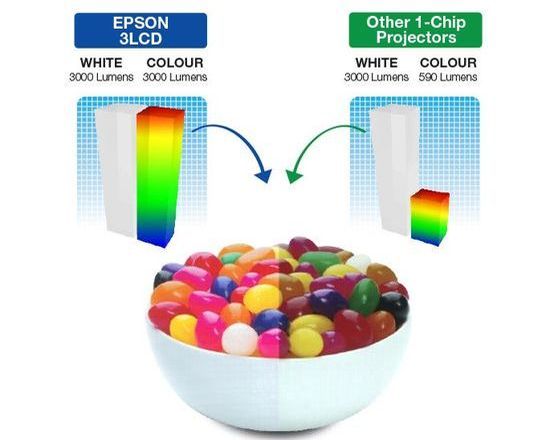
For this reason, 3LCD projectors often appear brighter than their DLP competition.
The model uses a fixed focal length and powered focus, with a 1.20:1 throw ratio. Its focusing range reaches 150 inches diagonally (100″@2.65m).
But image size affects picture quality, since the light flux is evenly distributed across the entire screen area. With a maximum brightness of up to 1,000 ISO lumens, the projector can only provide acceptable color saturation for a large image in complete darkness.
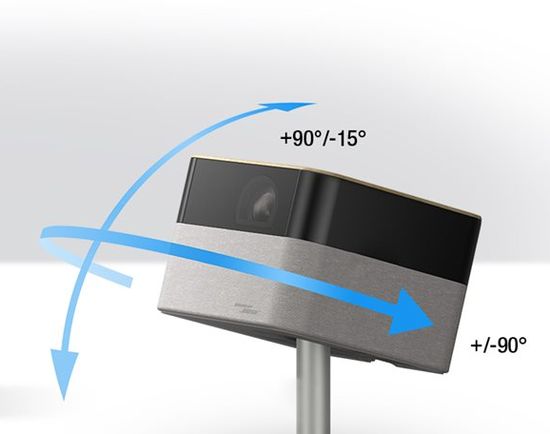
At (7.5 x 9.7 x 7.5 inches)@8.8 lbs/4 kg, the compact and portable Flex Plus is ideal as an outdoor projector. The vertical tilt of 90 degrees up and 15 degrees down, and the ±90-degree rotating stand, significantly simplify installation.
Moreover, the EpiqSense 2.0 technology supports almost all auto settings, including auto focus and alignment. This is especially convenient for use by children. In addition, the projector has an Obstacle Avoidance function and is equipped with a Smart Eye Protection option that automatically reduces the light output when people or pets are detected between the projector and the screen.
Epson lists the Lifestudio Flex Plus as 4K PRO-UHD, meaning it uses pixel shifting and supports up to 4K input. But it differs from the pixel-shift-based XPR technology found in DLP projectors.
4K Pro-UHD vs XPR
The pixel shifting was first used in JVC models under the name E-shift technology. Epsen later developed its own 4K-Enhancement version. It works by rapidly shifting pixels diagonally to generate several sub-frames.
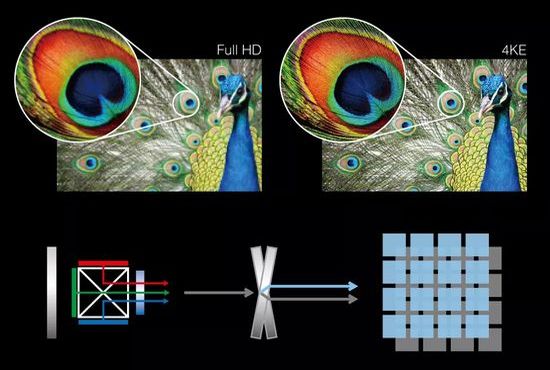
Due to the high frequency, the eye and brain perceive them as a single image. As a result, models with relatively inexpensive Full HD chips produce a sharper, higher-detail image. Its current 4K Pro-UHD version functionally is similar to upscaling in TVs.
But the statement about 4K resolution of such an image is not entirely correct. For example, duplicating a Full HD picture with 2 million pixels results in about 4 million ‘effective’ pixels, which is more consistent with Quad HD (2,560×1,440) resolution.
When receiving a 4K input, the projector downscales it to the chipset’s native Full HD (1080p) format and then upscales it using 4K Pro-UHD technology. Of course, the image quality is lower than native 4K.
XPR or eXpanded Pixel Resolution technology in DLP projectors also uses pixel shifting, but it’s designed operates differently.
An algorithm divides the 8 million pixels of the incoming 4K image (3,840 x 2,160) into four parts. The projector then uses 2 million micromirrors to display four sub-frames in sequence, shifting them diagonally by half a pixel relative to each other.
The shift is achieved by tilting the lens using four electromagnets in the XPR module. Due to the high frequency, the brain perceive them as higher frequency images. But DLP projectors with XPR technology do not do upscaling, for example, for Full HD content, reproducing it in its original format.
Epson’s 4K PRO-UHD technology provides better color accuracy and higher brightness, while XRP offers the highest possible sharpness and the fastest response times. However, upscaling and 4K playback are slightly different tasks.
Epson Projection Studio and audio
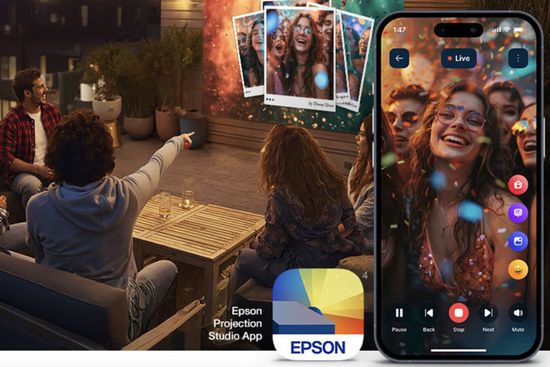
The Epson Projection Studio app is one of the Lifestudioьс bonuses. Activation requires only a simple Epson account. It’s designed to create interactive visuals for people together and control projector settings, including navigation, playback, and volume control.
Creating content with this app is simple and accessible even to children. After loading, for example, a photo, the projector offers one of their themed animated frames (including Birthday, Christmas, Halloween, Nature, etc.) and some audio tracks. After selecting and saving them, the created content is ready to be shown.
The built-in audio system by Bose использует two 5W stereo drivers, two 40mm full-range drivers and dual passive radiators. The EQ offers четыре modes, включая Cinema, Dialogue, Music, and Standard. Despite its compact form factor, the projector provides quite high quality of spacious sound for any content, which will be satisfactory for most people. However, for music lovers, the model offers an HDMI 2.0 (ARC/eARC) port, which enables lossless digital audio streaming to an external audio system.
In addition, Flex Plus supports Bluetooth Speaker Mode to play music without projecting an image.
The projector has Karaoke mode, but, unfortunately, it doesn’t compatible with a third-party microphone. However, in 2026 the company promises an Epson wireless (UHF) microphone.
Picture modes, Smart platform and gaming
The Flex Plus has Standard, Cinema, Vivid, and Natural picture modes. They are the same for both SDR and HDR. However, user settings are specific to each format. Of course, the model is equipped with a Color Management System (CMS).
Modes (SDR/HDR, ANSI lumens):
– Standard – 900/765 (almost perfect color accuracy, a minor blue tint in some colors);
– Cinema – 645/580 (color accuracy is slightly lower, but not visually perceived);
– Vivid – 745/670 (a minor blue tint in some colors);
– Natural – 580/600 (slightly more desaturated compared to Cinema).
Like other Epson projectors, the Flex Plus has a Google TV, powered by Android 14.
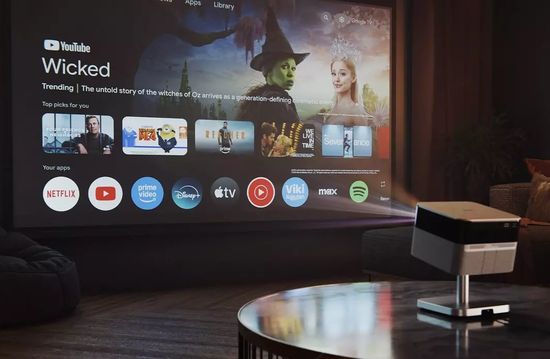
It provides quick and easy access to all the major streaming apps, including Netflix, Hulu, Disney+, Apple TV, Prime Video, HBO, YouTube, YouTube TV, etc. Of course, model comes with integrated Google Assistant voice control. The model also supports screen mirroring via Chromecast with fairly high color accuracy in all modes.
The Flex Plus has PC/Game Mode and ALLM for games. Unfortunately, measured input lag reaches 56ms for 1080p@60Hz, 35 ms for 1080p@120Hz, and 50ms for 4K@60Hz, which is sufficient for casual gaming, but too much for professional online gamers.
Conclusion
Pros
– 3LCD technology;
– pixel shift-based 4K PRO-UHD technology with HDR;
– premium audio by Bose;
– Google TV OS;
– Epson Projection Studio app;
– perfect color accuracy out of the box;
– EpiqSense 2.0;
– colored night light function.
Cons
– casual games only due to high input lag;
– only one HDMI port.
A Japanese company has created another compact projector with an excellent price-quality ratio. In terms of specs and functionality, it’s most similar to the JmGO N1 and Anker Nebula Mars 3, which offer:
– JmGO N1 ~ $500, 750 ISO Lumens, Full HD, RGB laser light engine;
– Anker Nebula Mars 3 – $700, 1,000 ANSI Lumens, Full HD, LED light sourse.
Of course, the Epson Lifestudio Flex Plus (EF-72) is a little more expensive and costs $850, but it offers significantly sharper image with 4K PRO-UHD technology. Furthermore, 3LCD technology delivers more saturated colors due to the absence of color wheel loss. Google TV, the Epson Projection Studio app, the EpiqSense 2.0, premium audio by Bose, the Colored Night Light function, and the brand’s impeccable reputation for a century and a half triumphantly round out the list of bonuses.
This video introduces the new Epson Lifestudio Flex Plus portable projector.